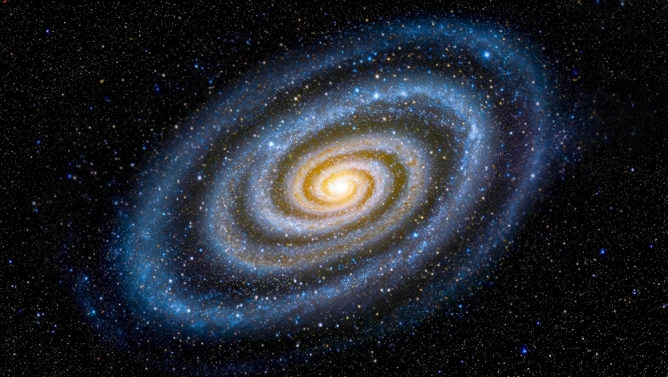
Astronomers have identified 20 very old stars in the Milky Way, which may have originated from the dwarf galaxy Loki, swallowed up 10 billion years ago.
Lara Maior


IT&C knowledge
McCarthy's PhotoWorks/ Shutterstock.com

Always see our news on Google
A recent study published in Monthly Notices of the Royal Astronomical Society identified 20 very old, metal-poor stars in the Milky Way that may have originated from the dwarf galaxy Loki. This galaxy is thought to have been absorbed by the Milky Way about 10 billion years ago. Scientists, led by astrophysicist Federico Sestito, suggest that studying these stars is essential for understanding the history of our galaxy and the Universe. The stars were observed using a powerful spectrograph, and their chemical and orbital analysis indicated a common origin. Computer simulations suggest that the merger with Loki could have dispersed the stars in various directions, thus explaining the observed orbits. Although the conclusions are promising, Sestito emphasizes the need for further observations to confirm the nature of the Loki galaxy.
Sources


Latest News
08:52
Călin Georgescu calls for the replacement of pre-trial detention / Bucharest Tribunal to decide on Monday whether he will be released from behind bars
08:44
Rareș Bogdan: “If the Luca Niculescu government were to fall, I believe the president would be forced, on the one hand, by USR, PNL, partly UDMR, and AUR, which would push for snap elections”
08:36
The World Bank is discussing with 30-40 countries the provision of emergency financial assistance amid the energy crisis.
08:18
The death toll from the shipwreck in Djibouti has reached 139, while 84 people are still missing
08:12
PSD decides today how it will support the Luca Niculescu government / The conditions the party has for the designated prime minister
See more news
NEWS ON THE SAME TOPICS
IT&C knowledge
Astronomers have detected the most distant fast radio burst, produced in a young galaxy more than 10 billion years ago
IT&C knowledge
NASA has confirmed that a higher stage of a SpaceX rocket crashed on the Moon, leaving behind a crater.


Personalized news feed, AI-powered search, and notifications in a more interactive experience.