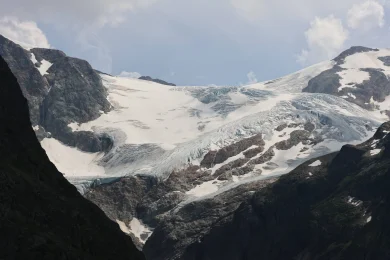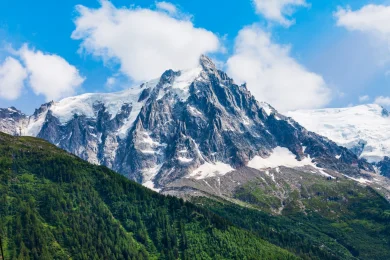

Before the incident in the Austrian Alps, French experts reported that Mont Blanc had reached 4,807.47 meters, following an increase of nearly two meters in the ice and snow cover compared with 2023, with measurements taken periodically and accompanied by a warning that the variations cannot be interpreted simplistically based on a single reading. Also in Europe, the Swiss Glamos network announced further volume losses for Switzerland’s glaciers: another 5.5% this year, while over the past five years the decline has reached nearly 20%.
Alongside the signals from glaciers, broader indicators of climate change were also reported: the average ocean surface temperature reached a record 21.1°C (in the context of an El Niño episode), while in Greenland the Petermann Glacier lost 76 km² of ice, the largest reduction of this kind since 2012.
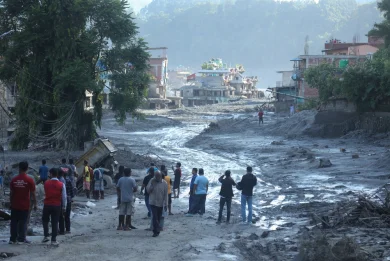
Beyond Europe, a study attributed the intensification of a devastating flood in Nepal on August 26 to the accelerated warming of the Himalayan region, glacier melt, and slope instability, concluding that disasters are increasingly the result of a combination of factors aggravated by climate change.