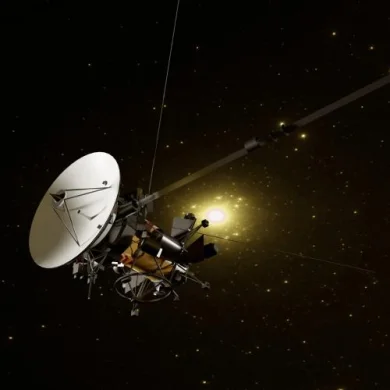
The launch of two new satellites strengthens the reliability of the European navigation system Galileo.


Always see our news on Google
The European Union has taken a new step in strengthening its spatial autonomy with the successful launch of two new Galileo satellites from the European Space Centre in French Guiana, aboard an Ariane 6 rocket. The new elements of the constellation will increase the availability, accuracy, and robustness of navigation services used daily by billions of people.
Brussels, December 17, 2025 – The European Union successfully launched two new satellites as part of the Galileo program, enhancing the capacity and reliability of its satellite navigation system. The launch took place from the European Space Centre in Kourou, French Guiana, aboard an Ariane 6 rocket, marking a new key moment for the EU's strategic autonomy in the space domain.
In brief
1. Two new Galileo satellites were successfully launched from Kourou, French Guiana, aboard an Ariane 6 rocket.
2. The launch is part of the Galileo L14 mission and strengthens the long-term reliability of the system.
3. The EU Agency for the Space Program (EUSPA) took command of the satellites a few hours after launch.
4. The satellites will enter operational service after approximately three months of testing and calibration.
5. Galileo is the most accurate global satellite navigation system and is used by about 4.5 billion people.
Shortly after separation from the launch vehicle, the European Union Agency for the Space Program (EUSPA) took operational control of the satellites during the critical launch and early orbit phase (LEOP). Approximately four hours after launch, EUSPA teams, with the support of the European Space Agency (ESA) and industrial partners, confirmed the establishment of communications, correct placement in orbit, and deployment of the solar panels.
In the following days and weeks, the satellites will undergo continuous testing of subsystems and orbital maneuvers to bring them to their final orbit at an altitude of 23,220 kilometers. The LEOP phase, along with payload testing, will last approximately three months, after which the satellites will be integrated into the operational Galileo constellation.
Once operational, the new satellites will contribute to improving the availability of services and the robustness of the system, being continuously monitored by the Galileo Security Monitoring Centre, which ensures the protection and integrity of services, including for sensitive uses.
Galileo is currently the most accurate global satellite navigation system, providing an accuracy of approximately one meter for open services and up to 20 centimeters through the high-precision service. The system is used worldwide for essential applications such as road, maritime, and air navigation, emergency interventions, drone operations, precision agriculture, telecommunications, and financial transactions that depend on precise timing.
Beyond the operational dimension, the launch also has a strategic stake. EUSPA plays a central role not only in the exploitation of the system but also in adapting Galileo's performance to market needs and supporting European companies that develop satellite-based navigation applications. According to estimates, the global GNSS services market could reach 580 billion euros by 2033, making Galileo a pillar of European digital competitiveness.
EUSPA Executive Director Rodrigo da Costa emphasized that each successful launch strengthens the EU's commitment to providing safe and reliable navigation services, adding that the new satellites represent "a new building block" in building Europe's resilience and innovation capacity.
The Galileo program is funded by the European Union and managed by the European Commission, with daily operations ensured by EUSPA, and technical development carried out with the support of ESA and the European industry in the field.
Latest News
00:32
22:56
22:37
22:23
22:09
See more news
NEWS ON THE SAME TOPICS