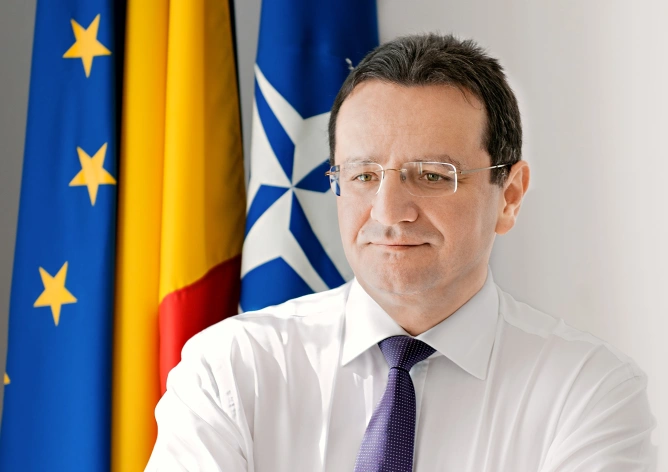
INTERVIEW George Cristian Maior, in Revistacultura.ro: A diplomatic perspective on the war in Iran



Always see our news on Google
In a Middle East shaken by the most extensive military escalation in recent years, the war in Iran has entered a critical phase. The coordinated attacks by the United States and Israel on strategic Iranian targets, followed by massive missile responses and the closure of the Strait of Hormuz, have transformed the conflict into a regional crisis with global effects – from energy security to the stability of international alliances. As tensions rise and the direction of the conflict remains uncertain, the international community watches with concern the spread of violence towards Gulf states and the rapid deterioration of the humanitarian situation. In this volatile context, we try to understand how the conflict is perceived from within the region, what stakes and objectives lie behind military and diplomatic decisions, and what prospects exist for de-escalating the crisis.
Nicu Ilie: In just a few days, the war in Iran has expanded and affected 12 countries in the region, and the potential impact may be even greater. Jordan has also been attacked by Iran. However, many countries, such as Jordan, are not combatants in this war, and all they can do is defend themselves. How great is the danger in the region and how much can everything escalate?
George Cristian Maior: The main axis of conflict is, of course, clearly defined. The parties in this war are the USA and Israel against Iran. How, to its disadvantage, there is a clear difference in military, strategic, human, and logistical capabilities, Iran has resorted to an asymmetric defensive strategy, striking military targets in several Arab countries, but also economic, transport, or even civilian infrastructure, in the hope that public opinion will pressure governments to work imperatively for the cessation of hostilities. In the hope that, by destabilizing through the provocation of economic and human costs, by affecting the normal state and social order in general, the world will advocate out of necessity against military intervention. Considering also what is happening in the strategic Strait of Hormuz, which (alongside the Strait of Malacca, which ensures the connection between the Indian Ocean and the South China Sea) is critical for global trade, Iran has adopted a method of escalation in a broader plan, with profound geopolitical and economic implications, with immediate global impact. A way to test resilience and, ultimately, to complicate, by extension, the general conflict front. Even if some claim that the real operational value – in a strictly military sense – of such deployments is limited, against such a special and unpredictable backdrop, the danger of escalation is real.
Nicu Ilie: You represent Romania and also as ambassador in Yemen, facing an extremely difficult situation marked by major violence in recent years. Is there a danger that this state could also be drawn into the conflict, given the special relationship between the Houthi combatants and Tehran? And if so, how can the conflict be prevented from reaching Africa and the Red Sea and blocking most maritime routes?
George Cristian Maior: There is this danger, since the Houthis have acted in this way during the Gaza conflict, when maritime routes in the Red Sea were quite seriously affected. Until now, the Houthis have only reacted rhetorically, which may also be for reasons of self-preservation, considering the increased firepower now used, the intensity of military force application in the area. But it is not excluded that the Houthis may suddenly change their attitude, and this situation is being closely monitored anyway.
Nicu Ilie: The United States has taken a major risk by standing alongside Israel in this conflict. However, as a good connoisseur of the region, but also as a former ambassador in the USA during Donald Trump's first term, what do you think were the options for the United States if Israel had attacked anyway?
George Cristian Maior: Communication between Israel and the USA has been clear and unequivocal – both politically and militarily – regarding the threat posed by the Iranian nuclear and ballistic program. And the USA has taken this political-military engagement, to eliminate a danger considered existential for its ally, but also, ultimately, for its own strategic interests. In American assessment, in its strategic thinking, an Iran possessing nuclear capabilities and enhanced ballistic capabilities is a regional threat, but also one with global relevance. Also, in a deeper analysis, a theocratic regime holding nuclear weapons gives a completely different dimension to this threat. This combination of theocracy and the nuclear element is much more complex and sensitive. Because such a theocratic regime may have possible impulses of ideological exceptionalism, beyond the presumed rationality as a rule in the external behavior of any state. I refer to an aggravation in relation to the classic thesis of nuclear deterrence, which, until now, has nevertheless maintained a level of global strategic stability.
Nicu Ilie: The conflict between Israel and Iran has been ongoing for a long time, and mutual bombings have been frequent since the outbreak of the Gaza conflict, caused by the fact that Iran was the main sponsor and partner of the Hezbollah group. Can it be said, then, that this war is just an escalation of the one in Palestine?
George Cristian Maior: I do not believe it is an extension, an escalation of the one in Gaza, although certain connections can certainly be made. Now we are talking about the nuclear and ballistic issue, about regional strategic balance, about the balance of power in a broader geographical space, about a specific geopolitical configuration, extremely complex and complicated. The Palestinian issue, whose resolution is also vital for the legitimacy and security of the order in the Middle East, has specific political, cultural, and historical roots. We must make these distinctions.
Nicu Ilie: Religion plays a major role in the area. As the main Shiite state, Iran has significant regional influence, but also historical conflicts. In Syria, Yemen, Pakistan, Bahrain, Azerbaijan, and Lebanon, the Shiite population is either majority or plays an important political role. Significant Shiite communities also exist in other states in the region, in Iraq, first and foremost. What do you think will be the impact of this war on these states? What can we expect?
George Cristian Maior: Certain things should be nuanced regarding the religious dimension you mentioned. Yes, there is a conflict, an ancestral tension between Sunnis (majority in the Muslim world) and Shiites, but this concerns more different interpretations of authority, legitimacy – or the configuration of relations between temporal power and spiritual power. A bit of history would not hurt to better understand the roots and origins of the conflict and, what interests us more, its current political and geopolitical relevance. The tensions between each other are more of a political nature. Shiites derive their specific identity from what they consider to be an illegitimate act in the succession of the Prophet, believing that his family should have naturally succeeded in the spiritual and political leadership of the community. Ali, the Prophet's cousin, was the fourth caliph, and he tragically ended up in a politically motivated conflict, thus in a primordial struggle for power. Shiites consider the other caliphs who followed him illegitimate, thus the entire Sunni order. In contrast, they believed that the succession should continue the bloodline of Ali. What I want to say is that this schism (which some compare, forced in my opinion, to that between Protestants and Catholics) has a clear political root and not a strictly religious one. Although there are some relatively different eschatological visions, in all other respects: theological, doctrinal, and worship practice differences are still minor. However, the political fault line between each other has been almost permanently accentuated, starting even with the martyrdom of Hussein, the son of Ali. He, with less than a hundred men, died heroically fighting against the numerically superior armies of the caliph from Damascus, in a dramatic action contesting his authority and corruption, which he claimed was dominating the government and distorting the concrete exercise of power. Thus, a new political fault line. Moreover, the heroic figure of Hussein is emblematic of Shiite culture and introduces an ethos of sacrifice in the face of what is perceived as oppression, injustice, while also introducing the idea of total independence from external power factors. Hussein is commemorated annually through the spectacular pilgrimage from Karbala, in Iraq, attended by millions of Shiite believers, in a procession full of fervor and intensity, and his name was invoked by tens of thousands during the Islamic revolution of 1979, in moral opposition to the figure of the Shah and his power system. This difference in the interpretation of legitimacy, which I mentioned, has translated over time into a different understanding of the composition of power, of authority, leading to a certain doctrine that considers the distinction between temporal power and spiritual power to be false. In the Shiite view, the two are inseparable. And from here comes the idea (and practice) of subordinating government to religious authorities, inaugurated by the revolution 47 years ago. Today, the geopolitical relevance of the conflict is still outlined from this perspective. The theocratic regime has tried to export this thinking, the principles of the revolution, this way of understanding political organization, acting to create what they call the "axis of resistance" sponsored by Iran. It has produced instability, insecurity in the area, leading to concerns for security and internal order in all Arab states. This line of action, alongside the direct threat to the security and interests of Israel, considered anyway an irreducible, existential enemy, has made the situation in the Middle East always tense and marked by threats. I say all this to better understand the internal springs of the regime's legitimacy and their external projection. This does not mean that Iran cannot support other forms of government – its history is not one of theocratic regimes – or that other ideological currents do not coexist in Iranian society, with a political vision quite different from the theocratic one.
Nicu Ilie: According to many military analyses, the option of intervening with ground troops is one that Americans cannot consider due to the terrain and difficult conditions. Moreover, neither the American military doctrine, as it is currently outlined, is favorable to massive involvement with troops. However, a war is not won from the air. Despite the predictable air inferiority, the ayatollah regime can resist for a long time and can continue both its drone program and its ballistic missile program, as well as its nuclear one. Insurgencies, such as the Kurdish one, or revolts can be limited both as operations and as objectives. Under these conditions, is it expected that we will see a long-lasting conflict, possibly lasting for years? And how would the entire region cope with such a war of attrition?
George Cristian Maior: I do not believe we will witness a ground intervention, due to the risks involved, the operational difficulty, and, ultimately, the political costs that would inevitably come with such a decision. Moreover, history, whether more distant or more recent, starting with Vietnam, has shown us what such an experiment could entail. On the other hand, it is possible that air intervention could still ensure, if not complete elimination, at least a drastic reduction of the nuclear and ballistic threat, as precise, quantifiable military objectives. I do not believe we will have an open ground war (perhaps, at most, interventions by special forces, with specific objectives – although I doubt it). And I do not believe it will be a long-lasting conflict, if, beyond rhetoric, propaganda, or possible political image issues, things remain fundamentally within the orbit of the initial strategic objectives.
Nicu Ilie: Iran is a country with major problems. Repeated violations of human rights, extremely harsh political policing, violent repression of protest movements, have all sparked numerous international protests. Moreover, the state is a sponsor of global terrorism. However, what has led to economic sanctions – and now to war – is the nuclear program. Indeed, it is hard to believe that a state with such an energy surplus and enormous potential to develop in the area of green energies would need a nuclear program for civilian purposes. Still, there is still a lack of clear evidence, from independent sources, to certify the existence of a secret nuclear program in Iran. Do you think it is possible that, in this case, after that of Iraq a few years ago, we will find out at the end of the war that there is no evidence to confirm it?
George Cristian Maior: Clear evidence regarding the uranium enrichment program exists, after many years of monitoring and information collection. In fact, it is publicly known and recognized by Iranian officials: over 400 kilograms of uranium enriched to 60% which can be quickly increased to 90%). And when you are in possession of programs that can develop such nuclear capabilities over time, it remains only the open or hidden intention to complete them or not. And pursuing the intention "to do or not to do" remains in this hypothetical sphere, when the instruments exist, already representing a huge risk in itself, some consider, difficult to resolve through negotiations. The ballistic program is well known, and here we are not only talking about its operational relevance in itself, but also about the possibility of correlating it with the nuclear element. Therefore, I do not believe we are in the same situation as in Iraq.
Nicu Ilie: Thousands of civilians have already died in the war. As in any conflict, the data circulated about casualties must be viewed with great caution. But regardless of the numbers, civilian losses exist. On the other hand, as in the case of the attack on Ukraine by Russia, there was no UN resolution justifying this attack. As a diplomat, how do you see such actions that evade classical diplomacy, institutions, and practices established after the Second World War, to prevent the exacerbation of conflicts?
George Cristian Maior: A very long time was dedicated to diplomacy – which, in the opinion of the initiators of the intervention, has exhausted its resources on this front. This does not mean that diplomacy will not be decisive for de-escalation and for restoring strategic balances post-conflict and, then, over time, for some forms of stability.
Nicu Ilie: In your recent book, "Superpolitik", you theorize the existence of moments when political life is unbalanced by favoring one of the two essential components: legitimacy and strategy. Do you think we are in such a moment? And what is the way out? What paths towards "superpolitik" exist, towards rebalancing the two components?
George Cristian Maior: It is true, in "Superpolitik" I talk about this phenomenon, which is actually recurrent in the history of international order and state order – this imbalance between legitimacy factors and the strategic dimension of the structure that characterizes a certain political order. It is clear to me that we are currently going through such a stage, we are witnessing this process that is already producing palpable imbalances, convulsions, and a high degree of instability, unpredictability. However, I do not believe it is about a "break of order", as has been claimed, but rather a strong, sometimes chaotic transition of the key relationships between the two mentioned components: those of legitimacy and those of strategy. They are vital dimensions, from which state and international order derives. Their rebalancing is possible: through qualitative redefinitions of the ideas of legitimacy (starting from the existing minimal base, with all the pressure that manifests on it) and by adjusting the strategic dimension to this context. Thus, a new alignment, as a premise for new balances. This in conditions where it seems we are witnessing a massive activation of the strategic side in the actions of some states, especially significant powers, both militarily and economically and technologically. This is what I called, in "Superpolitik", "hyperstrategy" (or "hyperstrategic attitudes"). It comes after a succession of behaviors that, also in "Superpolitik", I defined as hyper-legitimist or hyper-justifying, characterized by the fact that certain actors force the imposition of their own, particular concepts of legitimacy, disturbing the existing (fragile anyway) strategic balances and affecting the idea of general legitimacy, as long as it exists. These are the characteristics of a historical phase that began with the war in Ukraine, continues now with conflicts in the Middle East, but also with rising tensions in Asia. Although these are events with different strategic and political causalities, with specific historical origins, they exert this type of pressure on the internal and external order of states.
Nicu Ilie: Romanian diplomacy has a long tradition of remarkable results in the Middle East area. What is the current situation and what are the prospects?
George Cristian Maior: I believe we need to understand and be aware that our traditional approaches, shaped in the Cold War era, when we could play quite intelligently at the interface of often divergent interests between East and West and thus develop a certain mediation capacity, both in the Palestinian issue and in Israel's relations with Arab states, need to be adapted to the realities of the 21st century. It is already a rather tired cliché that says we have good relations with both Arab states and Israel and that in this historical paradigm our expression in the area should be seen. This is true and useful, but there are now many other states, from Europe or even globally, in the same situation; we cannot cling to a history that is quite distant. Moreover, we are now NATO and EU members. Therefore, it is good that, while preserving certain qualitative elements from tradition, which have created a positive perception here over time, we identify pragmatically new opportunities, now evident in the political sphere, but also in economic, technological, and security dimensions. In addition, alongside a specific history of our presence here, geography and geopolitical dynamics compel us to do so.
https://revistacultura.ro/o-perspectiva-diplomatica-asupra-razboiului-din-iran/
Latest News
07:29
07:26
07:22
07:16
07:13
See more news
NEWS ON THE SAME TOPICS