BAROMETRUL Informat.ro - INSCOP Research - Edition VII, January 2026. Chapter 1: The perception of Romanians regarding the justice system | 67.4% of Romanians believe that the justice system is not independent of political influences.



Always see our news on Google
Chapter 1: The Perception of Romanians Regarding the Justice System
BAROMETER Informat.ro – INSCOP Research is a monthly opinion poll conducted by INSCOP Research on behalf of the news platform Informat.ro in partnership with the think tank Strategic Thinking Group.
BAROMETER Informat.ro – INSCOP Research aims to bring to the public's attention topics of interest to stimulate national conversations about various subjects and essential public policies for the present and future of Romania, based on the opinions of Romanians, in partnership with think tanks and prestigious academic institutions. It is an initiative through which we aim to contribute to the strengthening of democracy by using scientific and credible tools that bring the voice of citizens to the forefront of public debate.
Methodology: Data was collected between January 12-15, 2026. Research method: interview via questionnaire. Data was collected using the CATI method (telephone interviews), with a simple stratified sample volume of 1,100 people, representative of significant socio-demographic categories (gender, age, occupation) for the non-institutionalized population of Romania, aged 18 and over. The maximum allowable error of the data is ± 3%, at a confidence level of 95%.
Graphical presentation of the data is available here: BAROMETER Informat.ro - INSCOP Research - Edition VII, January 2026. Chapter 1: The Perception of Romanians Regarding the Justice System
Remus Ștefureac – Director INSCOP Research: "The data shows a structural rupture between normative attachment to the idea of an independent justice and the concrete experience of citizens, who perceive the system as vulnerable to external influences and unfair in its functioning. A sociological paradox emerges: it is precisely the more educated, urban, and more connected groups to public life that are the most critical, indicating that distrust does not stem from disinterest, but from high expectations and informed evaluations. The negative evolution of the perception regarding the equal application of the law indicates an accelerated erosion of institutional legitimacy, with the potential to fuel either a sense of revolt or civic cynicism, resignation, and withdrawal from democratic participation. Overall, justice is perceived more as a necessary ideal than as a functional reality, which represents a major risk in the medium term for social cohesion and trust in the Romanian state."
Trust in Justice
25.5% of Romanian citizens have a lot or quite a lot of trust in Justice (9.5% a lot, while 16% say they have quite a lot of trust), while 70.5% declare that they have quite little, very little, or no trust in Justice (25.7% quite little and 44.8% very little or none). 4% do not know or do not respond.
Voters of PSD and AUR, individuals aged between 18 and 44, and those with primary education are the categories of the population that have a slightly higher level of trust in justice than the population average. They have a higher level of distrust in justice than the population average, especially USR voters, individuals over 60, those with higher education, and residents of large urban areas.

The Importance of an Independent Justice System
92.3% of survey participants believe it is very important or quite important for Romania to have an independent justice system (73.7% consider it very important, and 18.6% believe it is quite important). Only 3.5% of Romanians believe it is not important at all or quite unimportant for the country to have an independent justice system (1.3% quite unimportant, and 2.2% not important at all). 4.2% do not know or do not respond to the question.
The Independence of Justice from Political Influences
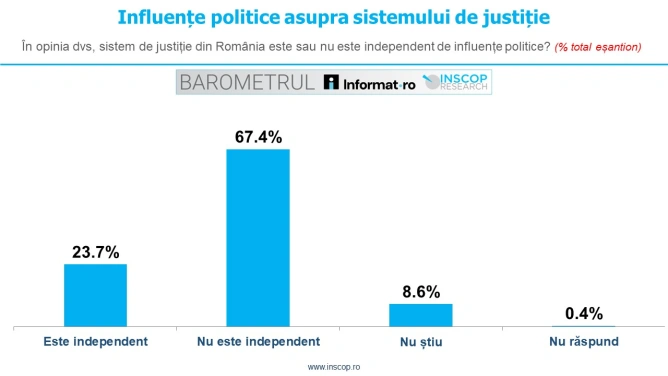
23.7% of those interviewed believe that the justice system in Romania is independent of political influences, while 67.4% consider that the justice system is not independent of such influences. 8.6% do not know, and 0.4% do not respond.
Those who believe that the judicial system is independent of political influences are in slightly higher proportions than the population average, especially PSD and AUR voters, individuals aged between 30 and 44, those with primary education, and residents of rural areas. Those who believe that the judicial system is NOT independent of political influences are in higher proportions than the average, especially USR voters, young people under 30, individuals with higher education, residents of Bucharest and large urban areas, and state employees.
Equal Application of the Law for All Citizens
When asked to what extent they believe that the law is applied equally for all citizens, 5.7% of Romanians say to a very large extent (compared to 12.6% in April 2025), 10.9% to a quite large extent (compared to 17.2% in April 2025). Cumulatively, in April 2025, 19.8% believed to a very large extent or quite a large extent that the law is applied equally for all citizens, with the percentage decreasing in January 2026 to 16.6%. 30.1% of Romanian citizens believe to a quite small extent (compared to 25.9% in April 2025), and 50.1% to a very small extent or not at all (compared to 42.6% in April 2025) that the law is applied equally for all citizens. Cumulatively, in April 2025, 68.5% believed to a quite small extent, to a very small extent, or not at all that the law is applied equally for all citizens, with the percentage increasing in January 2026 to 80.2%. The proportion of non-responses is 3.2% (compared to 1.7% in April 2025).

They believe that the law is applied equally for all citizens to a large extent and quite a large extent, in slightly higher proportions than the population average, especially PSD and PNL voters and young people under 30. They consider that the law is applied equally for all citizens to a small/very small extent or not at all in slightly higher proportions than the population average, especially USR and AUR voters, respectively residents of small urban areas.
Latest News
23:01
22:57
22:53
22:50
22:43
See more news
NEWS ON THE SAME TOPICS
.webp)




.webp)