BAROMETRUL Informat.ro - INSCOP Research - Edition IX, April 2026. Chapter 5: Human values in Romanian society | Faith is important for having a moral life vs Most people try to take advantage of others



Always see our news on Google
BAROMETER Informat.ro - INSCOP Research - Edition IX, April 2026
Chapter 5: Human values in Romanian society
BAROMETER Informat.ro – INSCOP Research is a monthly opinion poll conducted by INSCOP Research on behalf of the news platform Informat.ro in partnership with the think-tank Strategic Thinking Group.
BAROMETER Informat.ro – INSCOP Research aims to bring to the public's attention topics of interest to stimulate national conversations about various subjects and essential public policies for the present and future of Romania, based on the opinions of Romanians in partnership with think tanks and prestigious academic institutions. It is an initiative through which we aim to contribute to the strengthening of democracy by using scientific and credible tools that bring the voice of citizens to the forefront of public debate.
Methodology: Data was collected between April 1-7, 2026. Research method: interview via questionnaire. Data was collected using the CATI method (telephone interviews), with a simple stratified sample volume of 1100 people, representative of significant socio-demographic categories (gender, age, occupation) for the non-institutionalized population of Romania, aged 18 and over. The maximum allowable error of the data is ± 3%, at a confidence level of 95%.
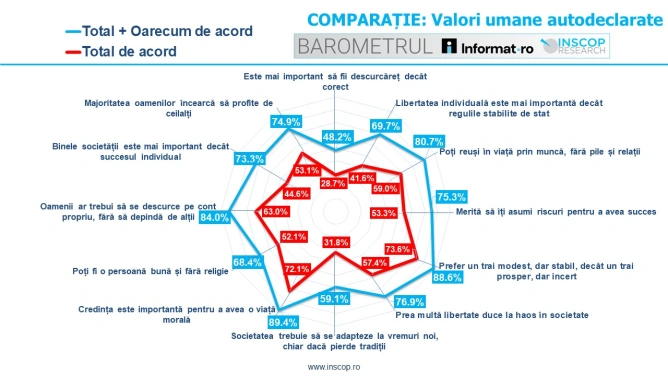
The study tested the opinions of Romanians regarding 12 values described through a series of statements to which survey participants could express total or partial agreement, or total or partial disagreement.
Graphical presentation of the data is available here.
Top human values based on total or partial agreement for each of the 12 statements
1. Belief is important for having a moral life – 89.4%
2. I prefer a modest but stable life rather than a prosperous but uncertain life – 88.6%
3. People should manage on their own without depending on others – 84.0%
4. You can succeed in life through hard work, without connections and relationships – 80.7%
5. Too much freedom leads to chaos in society – 76.9%
6. It is worth taking risks to be successful – 75.3%
7. Most people try to take advantage of others – 74.9%
8. The good of society is more important than individual success – 73.3%
9. Individual freedom is more important than the rules set by the state – 69.7%
10. You can be a good person without religion – 68.4%
11. Society must adapt to new times, even if it loses traditions – 59.1%
12. It is more important to be resourceful than correct – 48.2%
Top human values based on total agreement (high intensity) for each of the 12 statements
1. I prefer a modest but stable life rather than a prosperous but uncertain life – 73.6%
2. Belief is important for having a moral life – 72.1%
3. People should manage on their own without depending on others – 63.0%
4. You can succeed in life through hard work, without connections and relationships – 59.0%
5. Too much freedom leads to chaos in society – 57.4%
6. It is worth taking risks to be successful – 53.3%
7. Most people try to take advantage of others – 53.1%
8. You can be a good person without religion – 52.1%
9. The good of society is more important than individual success – 44.6%
10. Individual freedom is more important than the rules set by the state – 41.6%
11. Society must adapt to new times, even if it loses traditions – 31.8%
12. It is more important to be resourceful than correct – 28.7%
Main conclusions of the research “Human values in Romanian society”
1. Society perceived as materialistic, but with different moral aspirations
Romanians describe society as being dominated by money and status, yet their own responses to normative items indicate a clear aspiration towards morality, work, and fairness. This results in a typical rupture of societies with a trust deficit, between negative perceptions of others and positive self-representation.
2. Stability is the dominant latent value
Beyond explicit formulations, responses converge towards a strong preference for security, predictability, and risk avoidance. This structures attitudes towards the economy, freedom, and social change. Romania appears as a defensive society, not an aspirational one.
3. Pragmatic individualism, not ideological
There is support for personal autonomy (resourcefulness, individual responsibility), but this is not classical liberalism, rather a type of "you manage because the system does not help you." It is a necessity-driven individualism, not one of conviction.
4. The duality of freedom vs. order is unresolved
Romanians simultaneously support individual freedom and the idea that too much freedom produces chaos. This coexistence indicates an ambivalent value profile, predisposed to the rapid acceptance of restrictive measures if justified by stability.
5. Meritocracy is an aspirational belief, not based on experience
The majority believe that success can be achieved through hard work, yet this belief coexists with the perception that people take advantage of each other and that "resourcefulness" is important. We have an idealized meritocracy, but poorly supported by social experience.
6. Religion remains a symbolic pillar, but not exclusive
Belief is strongly associated with morality, yet there is also acceptance of the idea that one can be moral without religion. This indicates a transition from normative religiosity to cultural religiosity, especially in educated and urban segments.
7. Conditional acceptance of modernization
The data show openness to adaptation and change, but with significant resistance related to the loss of traditions. Romania does not reject modernity, but negotiates it, indicating a conservative model of modernization, not disruptive.
8. High level of generalized social distrust
The perception that most people try to take advantage of others indicates a low level of social capital among Romanians. This explains the preference for stability, reluctance towards risk, and attachment to control structures.
9. Electoral cleavages are more about intensity than direction
Differences between the electorates of parties exist, but do not radically change the hierarchy of values. The mainstream electorates (PSD, PNL) are more oriented towards stability and tradition. The USR electorate is more open to change and individual autonomy. The AUR electorate combines moral conservatism with high social distrust. This results in a relatively homogeneous value system, with variations in emphasis, not paradigm.
10. The real cleavage is socio-demographic: education and age
The most consistent differences appear between young and old (more openness, risk, autonomy among the young, respectively more preference for stability and order among the elderly). Equally relevant is the cleavage between high education vs. low education (more liberal individualism and relativization of religion among those with higher education, respectively more traditionalism among those with primary education). The urban-rural cleavage also matters, with urban areas supporting modernization vs. rural areas having a high appetite for conservative values. These cleavages indicate a slow polarization between traditional Romania and modernized Romania, with potential for accentuation over time.
Based on the data, we can identify 5 value typologies
1. DEFENSIVE TRADITIONALISTS: stability is absolutely prioritized, social order prevails over freedom, religion is a central moral foundation, distrust in others is high, and resistance to change is great. This segment operates in a universe perceived as unstable and dangerous. Values are organized around protection and conservation. They accept the idea of merit, but do not fully believe in the proper functioning of the system. This is a social segment characterized by high age, low or medium education, coming from rural and small urban areas, and is overrepresented in the electorate of traditional and conservative parties.
2. SURVIVAL PRAGMATICS: emphasis on "resourcefulness" and adaptation, acceptance of tough competition and lack of fairness, very high distrust in others, necessity-driven individualism, seeking stability perceived as difficult to achieve. This is the segment that internalizes the idea that "the rules do not work" the most. They are citizens who rely on an opportunistic adaptation code to a system perceived as unfair, a segment where the greatest dissonance is observed between declared values (fairness, work) and perceived effective strategies (resourcefulness). From a socio-demographic profile perspective, they are people of working age (30-59 years), with medium education, from small urban and peri-urban areas, distributed relatively evenly across all political spectrums.
3. ASPIRATIONAL INDIVIDUALISTS: strong belief in merit and work, acceptance of risk and social mobility, personal autonomy, relativization of religion, and openness to change. This segment sees society as imperfect but reformable, being anchored in the narrative of personal progress. On the other hand, under pressure (crises), people in this segment can quickly migrate towards stability and protection. The socio-demographic profile of this segment consists of young people and young adults, individuals with medium and higher education, from large urban areas.
4. MORAL COMMUNITARIANS: the collective good is central, morality is important (often linked to religion, but not exclusively), social solidarity is a priority, freedom must be balanced by responsibility, but the level of social trust is moderate. This segment seeks to reconcile the individual with the community, being guided by the ethics of social balance, but can oscillate between solutions of a protective state and individual responsibility. It is a segment that covers various ages, has medium and higher education, from urban and rural areas, and is found at all party levels.
5. AMBIVALENT MODERATES: simultaneous agreement with seemingly contradictory values, freedom, but also order, tradition, but also modernization, merit, but also skepticism, medium level of engagement and reflection. This is a typical segment for societies in transition, which operates based on compromise and contextual adaptation, and can be mobilized in different directions. It is a segment that covers all ages, has a medium level of education, from small and large urban areas, with volatile political options.
Remus Ștefureac, director of INSCOP: "The Informat.ro – INSCOP Barometer shows a society organized around three major axes: stability vs. risk, order vs. freedom, traditional morality vs. moral autonomy. No segment is ideologically "pure". Romania is not classically polarized, but stratified based on combinations of values, with much ambivalence. Therefore, the real political/ideological cleavage in Romanian society is more between Modernization vs. Protection, not Left vs. Right, a traditional cleavage that no longer has any real traction at the population level."
Dominant values in Romanian society
48.7% of survey participants believe that in today's Romania, people value money and status more. 20.4% mention family and relationships, 9.5% stability, 9.4% belief and traditions, and 8.7% personal freedom. The proportion of non-responses is 3.4%.
Voters of USR, young people under 30, individuals with higher education, and public sector employees believe the most that in today's Romania, people value money and status more. Voters of AUR and those with primary education indicate a higher percentage than the average for family and relationships as the dominant value in Romanian society.
Agreement with the statement: Human values
"It is more important to be resourceful than correct"
When asked to what extent they agree with the statement: "It is more important to be resourceful than correct", 28.7% of respondents say they totally agree, 19.5% somewhat agree, while 11.2% somewhat disagree and 38.3% totally disagree. 2.3% do not know or do not respond.
They agree with the given statement in a higher proportion than the rest of the population: voters of AUR and PSD, young people under 30, individuals with primary education. They disagree in a higher percentage than the average: voters of PNL and USR, individuals between 45 and 59 years old, those with higher education, residents of Bucharest and large urban areas, public sector employees.
"Individual freedom is more important than the rules set by the state"
41.6% of respondents totally agree with the statement "Individual freedom is more important than the rules set by the state", while 28.1% somewhat agree. 10.2% somewhat disagree with this statement, and 14.9% totally disagree. The proportion of non-responses is 5.2%.
They agree with the given statement in a higher proportion than the rest of the population: voters of PSD and AUR, young people under 30, individuals with medium education. They disagree in a higher percentage than the average: voters of USR, individuals with higher education, residents of the capital.
"You can succeed in life through hard work, without connections and relationships"
The statement "You can succeed in life through hard work, without connections and relationships" meets the total agreement of 59% of respondents. 21.7% somewhat agree with the statement, 6.3% somewhat disagree, and 11.9% totally disagree. 1.1% do not know or do not respond.
They agree with the given statement in a higher proportion than the rest of the population: voters of USR and AUR, individuals between 30 and 44 years old, those with primary education, private sector employees. They disagree in a higher percentage than the average: voters of PSD, individuals over 60 years old, public sector employees.
"It is worth taking risks to be successful"
When asked to what extent they agree with the statement: "It is worth taking risks to be successful", 53.3% of respondents say they totally agree, 22% somewhat agree, while 6.3% somewhat disagree and 16% totally disagree. The proportion of non-responses is 2.4%.
They agree with the given statement in a higher proportion than the rest of the population: voters of USR, men, individuals between 18 and 44 years old, those with higher education, residents of Bucharest. They disagree in a higher percentage than the average: voters of PSD and PNL, women, individuals over 45 years old, those with primary and medium education, residents of rural areas.
"I prefer a modest but stable life rather than a prosperous but uncertain life"
73.6% of respondents totally agree with the statement "I prefer a modest but stable life rather than a prosperous but uncertain life", while 15% somewhat agree. 2.9% somewhat disagree, and 7% totally disagree. 1.5% do not know or do not respond.
Individuals over 60 years old agree with the given statement in a higher proportion than the rest of the population. They disagree in a higher percentage than the average: voters of USR, young people under 30, those with primary education.
"Too much freedom leads to chaos in society"
The statement "Too much freedom leads to chaos in society" meets the total agreement of 57.4% of survey participants. 19.5% somewhat agree, 6.5% somewhat disagree, and 12.9% totally disagree. The proportion of non-responses is 3.7%.
They agree with the given statement in a higher proportion than the rest of the population: voters of PNL and women. They disagree in a higher percentage than the average: voters of USR, men, individuals with higher education, private sector employees.
"Society must adapt to new times, even if it loses traditions"
When asked to what extent they agree with the statement: "Society must adapt to new times, even if it loses traditions", 31.8% of respondents say they totally agree, 27.3% somewhat agree, while 10.3% somewhat disagree and 28% totally disagree. 2.6% do not know or do not respond.
They agree with the given statement in a higher proportion than the rest of the population: voters of PNL and USR, young people under 30, individuals with higher education, residents of Bucharest. They disagree in a higher percentage than the average: voters of PSD, individuals over 60 years old.
"Belief is important for having a moral life"
72.1% of respondents totally agree with the statement "Belief is important for having a moral life", while 17.3% somewhat agree. 4% somewhat disagree with this statement, and 5.7% totally disagree. The proportion of non-responses is 0.9%.
Voters of AUR agree with the given statement in a higher proportion than the rest of the population. They disagree in a higher percentage than the average: voters of USR, young people under 30, those with higher education, residents of Bucharest.
"You can be a good person without religion"
The statement "You can be a good person without religion" meets the total agreement of 52.1% of respondents. 16.3% somewhat agree with the statement, 5.4% somewhat disagree, and 24.4% totally disagree. 1.9% do not know or do not respond.
They agree with the given statement in a higher proportion than the rest of the population: voters of PNL and USR, men, young people under 30, and individuals between 45 and 59 years old, those with higher education, residents of Bucharest, private sector employees. They disagree in a higher percentage than the average: voters of PSD, women, individuals over 60 years old, those with primary education, residents of rural areas.
"People should manage on their own, without depending on others"
When asked to what extent they agree with the statement: "People should manage on their own, without depending on others", 63% of respondents say they totally agree, 21% somewhat agree, while 5.8% somewhat disagree and 8% totally disagree. The proportion of non-responses is 2.2%.
Voters of AUR agree with the given statement in a higher proportion than the rest of the population. They disagree in a higher percentage than the average: voters of PNL, young people under 30, individuals with higher education.
"The good of society is more important than individual success"
44.6% of respondents totally agree with the statement "The good of society is more important than individual success", while 28.7% somewhat agree. 8.6% somewhat disagree, and 13.8% totally disagree. 4.4% do not know or do not respond.
They agree with the given statement in a higher proportion than the rest of the population: voters of USR and men. They disagree in a higher percentage than the average: individuals between 18 and 44 years old, those with higher education.
"Most people try to take advantage of others"
The statement "Most people try to take advantage of others" meets the total agreement of 53.1% of survey participants. 21.8% somewhat agree, 6.1% somewhat disagree, and 17.1% totally disagree. The proportion of non-responses is 1.9%.
They agree with the given statement in a higher proportion than the rest of the population: young people under 30, individuals with medium education, residents of large urban areas, public sector employees. They disagree in a higher percentage than the average: voters of PSD, individuals with primary education, residents of rural areas.
Latest News
22:57
22:53
22:42
22:30
22:28
See more news