ANALYSIS. The effects of Trump's statements about imposing new tariffs on the US stock market




Always see our news on Google
President Trump's statements regarding tariffs have acted, in the last 12 months, as volatility detonators: they triggered sudden sell-offs on Wall Street on "shock" days (April 2025, January 2026), but the effect was generally short-lived, with markets quickly recovering once the threats were nuanced or withdrawn.
Overall dynamics: sentiment shock, not a trend of collapse
The "reciprocal" tariff package announced on April 2, 2025, with a base tariff of at least 10% on imports and higher quotas for dozens of countries, led to one of the toughest trading sessions since 2020, with the S&P 500 dropping by about 4.8%, and Nasdaq by nearly 6% in a single day, amid fears of recession and inflation due to tariffs.
However, by early May 2025, the S&P 500 had practically recovered all the losses from "Liberation Day," marking a series of new consecutive growth sessions and returning above the level from April 2, indicating that the shock was more of a sentiment than the beginning of a structural bear market.
In the summer of 2025, with the implementation of some tariffs and announced exceptions for tech giants producing in the U.S., the reaction of the American stock market was much more tempered: Nasdaq closed with slight gains, and the S&P 500 advanced marginally, suggesting that the markets had already digested much of the tariff risk and appreciated the clarifications and exceptions.
The "Greenland" episode: threat – panic – recovery
During the weekend of January 18-19, 2026, Trump linked the dispute over Greenland to the threat of progressive tariffs (10% from February 1, possibly 25% from June) on eight NATO allies, reigniting fears of a transatlantic trade war and reactivating the "Sell America" strategy tested after the broad tariffs of 2025.
The first American trading session open after that weekend (Tuesday, January 20, 2026) saw a drop of about 2.1% in the S&P 500 – the largest daily drop since an episode in the previous October – and investors sought refuge in safe assets, such as the Swiss franc and gold.
Shortly after, following Trump's announcement of a "framework" with NATO and his backtrack on tariffs related to Greenland, the markets quickly recovered: on January 21, 2026, the Dow closed up +580 points (about +1.2%), and the S&P 500 rose by approximately 1.1%, recovering much of the loss suffered the day before.
How transmission works: from tweet to price
Trump's statements first hit confidence: surprise announcements of high tariffs, in a combative tone, are interpreted by the market as negative shocks to economic policy, which can affect global supply chains, corporate profits, and interest rate trajectories.
The initial reaction is "risk-off":
Aggressive sell-offs on major indices (S&P 500, Nasdaq) and, in some cases, rapid entries into correction or bear territory at the segment level (for example, Russell 2000 entered bear after the shock of April 2, 2025).
Flows into bonds, safe-haven currencies, and gold, which reinforces the panic message and amplifies the decline in the stock markets on the day of the event.
Over a horizon of a few weeks, the picture changes: negotiations, exceptions, and announcements of "pauses" or "frameworks" temper the perception of risk, and flows reverse, with recovery rallies wiping out losses from the shock day (example: complete recovery of losses from April 2, 2025, by May 2, 2025, or the rally after the withdrawal of tariff threats regarding Greenland).
Timely timeline: statements vs. S&P 500 / Nasdaq movement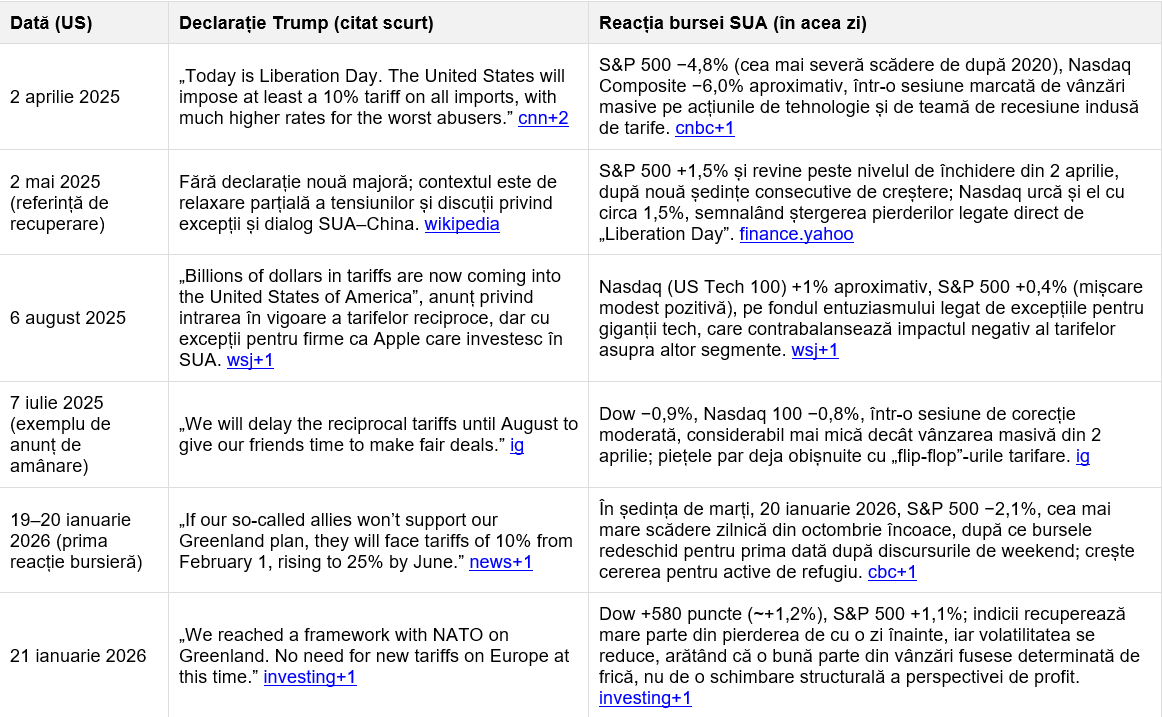 Overall, the last year confirms that tariffs and even just the simple tariff rhetoric of President Trump are a strong trigger for short-term corrections in the American stock market, but also that the markets remain, ultimately, governed by fundamental rules: once investors grasp the real magnitude of the measures or hear signals of de-escalation, recovery rallies can be as spectacular as the initial collapses.
Analysis conducted with the help of Perplexity
Latest News
21:24
21:11
20:59
20:42
20:22
See more news
NEWS ON THE SAME TOPICS