SPECIAL Informat.ro / The invisible map of the Muslim religious world and rivalries in the Middle East: Sunnis, Shiites ...



Always see our news on Google
Just as Christianity is divided into major branches – Orthodox, Catholic, Protestant – there are families of faith in Islam with different dogmas, rituals, religious leaders, and centers of power. In the Christian world, separations have led to distinct jurisdictions, patriarchs, and popes, but all claim descent from the same founding figure, Jesus; similarly, in Islam, Sunnis and Shiites relate to the same prophet, Muhammad, but disagreement over his successors and religious authority has created a lasting rift that today shapes the geopolitics of the Middle East.
From Succession Conflict to Two Major Branches
The fundamental separation in Islam occurred in the 7th century, after the death of the prophet Muhammad (632), when the Muslim community could not agree on who should lead the ummah – the community of believers. Some believed that the leader, the caliph, should be chosen by the community from among the Prophet's close companions – these would historically become the Sunnis – while another group argued that only Ali, Muhammad's cousin and son-in-law, and his direct descendants have the divine legitimacy to lead – the core of future Shiism.
Since then, the fault line has not disappeared but has generated civil wars (the first fitna), rival dynasties, and, over time, two parallel theological universes, each with its own centers of worship, key celebrations, and protective states. Still, in terms of daily practice – praying five times a day, fasting during Ramadan, pilgrimage to Mecca – an ordinary Muslim from both camps would recognize the same basic architecture of faith.
Who are the Sunnis
Sunnism is the majority branch of Islam, encompassing approximately 87–90% of the world's Muslims. Recent estimates suggest that globally, over 1.5–1.6 billion people can be considered Sunnis, from Indonesia and Pakistan to Egypt and Morocco.
Defining characteristics:
Religious authority: Sunnis emphasize community consensus and schools of law (madhhab), without a vertical "papal" hierarchy; authority is diffuse, in the hands of networks of ulema (religious scholars).
Geography: they have overwhelming majorities in Indonesia, Pakistan, Bangladesh, Egypt, Turkey, Saudi Arabia, most states in North Africa, and much of the Sunni Arab world.
Political identity: in the 20th century, secular regimes (Nasser's Egypt, Kemalist Turkey) and conservative monarchies (Saudi Arabia, Jordan) represented very different faces of the Sunni world, from Arab nationalism to political Islam (Muslim Brotherhood).
Useful example: just as Catholicism has multiple orders and traditions (Jesuits, Franciscans) under the same umbrella, Sunnism encompasses a plurality of schools of law and theological currents, from Hanbali traditionalism to Sufi mysticism.
Who are the Shiites and where are they located
Shiites represent, on a global scale, approximately 10–13% of Muslims, or between 200 and 260 million people, concentrated in a few key states. The overwhelming majority of Shiites belong to the "Imamite" branch (Twelvers), who believe in the line of 12 infallible imams, descendants of Ali.
According to Pew estimates and other demographic sources, the largest Shiite communities are found in: Iran, Iraq, Pakistan, India, Azerbaijan, Yemen, Turkey, Syria, Lebanon.
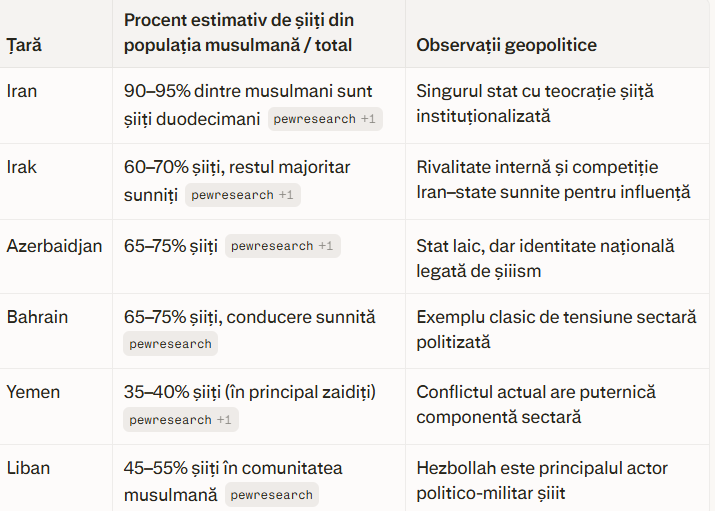
Theologically, Shiites assign a central role to the concept of the imam as a figure with spiritual authority and, in Twelver tradition, as a privileged intermediary between the divine and the community. Their rituals include the dramatic commemoration of the martyrdom of Imam Husayn at Karbala (Ashura), which forms the core of a spirituality of suffering and resistance.
Wahhabism and other currents: ideology, not a "separate branch"
Wahhabism is not a standalone branch but an ultraconservative current within Sunnism, emerging in the 18th century on the Arabian Peninsula, around the preaching of Muhammad ibn Abd al-Wahhab and his alliance with the Al Saud family. It promotes a literalist interpretation of the Quran and hadiths, rejecting many popular practices (the cult of saints, visiting graves) that it considers condemnable innovations.
Today, Wahhabism is the official doctrine, with nuances, in Saudi Arabia and influences Salafist movements in various Sunni countries, from the Persian Gulf to North Africa and South Asia. Although theologically it is not identical to all forms of Salafism, in practice, the terms are often overlapping in political and media discourse.
Other currents to mention:
Ibadi – a distinct minority, concentrated in Oman, with about 0.2–0.3% of the total Muslim population, with doctrine between early Kharijite and Sunni traditions.
Alawites – an esoteric group present in Syria, associated with the political leadership of the Assad family, historically considered a branch derived from Shiism, but with very specific doctrines.
For the orthodox reader, it can be said that Wahhabism is more of an "internal ideological line" within the Sunni world, with a disproportionate political impact relative to the number of adherents, similar to the role of an ultra-conservative current within a broad Church.
The religious composition of Iran
Officially, Iran is an Islamic Shiite republic, having, according to classical data cited by the CIA World Factbook and other sources, between 90 and 95% of Shiite Muslims (almost all Twelvers) and 5–10% Sunni Muslims. An analysis of census data and government estimates indicates that approximately 99% of Iran's population is registered as Muslim, with the overwhelming majority being Shiite.
However, independent sociological surveys suggest a more fluid religious landscape, with a portion of the population identifying as "non-religious," agnostic, or "spiritual but not religious," which does not change the official axis: the state remains built on Twelver Shiite doctrine and the concept of velayat-e faqih (the leadership of the jurist). Sunni minorities are concentrated among Kurds, Turkmen, and Baluchis, while other confessions (Christians, Zoroastrians, Baha'is) are officially very small in proportion.
From a regional perspective, Iran is the main power pole of the Shiites, sponsoring or supporting Shiite movements in Iraq, Lebanon (Hezbollah), Yemen (Houthi), or Bahrain, which gives it a distinct geopolitical identity from its Sunni neighbors.
How these differences affect Arab-Muslim rivalries
In demographic terms, the Muslim world is overwhelmingly Sunni – about 85–90% – while Shiites form a concentrated minority in a few strategic points (Iran, Iraq, Persian Gulf). This distribution creates a geometry of power in which, in many states, the political and religious elite belong to one group, while a significant part of the population belongs to the other, fueling sectarian tensions.
From a geopolitical perspective, religious differences act as a conflict multiplier along the following axes:
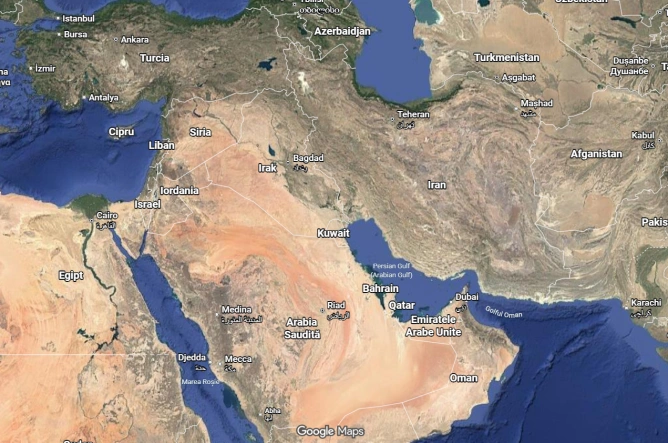
Iran vs. Sunni monarchies in the Gulf (especially Saudi Arabia): competition for leadership in the Islamic world, with theological dimensions (Shiites vs. Wahhabis) and geostrategic dimensions (control of energy routes, influence in Iraq, Syria, Yemen).
Saudi Arabia vs. Qatar/Turkey: intra-Sunni rivalries, in which a conservative Wahhabi Islam confronts more "Muslim Brotherhood" or national-Islamist versions; sectarianism plays a smaller role than regional ambition divergences.
In Syria, Iraq, and Yemen, the Shiite-Sunni divide is not the sole cause of conflicts, but it becomes the lens through which Iran and Saudi Arabia structure alliances, and Turkey positions its interests, especially regarding Sunni communities and the Kurdish issue. Practically, each of the three powers tries to be the "leading state" for their own co-religionists or for a certain type of political Islam, transforming the religious fault line into an architecture of coalitions and proxies.
The cases of Syria, Iraq, and Yemen
Syria: Alawite regime, "Shiite axis" and Sunni opposition
In Syria, the Assad regime is dominated by Alawites, a branch close to Shiism, which is why Iran has presented the defense of Damascus as the defense of the "axis of Shiite resistance" and anti-Western. Tehran has sent advisors from the Revolutionary Guards, Hezbollah fighters, and Shiite militias from Iraq, Afghanistan, and Pakistan, transforming the conflict into a central issue of its regional projection.
On the other side, Saudi Arabia has supported various stages of Sunni opposition groups, from factions of the Free Syrian Army to Salafist formations, using anti-Shiite discourse to delegitimize the Assad regime and Iranian influence. Turkey has also supported the Sunni opposition and has called for Assad's departure from the beginning, but has operated more nuanced: while Riyadh viewed Syria in the logic of a cold war with Iran, Ankara combined solidarity with Syrian Sunnis with security obsession regarding Kurdish entities at the border.
Iraq: Shiite majority, Sunni minority, and the balance of power
In Iraq, the fall of Saddam Hussein reversed the power balance: a long-marginalized Shiite majority took control of institutions, while the Sunni community felt the transition as a historic loss. Iran took advantage of this realignment to cultivate Shiite parties and militias, from mainstream political formations to paramilitary units that became pivots of Iraqi security and channels of direct influence.
Saudi Arabia has tried to present itself as the protector of Iraqi Sunnis, initially supporting Sunni political forces and, indirectly, tribal rebellions, but with less success than Iran in the Shiite area. Turkey, for its part, has pursued two objectives: to avoid the total marginalization of Sunnis (whom it perceives as a counterbalance to Iranian influence) and to limit Kurdish autonomy in the north, which has pushed Ankara towards a "sectarian balance" policy in favor of Sunnis and Turkmen.
Yemen: local war, used as a theater of Saudi-Iranian rivalry
In Yemen, the civil war started from internal causes – the collapse of a fragile political system, socio-economic grievances, tribal rivalries – but was quickly reframed in terms of Saudi-Iranian rivalry. The Houthi movement, of Zaydi Shiite tradition, has been presented by Riyadh as an Iranian "proxy" at the southern border, justifying the military intervention of the Saudi-led coalition to reinstall President Hadi, a Sunni ally.
Iran, for its part, has provided the Houthis with political, informational support, and, according to several Western reports, weaponry and expertise, but without fully controlling the local dynamics; for Tehran, Yemen is more of a "low-cost, high-pressure" file against Saudi Arabia. Unlike Syria and Iraq, Turkey has played a much more modest role in Yemen, maintaining a declarative critical position against the Saudi intervention, but without direct military involvement, which illustrates that sectarianism is not the only filter of its regional policy.
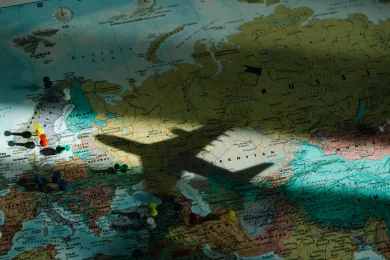
How the "religious front" looks on the map
If we look from Iran, Syria (the Assad regime), Iraq (Shiite majority in power), and the Houthi movement in Yemen form a "arc" of Shiite or pro-Iranian influence, linking Tehran to the Mediterranean and the Red Sea. From Saudi Arabia's perspective, the same configuration appears as a Shiite encirclement, to which it responds by supporting Sunni actors and promoting its own religious and political model – Wahhabi, monarchical, guardian of the two holy places.
Turkey, on the other hand, does not explicitly position itself as the "leader of Sunnis" in doctrinal terms, but as a national Sunni power and neo-Ottoman that defends its security interests and influences in Syria and Iraq, sometimes in convergence with Saudi Arabia (on the Assad issue), other times in competition (against Qatar, the Muslim Brotherhood, and influence over the Sunni opposition). In practice, the religious divide outlines the corridor of possible alliances, but the actual content of the Iran-Saudi Arabia-Turkey policy is determined by power calculations, energy files, and each capital's relationship with Washington, Moscow, and Brussels.
Sectarian internal conflicts: in Iraq, Lebanon, Bahrain, Yemen, the Shiite-Sunni line overlaps with ethnic, class, and power divides, transforming political crises into a zero-sum game between religious communities.
However, it is important to emphasize that religion is not the only explanation and not always the originating factor of rivalry. Often, regimes, intelligence services, and external powers have instrumentalized religious identities to secure their power or extend their influence. Just as in Europe confessionalism was used by states to justify their alliances and wars – Catholic vs. Protestant – in the Middle East, the labels "Shiite" and "Sunni" are often the language in which power conflicts, resources, and security are expressed.
Analysis conducted with the support of Perplexity
Latest News
16:50
16:32
16:31
16:24
16:13
See more news
NEWS ON THE SAME TOPICS













.webp)