EXCLUSIVE Romania, in the vision of the press from Russia: The top topics from the last two weeks


Always see our news on Google
Romania has appeared in the Russian press in the last two weeks, especially in publications such as RIA Novosti, Argumenty i Fakty, Lenta.ru, and Zvezda, primarily as a stage for a deep internal political crisis and as a NATO frontier state, with a strategic role in the Black Sea. Against this backdrop, Romania is increasingly presented as an actor in the Western security architecture. The present analysis includes a ranking of the most discussed topics, based on data collected between April 11-24, 2026, during which 398 articles published in the Russian press were identified.
The political crisis in Bucharest, through the eyes of the Russian press
The most visible topic about Romania is the simultaneous resignation of the Deputy Prime Minister and six ministers from the Bucharest cabinet, coming from the Social Democratic Party (PSD). Agencies and sites such as RIA Novosti, Argumenty i Fakty, Rossiyskaya Gazeta, and AiF-Moscow emphasize that the ministers of agriculture, energy, labor, justice, health, transport, as well as the Secretary General of the government, have also resigned, and this collective gesture is presented as the beginning of a major political crisis in Romania.
The PSD's statement becomes the central axis of the narrative in several materials, including in the texts from Argumenty i Fakty and AiF-Moscow. Social democrats are quoted with the assertion that the Prime Minister "no longer enjoys the support of the parliamentary majority," which means that "he no longer has democratic legitimacy to hold the position of head of the government of Romania."
The articles insist, especially in the texts published by RIA Novosti and Argumenty i Fakty, on a few key ideas. First, the rupture between the Prime Minister and the parliamentary majority is presented as a serious systemic fracture, not just a temporary coalition crisis. Second, references to the Constitution and the principle that no one can "exercise national sovereignty in their own name, against the will of the parliament" are highlighted. Third, the Prime Minister's remaining in office is qualified as "extremely irresponsible," as it would mean leading "an inefficient government, without a parliamentary majority," with "negative consequences for the country."
An article from Argumenty i Fakty explains that the PSD is calling for the verification of the government's legitimacy at the Constitutional Court and, by withdrawing the ministers, triggers the procedure for changing power through the presidential administration. The tone of these publications is strongly critical of the Bucharest cabinet: Romania is outlined as an example of political instability, blocked by disputes over "harsh austerity measures" and the lack of dialogue within the coalition.
The President of Romania, Nicușor Dan, is explicitly mentioned in an article from RIA Novosti, in connection with the debate regarding a possible referendum for unification with the Republic of Moldova. The agency notes that "the President of Romania Nicușor Dan has spoken out against the idea of organizing a referendum regarding a possible unification with Moldova, considering that this initiative is not appropriate at this time."
Overall, in internal terms, these publications project the image of a Romania whose institutions are contested and whose government is losing democratic legitimacy, in the context of austerity and a coalition in disarray.
Romania as a NATO platform in the Black Sea
The second major pillar of the narrative is related to the war in Ukraine and Romania's strategic role in NATO's deployment in the Black Sea area. Platforms such as Zvezda, RIA Novosti, and Argumenty i Fakty publish detailed materials about the activities of British and American reconnaissance planes, RC-135W and CL-650, in proximity to Crimea and the Russian coast, ahead of massive drone and missile attacks launched by the Ukrainian army.
A text appearing on Zvezda and repeated by other channels notes that, before the attacks on terminals in the Black Sea, "NATO reconnaissance satellites were monitoring the positions of ships in Sevastopol and Novorossiysk," and reconnaissance planes were flying intensively in the area. At this point, Romania is explicitly introduced with the phrase: "In particular, an early warning aircraft of NATO's Air Forces was detected over Romania, flying towards Sevastopol." The tone of these publications is critical of NATO and suggests that Ukrainian strikes are "conducted by Western intelligence services and NATO generals," who rely on allied infrastructure in states such as Romania.
The same narrative line is found in the texts of RIA Novosti and AiF-Moscow dedicated to the American reconnaissance aircraft Artemis II, a modified Bombardier Challenger 650. RIA Novosti writes that the aircraft "took off from the city of Constanța, in Romania, around 09:00, flew along the coast of Crimea, then returned after reaching near the border between Russia and Georgia," emphasizing that these patrols over the Black Sea have become regular. AiF-Moscow notes, in turn, that Artemis II "took off from the airfield in Constanța, followed the route along the coasts of Crimea, without entering Russian airspace, and made several maneuvers over international waters." In these materials, Romania is presented as a starting point for American reconnaissance aircraft and as essential airspace for NATO operations in the region.
Romania in the Western security architecture
Another group of mentions about Romania appears in news related to arms contracts and cooperation in the field of security. A material from Lenta.ru, also repeated by other sites, informs that the U.S. State Department has approved the sale to Lithuania of 168 AIM-9X Sidewinder Block II missiles and notes, in a separate sentence, that "the U.S. State Department has previously approved a possible sale to Romania of AIM-9X Sidewinder Block II air-to-air missiles."
Translated into Romanian, the message is: "The U.S. State Department has previously approved a possible sale to Romania of AIM-9X Sidewinder Block II air-to-air missiles." Although Romania is not the main subject of the news, the association with Lithuania places it in the category of states on the eastern flank that are strengthening their defense capabilities and "contributing to stability in the region," according to the wording of the State Department cited by Lenta.ru.
Transnistria and Sergei Shoigu's statements
Although the military context around Romania naturally extends to Odesa and Transnistria, in the set of analyzed articles, there is no distinct material in which Sergei Shoigu is directly quoted regarding a possible military intervention in Transnistria or the protection of the Russian minority, in explicit connection with Romania. This absence is all the more remarkable as, in an interview given to Komsomolskaya Pravda, the former Minister of Defense, who has since become the Secretary of the Security Council of Russia, declares that Russia is ready "to take all necessary measures and to resort to all available methods" to protect Russian citizens in Transnistria, "in accordance with the Constitution of the Russian Federation."
In the same interview, Shoigu emphasizes that "it should not be forgotten that over 220,000 Russian citizens live in Transnistria and that their interests and security are threatened due to the reckless and irresponsible actions of Kyiv and Chișinău," a formulation repeated by numerous international sources. However, this very harsh rhetoric, which leaves the scenario of intervention open – "nothing should be excluded" and "considering all possible scenarios, even the least likely ones" – is not followed, during the analyzed period, by Russian media activity in which Romania is directly linked to a possible conflict in Transnistria.
The general tone in the Russian press
Analyzing the 398 articles published between April 11-24, 2026, several clear features of how Romania is represented in the Russian press emerge. Of these, 359 (90%) have a neutral tone, 27 (7%) a negative tone, and 12 (3%) a positive tone.
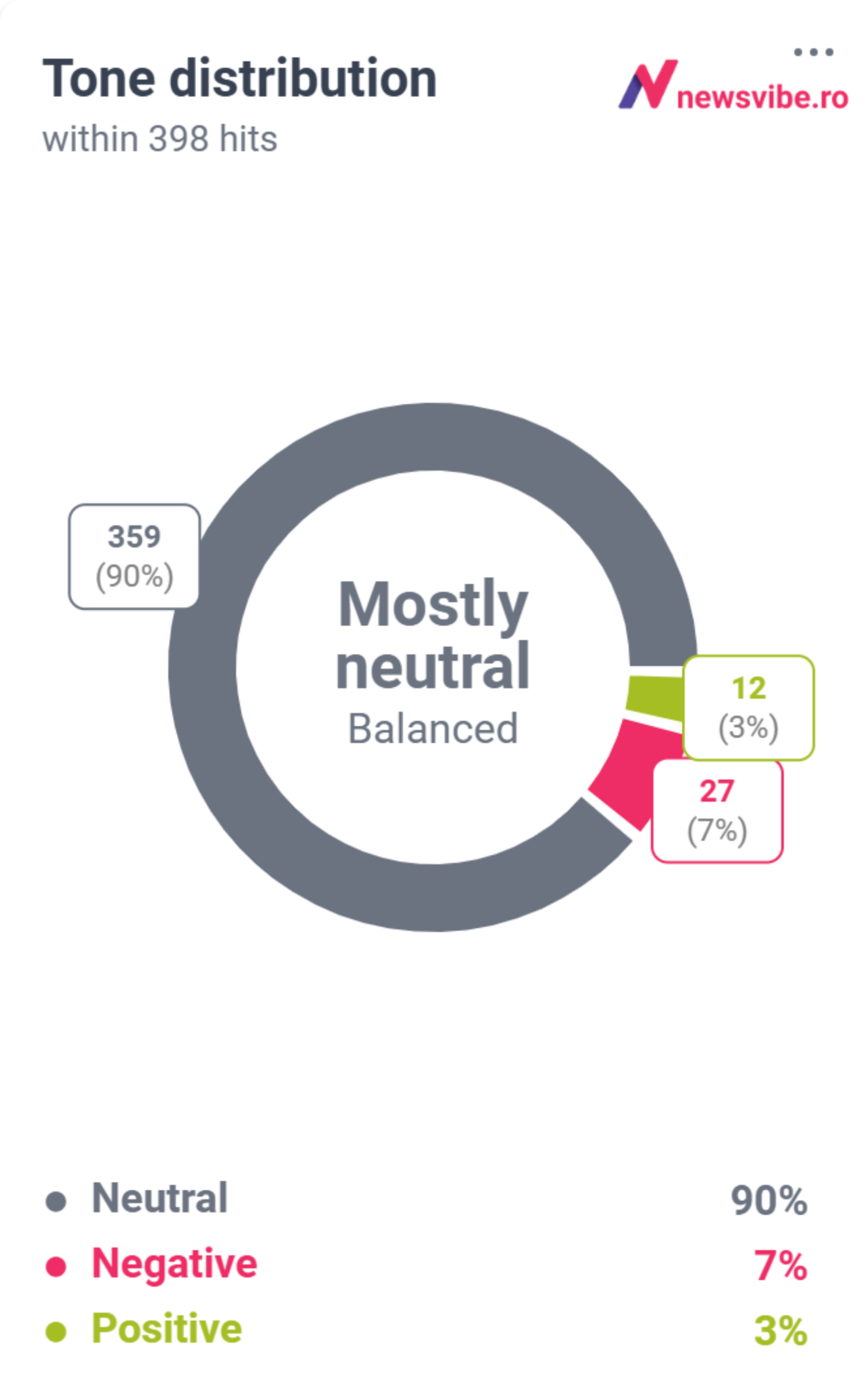 Graph: NewsVibe
*****Synthesis made with the help of a data monitoring flow provided by the media monitoring platform NewsVibe Romania. The analysis, data, and images presented have been enhanced with the help of Machine Learning and Artificial Intelligence tools.
Latest News
23:12
22:53
22:53
22:25
22:06
See more news
NEWS ON THE SAME TOPICS


.webp)