DOC Romania, in the press from Russia: The top topics from January


Always see our news on Google
In the last month, the Russian press has paid attention to Romania and its political figures, especially in the context of geopolitical tensions in Eastern Europe. The data was collected by the media monitoring platform NewsVibe Romania, during the last month, finding 472 articles published in the Russian press during this period. This information reflects an increased interest in the connections between Romania, Moldova, and Ukraine, with an emphasis on anti-Western narratives. Topics related to Romania appear indirectly but frequently, through the lens of President Nicușor Dan and the unionist aspirations in the Republic of Moldova. The predominant tone is neutral, although key political articles tend towards a negative tone, portraying Romania as an actor supported by the EU and NATO. This material will include a ranking of the most discussed topics based on this data, highlighting key publications such as RIA Novosti, Lenta.ru, Izvestia, and others.
Top Most Discussed Topics About Romania
Statements by President Nicușor Dan
Among the most prominent topics directly related to Romania is the portrayal of President Nicușor Dan, mentioned in eight major articles. The overall tone is mixed, but predominantly negative or critical, presenting him as a leader hostile to Russia and Ukraine, but moderate regarding the union with Moldova. Dan has been quoted criticizing Kyiv's plan to reduce Romanian-language high schools in the Cernăuți region, where Romanian minorities live. Sources like Lenta.ru, Life.ru, RT Russian, and News.mail.ru describe him as "condemning" Ukraine's decision, highlighting the "serious problem" of linguistic discrimination against Romanian minorities. This underscores Russia's effort to create divisions between Romania and Ukraine, in the context of the war on the front in Ukraine, as well as the hybrid narrative it propagates.
The Union of the Republic of Moldova with Romania
Another dominant subject involves Romania as a potential "annexer" of the Republic of Moldova, through Maia Sandu's statements. Mentioned in over 20 articles, the tone is vehemently negative, accusing Bucharest of imperialist ambitions. Publications such as Iz.ru, News.ru, and Vz.ru vehemently criticize the idea of "аншлюс" (annexation), and Russian senator Aleksei Pushkov called Sandu "the traitor of her own republic." At the same time, Nicușor Dan rejected the idea of a referendum for unification with the Republic of Moldova, contradicting Maia Sandu's statements. In this context, the Russian press portrays him as pragmatic, avoiding the "annexation" promoted by Sandu.
Passports and Travel Restrictions for Russian Travelers
The Entry/Exit System (EES) imposed by the European Union in the Schengen area for non-EU citizens has also been a subject covered by the Russian press, highlighting the restrictions imposed by Romania on non-biometric Russian passports, which is presented as a coordinated anti-Russian discrimination at the EU level. The publication Life.ru amplifies this narrative, describing the decision as a hostile measure that complicates the mobility of Russian citizens, framing Romania as an active participant in Western sanctions.
General Tone in the Russian Press:
Of the 472 articles, 400 (85%) have a neutral tone, 68 (14%) negative, and only one (0.2%) positive. However, in sensitive political articles, the tone becomes hostile: Romania is seen as a vector of Western influence.
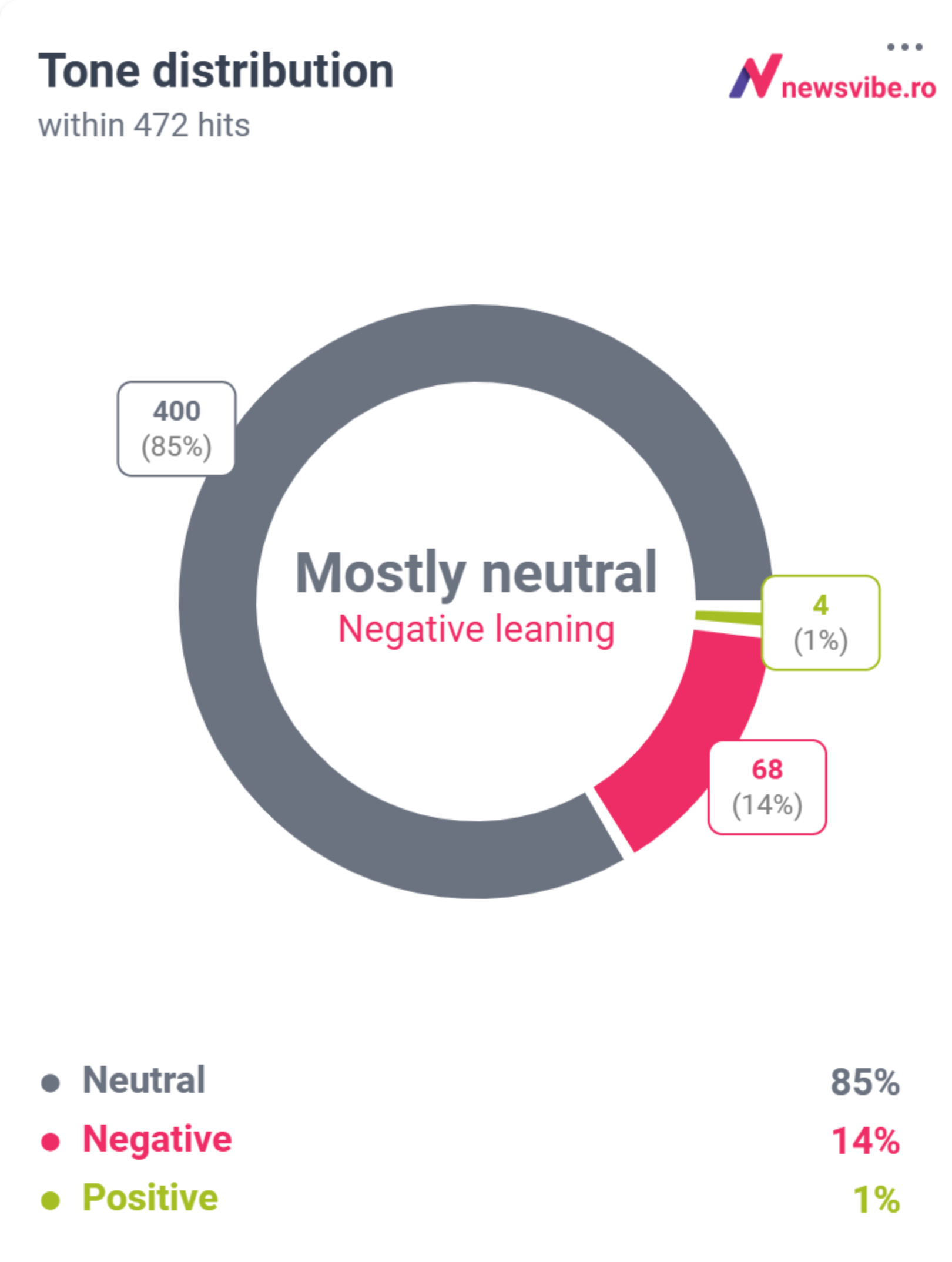
Graph: Newsvibe
Geopolitical Context and Implications
The data reveals a clear dynamic in which discussions about Romania are often eclipsed by those about Moldova, but remain essential in the Russian anti-NATO narrative, positioning Bucharest as a pawn of Western influence in Eastern Europe. Nicușor Dan stands out as a moderate voice, explicitly refusing unification with Moldova – a stark contrast to Maia Sandu's radical position, which advocates for the "liquidation" of the republic in favor of Romania.
This reflects Moscow's broader strategy to divide the West, exploiting tensions between Romania and Ukraine (such as disputes over minorities and schools) to undermine NATO solidarity on the eastern flank. Overall, the media coverage suggests a hybrid campaign aimed at isolating pro-Western Moldova and discrediting unification as an existential threat, reinforcing the Russian narrative of post-Soviet sovereignty threatened by EU/NATO expansion.
*****Synthesis made with the help of a data monitoring flow provided by the media monitoring platform NewsVibe Romania. The analysis, data, and images presented have been enhanced with the help of Machine Learning and Artificial Intelligence tools.
Latest News
22:57
22:46
22:39
22:25
21:55
See more news
NEWS ON THE SAME TOPICS


.webp)