SPECIAL Informat.ro / Romania, in the European press: The top topics from the last two weeks in the European press, about Romanians and Romania




Always see our news on Google
In the last two weeks, Romania and Romanians have entered the agenda of the European press through three major registers: cultural heritage of historical importance, sensitive cases from the diaspora, and developments in the sports area, with a balance between positive, neutral, and negative tones. The analysis is based on data collected by the media monitoring platform NewsVibe Romania for the period of March 21 - April 3, which indicates 1,238 articles published in European countries, with the most mentions coming from Italy, Austria, the United Kingdom, France, Greece, Portugal, and the Netherlands.
Heritage and Culture
The most powerful story with European impact is the recovery of Romanian gold artifacts stolen from the Drents Museum in Assen, in the Netherlands, with the Coif from Coșofenești being the centerpiece. Euronews headlines: "The priceless ancient gold helmet from Romania, stolen last year from a museum in the Netherlands, has been recovered," describing the piece as "one of Romania's most venerated national treasures, from the Dacian civilization" and emphasizing that it is a 2,500-year-old object presented to the press in Assen under the protection of armed police.
Dutch prosecutor Corien Fahner is quoted by Euronews saying that the recovery was "a roller-coaster, especially for Romania, but also for the staff of the Drents Museum," indicating empathy towards the Romanian side and recognition of the symbolic value of the artifact. In Greece, sites like Proto Thema headline "Romania: the stolen gold helmet from Coșofenești has been found – It is 2,500 years old," describing the piece as "of inestimable value" and "emblematic of the metallurgy of the era" in the area of present-day Romania. Other materials, with titles like "Mystery with archaeological objects" or "Thriller with archaeological treasures: the 5th-century gold helmet was found in the Netherlands," emphasize the direct association between the discovery and "the ancient history of Romania."
Eurojust publishes its own statement, "Precious historical art recovered by Dutch and Romanian authorities," explaining that immediately after the theft, a joint investigation team was established between the Netherlands and Romania, which allowed for "intense cooperation" that led to the recovery of the artifacts. The tone is neutral-institutional but favorable: Romania appears as a partner of the Netherlands in protecting heritage, which strengthens its profile as a responsible state in European justice and cultural mechanisms.
In the cultural-tourism area, the publication IT Boltwise, in a German-language article titled "The historic center of Sibiu: a treasure of history and architecture," describes the old town as "a jewel of medieval architecture," a UNESCO site, and an example of the conservation of the Saxon heritage in the heart of Romania. The text builds a clearly positive image, positioning Sibiu and implicitly Romania as a European tourist destination with a distinct architectural identity. In this area, the tone is predominantly positive: Romania is associated with heritage, history, and European cooperation.
Romanian Diaspora
The densest and most emotionally charged category of news about Romanians remains the diaspora, especially in countries like Italy, Austria, the United Kingdom, and France. Here, the tone oscillates from neutral-institutional (work accidents, investigations) to strongly negative (crime, extreme violence).
In Italy, La Nazione publishes two articles about the trial of Vasile Frumuzache, a 33-year-old Romanian security guard who confessed to the murder of compatriots Ana Maria Andrei and Maria Denisa Paun. The court rejects the defense's request for a new expert evaluation, considering the prosecutors' assessment from Prato sufficient, and the newspaper emphasizes that the "Romanian guard" killed two Romanian escorts in Tuscany, explicitly linking nationality to the severity of the acts.
Also in La Nazione, in a text about domestic violence, it reports that "a 36-year-old Romanian man, already warned by the police for episodes of mistreatment of his partner, returned home in an obvious state of intoxication in Montoro," with the minor daughters being the ones who called 112. The article inscribes the case in a series of episodes of family violence, contributing to a repeated association between Romanians and domestic abuse.
In Austria, publications like Heute and Turkish-language sites from Vienna, including Haberler Vienna, report on the conviction of a "gang" in which two of the defendants are of Romanian origin. The court finds "exceptional cruelty" and "base motives," and the fact that the main defendant is 16 years old and "of Romanian origin" is repeatedly emphasized.
In the United Kingdom, sites like london24news broadcast the news "The moment a Romanian thief is caught by a baby monitor rummaging through the bedroom in search of valuables." Neculai Nederi, described as "a career criminal lacking honesty," is presented as having over 50 convictions and sentences served in Romania, Bulgaria, and Germany.
In France, a public television piece about an international goods theft network in Somme talks about four Romanian men suspected of being part of the network, one of whom has already been sentenced to ten months in prison and five years of prohibition from French territory. The strong emphasis on "Romanian nationality" supports a perception framework in which Romanians are associated with cross-border organized crime.
Sports and Public Image
In the sports space, news related to Romania has a much more neutral or even positive tone. The Portuguese journal Record writes "Lucescu leaves the Romanian national team after missing the 2026 World Cup" about coach Mircea Lucescu, mentioning his record at the helm of the team and the fact that Gheorghe Hagi, "known as 'Maradona from the Carpathians'," is the main favorite to succeed him.
In Italy, the sports site Fanpage and publications like Corriere dello Sport headline "Romania, Mircea Lucescu dismissed: Gheorghe Hagi favorite for the bench," explaining that the federation in Bucharest decided to open "a new technical phase" after the failure against Turkey. Other articles, in La Gazzetta dello Sport or in general press La Repubblica, reiterate the same line: Lucescu, at 80 years old, ends his term, and Hagi, the legend of Romanian football, is seen as the "natural successor." In the French press, analytical materials, such as those published by L'Équipe about Lucescu's dismissal, maintain the same tone: respect for the coach's career, emphasis on his health, and discussions about the future of Romania's technical bench.
General Tone in the European Press:
Of the 1,238 articles, 981 (79%) have a neutral tone, 138 (11%) have a negative tone, and 119 (10%) have a positive tone.
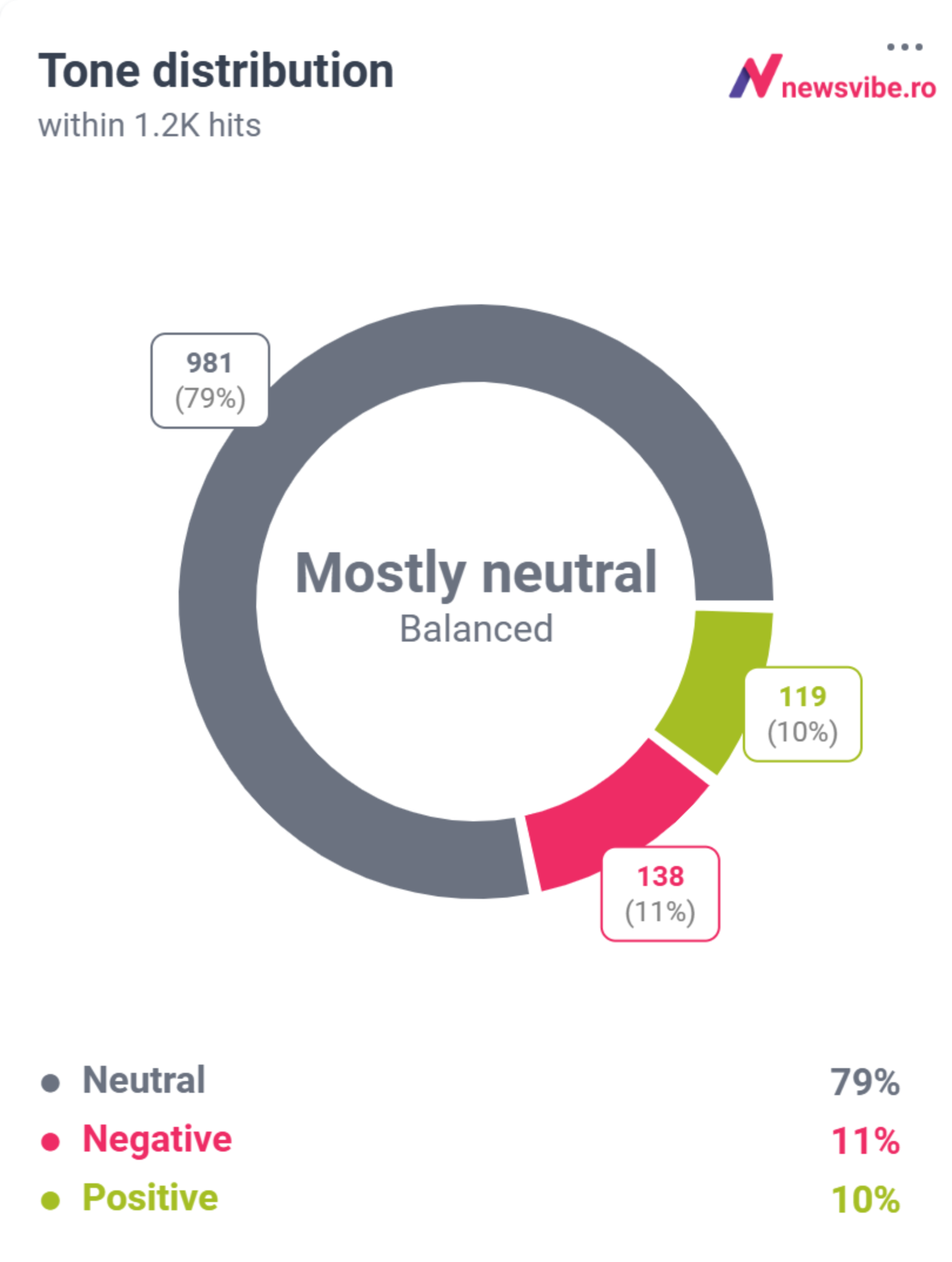
Graph: NewsVibe
****Summary created with the help of a data monitoring flow provided by the media monitoring platform NewsVibe Romania. The analysis, data, and images presented have been enhanced with the help of Machine Learning and Artificial Intelligence tools.
Latest News
07:42
07:42
07:21
07:18
07:09
See more news
NEWS ON THE SAME TOPICS