From "Trojan horse" to European pivot? What changes can we expect in Hungary from Péter Magyar after Orban's defeat and who are the possible key figures in the future government?


Always see our news on Google
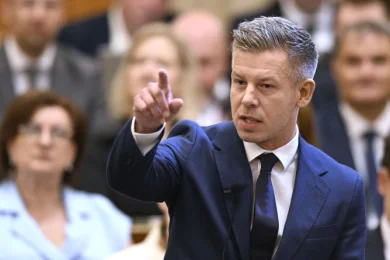
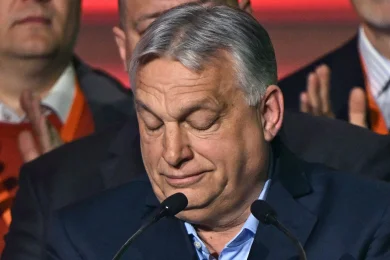
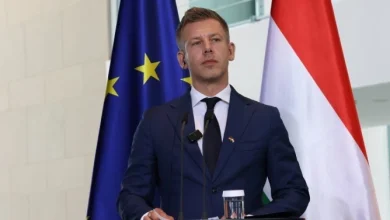
After 16 years of Viktor Orbán's dominance, the categorical victory of the Tisza party led by Péter Magyar has been described in the European press as "a moment of reset" not only for Hungary but also for the EU-NATO relationship. For many observers, the question is no longer whether the Orbán era has ended, but how deeply Magyar will dare to reshape a political, economic, and media system built precisely to prevent major changes.
Where does Magyar come from and what does he promise in place of Orbán's "liberalism"?
Péter Magyar is perceived by most analysts as a clear interruption of the "Orbán regime," but not as a total ideological break: the change is mainly in external orientation, governance style, and relationship with the rule of law, against the backdrop of moderate national conservatism, not a progressive turn.
It is noteworthy that Péter Magyar does not come from outside the system: he was an insider in the Fidesz ecosystem, with positions in administration and personal connections with the elites in Budapest, before positioning himself as an anti-corruption activist and advocate for "returning to Europe." Analyses from Al Jazeera and RFE/RL underline this dual identity: a right-wing conservative, but presenting his program as an alternative to Orbán's personalist authoritarianism.
Magyar's central discourse is that Hungary's problem is not conservatism as such, but systemic corruption, the capture of institutions, international isolation, and the "humiliation" of the country in front of Western partners. He presents himself as the leader who can offer a modern, pro-European right without abandoning references to nation, family, and order, which are so electorally useful to Orbán.
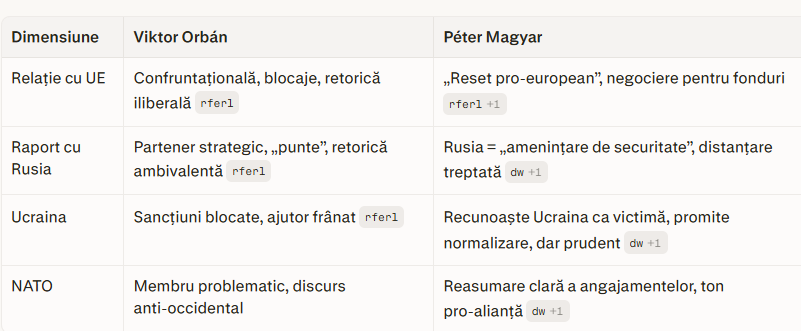
Orbán vs. Magyar: geopolitics and rule of law
Relationship with the EU and NATO
Here we see the clearest break. Politico, DW, and RFE/RL speak of the expectation of an "accelerated normalization" of the relationship with Brussels and NATO allies. Magyar promises to take Hungary out of the role of a state that permanently blocks major European files and to negotiate a package through which funds frozen on the grounds of the rule of law will be unlocked in exchange for verifiable reforms.
Russia and Ukraine
On the Russian file, Magyar has sent explicitly tougher messages: he accepts the architecture of sanctions, speaks of Russia as a security threat, and clarifies that Budapest will no longer play the role of the Kremlin's privileged intermediary in the EU. At the same time, he proposes a gradual decoupling from Russian energy, with a horizon of 2035 – a compromise between Western expectations and internal economic realities.
Regarding Ukraine, the new leader announces the intention to unlock financial and military support packages at the European level, conditioning political support on guarantees regarding the rights of the Hungarian minority in Transcarpathia. Thus, he formulates a pro-Western line, but with an emphasis on Hungarian interests, not a "take it or leave it" alignment.
Rule of law and anti-corruption
The theme of dismantling the "captured state" by the Fidesz network is the internal axis of Magyar's project. He promises:
limiting the prime minister's mandates;
strengthening the Court of Accounts and independent control mechanisms;
strengthening anti-corruption institutions;
revising the legal framework regarding media concentration and clientelist public funding.
Péter Krekó, director of the Political Capital think tank, warns, however, in an interview cited by DW, that rebuilding the rule of law in an environment where Fidesz has planted loyalists in all institutional nodes will be "a marathon, not a sprint." In other words, the intention is clear, but the ability to deliver it quickly depends on the balance of power within the state apparatus.
What remains the same: conservatism, migration, identity
Magyar does not propose a cultural revolution. He explicitly defines himself as a conservative leader, pro-family, pro-order, with a right-wing discourse compatible with the EPP or the moderate wing of the European right. In the sphere of values, it is unlikely that we will witness a spectacular progressive turn:
In the area of values, Péter Magyar and Tisza do not currently propose a radical break from the conservative architecture built by Fidesz: the party's program speaks of "expanding support policies for families" and measures for low incomes, without explicitly contesting existing pronatalist policies. On the LGBT and "gender" file, the difference is mainly seen in tone: Magyar criticized the Pride ban adopted by Parliament, saying it was used "to distract attention from the fact that Hungarians are suffering in the country" and promising that if he governs, he will protect the right to assemble. In his victory speech, he stated that Hungary should be a country "where no one is stigmatized for loving differently than the majority," marking a departure from the aggressive anti-LGBT rhetoric of the Orbán era. However, up to this point, neither Magyar nor Tisza have clearly announced the repeal of anti-LGBT "propaganda" laws or the anti-gender framework, and civil rights NGOs criticize them precisely for the absence of firm commitments in this direction.
The migration area is the most explicit line of continuity: Magyar indicated that he will maintain very strict border controls and reject mandatory relocation quotas, in order not to break the public consensus formed around the "fortress Hungary" on this issue.
Political scientists cited by Euronews and CEPA point out that this combination – pro-EU on geopolitics, but firmly conservative on identity – is designed precisely to maintain a bridge with Orbán's electorate and avoid an internal polarization of the "cultural war" type.
"The Magyar Government": who are the key people
Although the complete list of the Cabinet has not yet been officially announced, the Hungarian and European press has already outlined a core of future ministers and dignitaries around Péter Magyar. In Tisza's logic, the aim is to combine technocrats with a pro-European profile with new figures in politics, but with notoriety in business, civil society, or culture.
Anita Orbán – future foreign minister
Tisza officially presented Anita Orbán (without any family connection to Viktor Orbán) as the "designated foreign minister" even during the campaign, and the ECFR think tank cites her as the main voice of Hungary's post-Orbán western pivot.
She is an expert in energy and foreign policy, a former ambassador with special missions for energy security, with experience advising the European Parliament and the US Congress on V4 issues. She has held top positions in the private sector (including at Vodafone Hungary and Vodafone Global) and is a recurrent presence in Forbes' rankings of the most influential women in Hungarian business.
Her key message, quoted by ECFR: Hungary must "stop being the bad apple among the red spokes and become a spoke of the wheel." The information that Oana Țoiu has already held bilateral discussions with Anita Orbán also confirms through Romanian channels that she is perceived as the future interlocutor for foreign policy in Budapest, which sends a signal of institutional continuity and openness to a less conflictual dialogue with Bucharest.
István Kapitány – the architect of the Tisza economy
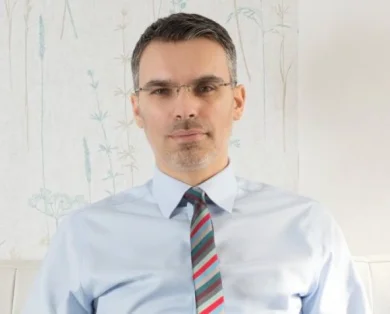
– A former high-ranking executive at Shell, István Kapitány was the first "designated minister" presented by Magyar, responsible for economy and energy. His profile is eminently technocratic and pro-business, with a focus on attracting investments, a gradual energy transition, and restoring Hungary's credibility in international markets after years of conflict with Brussels. His potential appointment signals that Magyar wants to quickly move away from the logic of "crony capitalism" formed around Fidesz oligarchs and reconnect the economy to Western capital, without breaking ties with Eastern investors.
Zsolt Hegedűs – favorite for Health
– Zsolt Hegedűs, a doctor and health policy expert, frequently appears in international press as the "leading candidate for health minister in a future Hungarian government." He became viral in post-election clips, dancing on stage at the Tisza victory celebration, but professionally he is presented as a specialist in healthcare system reform and combating corruption in medical procurement – a field strongly associated, during the Orbán era, with scandals and political favoritism.
Other names circulated in proximity to the Magyar government
The list of Tisza candidates also presents other figures likely to enter the cabinet or key positions:
Andrea Rost – internationally renowned soprano, placed in eligible positions, likely destined for a role in culture or cultural diplomacy.
László Gajdos – director of the zoo in Nyíregyháza, with a public manager profile, possibly appointed in the area of environment or regional development.
Ágnes Forsthoffer – vice president of Tisza, with a political organizer profile and background in social policies.
Márk Radnai and Zoltán Tarr – party vice presidents, rumored for portfolios related to public administration or institutional reform.
Kriszta Bódis – an expert in social policies, likely in line for a portfolio of labor or social protection.
Zoltán Tanács – responsible for developing the Tisza program, a candidate for coordinating government programming.
Romulusz Ruszin Szendi – former chief of staff of the army, a potential important actor in the defense area or national security advisor in a government that wants to rebuild NATO trust.
As far as the Hungarian, European press, and the NewsVibe monitoring application indicate so far, none of these potential ministers are directly associated with serious criminal cases or large-scale corruption investigations – in contrast to numerous Fidesz figures, symbols of Orbán's "crony capitalism."
However, the connection of some names, such as Anita Orbán, with the old pro-Euro-Atlantic area of Fidesz has sparked debates in the Hungarian press: for some analysts, this offers a guarantee of competence and diplomatic realism; for others, it risks maintaining suspicion of continuity with the old power networks.
What "Magyarism" looks like: Europeanized conservative right
If Orbán's Fidesz has come to be labeled as a model of "illiberal democracy" – with formally democratic institutions but with personalized control over justice, media, and economic resources – the Magyar project approaches what we might call a Europeanized conservative right: national in discourse, but pro-EU in strategic orientation, pragmatic in relation to NATO, and firm regarding the rule of law.
Three structural differences are recurrently highlighted by analysts:
The way power is exercised – From a regime built around a leader who modified the Constitution to consolidate his mandates, Magyar promises power rotation and clear term limits.
Geopolitical positioning – From the balancing act between Brussels and Moscow, with clear state tendencies creating blockages in the EU, to a conditional pro-Westernism based on national interests, but without systematic double-dealing.
Relationship with the EU – From permanent confrontation and using European funds as a resource for political patronage, to a "grand bargain" whereby European money becomes fuel for reforms and institutional reconstruction. At the same time, two elements of continuity are evident:
Social conservatism – Without a major turn towards cultural liberalism, which keeps Hungary among the Eastern European states with center-right agendas focused on traditional values.
Skepticism towards migration – Tough border policy, cautious rhetoric towards relocations, with a constant emphasis on security and identity.
Implications and risks
For the EU, NATO, and neighbors – including Romania – Magyar's coming is seen as an opportunity to transform Hungary from a "problem child" into a predictable partner, without expecting, however, a "liberal miracle." For Hungarian society, the stakes are whether the promise of dismantling the captured state can be delivered without generating a fierce counter-mobilization from the Fidesz networks, which remain strong in territory and media.
Experts like Péter Krekó draw attention to the fact that Magyar's success will depend on three factors:
the speed with which he can produce visible results (unblocked EU funds, economic growth, tempering inflation);
the ability to maintain the cohesion of an internal coalition that unites former Fidesz supporters, pro-European urban electorate, and some disappointed leftists;
the ability to manage the information war with Orbán's still powerful media apparatus.
In this context, "Magyarism" is shaping up more as an attempt to move Hungary from the gray area of illiberalism into a European conservative mainstream, rather than a direct leap into liberal progressivism; a fundamental change for the EU and NATO, but one that retains part of the cultural and identity DNA of the last two decades of Hungarian politics.
****Synthesis made with the help of a data monitoring flow provided by the NewsVibe Romania media monitoring platform. The analysis, data, and images presented have been enhanced with the help of Machine Learning and Artificial Intelligence tools
Latest News
20:00
19:54
19:25
19:19
19:10
See more news
NEWS ON THE SAME TOPICS