



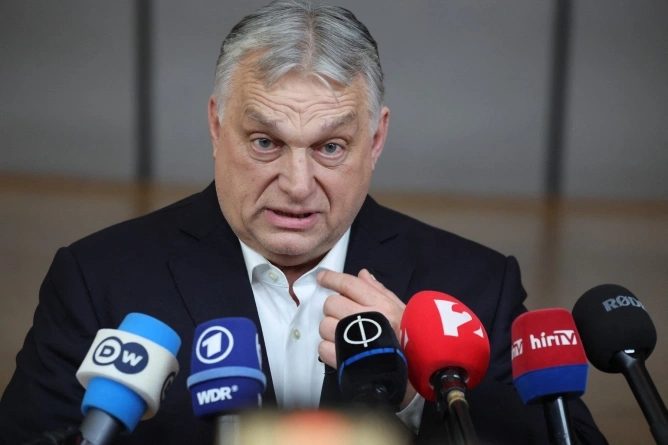
ANALYSIS The most recent opinion poll in Hungary shows for the first time a vulnerable Viktor Orban in the position of prime minister, ahead of the parliamentary elections in April.



Always see our news on Google
TISZA consolidates its lead in the most recent opinion polls regarding voting intentions for the parliamentary elections on April 12, while Fidesz clearly enters for the first time in the role of a challenger coming in second, against the backdrop of blockages with the EU and the sexual scandal "honey trap" targeting Péter Magyar, transformed by the opposition into an example of the regime's abuse of power.
According to the Medián poll conducted between February 18 and 23, TISZA is credited with 42% of voting intentions among the total population, while Fidesz stands at 31%. If we look only at decided voters, TISZA reaches 55%, up from 51% in January, while Fidesz drops to 35%, down from 39% last month.
What the new poll shows and how it compares to previous data
The latest data comes from a Medián poll in February, indicating an expansion of TISZA's lead over Fidesz, after TISZA was already ahead in January (40% vs. 33% in the total population).
An IDEA Intézet poll from February 6 placed TISZA at 48% in voting intentions for the parliamentary elections, compared to 38% for Fidesz–KDNP; DK and Mi Hazánk are at 5%, and MKKP at 3%, below the threshold, according to EuroNews.
Other institutes confirm the trend, but with varying degrees of TISZA's advantage.
Závecz Research measures voting intention at 49% for TISZA and 39% for Fidesz among certain voters, thus an advantage of about 10 percentage points. 21 Research Centre indicates a lead between 7 and 16 points for TISZA, depending on the segment (all respondents vs. certain voters).
However, there are also government-affiliated houses that reverse the picture. Nézőpont gave last week Fidesz ahead (46% vs. 40% TISZA), while the Centre for Fundamental Rights speaks of 49% Fidesz and 42% TISZA among decided voters.
In relation to previous polls
Compared to the end of 2025 and January 2026, the common trend of independent polls is:
Growth of TISZA: from an emerging challenger position to a clear leader in several metrics (a jump of a few percentage points in just a few months).
Erosion of Fidesz: loss of support among urban and educated voters, against the backdrop of economic stagnation and conflict with Brussels.
Government-affiliated institutes insist on the existence of a "latent reservoir" of 200,000–300,000 unmobilized Fidesz supporters, which could close the gap in the campaign. In contrast, TISZA is described as having an already "hyperactive" electorate, with little additional room for growth through mobilization. The context of the opinion poll that leaves Orban completely surpassed: Hungary's relationship with the EU and blockages
Hungary remains at the center of a prolonged confrontation with the EU regarding the rule of law, judicial independence, and the use of European funds. The Commission has withheld billions of euros, and a general advocate of the EU Court of Justice has recently recommended maintaining the annulment of some funding for Budapest, which exacerbates the budget deficit and prolongs economic stagnation.
Budapest continues to be the only member state subject to the rule of law conditionality mechanism, and the risk of total suspension of some funding flows remains real in the new budgetary framework. Domestically, the government has used emergency decrees to block actions in court by opposition municipalities in the dispute over the "solidarity tax," criticized as a new blow to the rule of law.
This combination – withholding EU funds, a frontal conflict with Brussels, and executive interventions against local authorities – fuels the perception of European isolation and abuse of power.
For TISZA, the central narrative is the promise of "normalization" of relations with the EU, unblocking funds, and re-anchoring Hungary on a "more western, less eastern" trajectory.
The sexual scandal targeting Péter Magyar
In February, Péter Magyar filed a criminal complaint, accusing the government of organizing a "honey trap" operation to compromise him politically. He claims that in August 2024 he was invited by a former lover to an apartment in Budapest, where a consensual sexual encounter was allegedly filmed clandestinely with "secret service means," without his consent. Magyar asserts that the material would be used for blackmail or for potential publication around the elections, directly accusing Orbán's circle of orchestrating the operation. He speaks of a practice "without precedent in Europe," in which the governing party would use intelligence methods to discredit the main political rival.
Legally, the complaint invokes "unauthorized collection of secret information" and "unauthorized use of a hidden device," both offenses under Hungarian law, plus the abusive use of personal data. Politically, the scandal has an ambivalent effect: Fidesz tries to strike at Magyar's moral credibility, while TISZA transforms him into an emblematic proof of the "captured state" and the intrusion of politics into private life.
How the polls, the EU, and the Magyar scandal are connected
TISZA's advance in independent polls comes against the backdrop of social fatigue regarding the ongoing conflict with the EU and the economic costs of withholding funds.
The blockages with Brussels and the use of emergency decrees strengthen the opposition's narrative regarding the erosion of the rule of law and the need for a change of power.
The sexual scandal does not seem, so far, to have undermined support for TISZA; on the contrary, Magyar manages to reframe it as an example of abuse by the security apparatus by the power.
Overall, the new wave of polls suggests that for the first time since 2010, the scenario of a "post-Orbán" becomes credible, yet the outcome remains open, given the gap between the metrics of independent institutes and those close to Fidesz and the existence of a significant pool of undecided or unmobilized voters.
Why the EU fears excessive pressure now against Viktor Orban's Hungary
Currently, the EU is seeking a way out of the blockage created by Budapest over the 90 billion euro package for Ukraine and, more generally, from Hungary's repeated vetoes on key issues. European officials cited by Politico (picked up by European Pravda) and sources from the Commission explicitly speak about the risk that "pressuring Orbán during the campaign may not be the smartest move."
The main reasons for this caution:
Orbán has built a victimizing narrative: he presents himself as the leader defending Hungary from "the bureaucrats in Brussels" and from "impositions" regarding the war, migration, LGBTIQ rights, etc.; any new procedure or sanction is immediately recycled into a campaign message.
The Commission and some capitals fear that a visible escalation (new infringement procedures, further cuts in funds, threats to voting rights) would provide additional campaign material and could strengthen the mobilization of the pro-Fidesz core, instead of eroding it.
There is concern that a tough confrontation right now would be perceived internally as direct interference by the EU in the elections, potentially delegitimizing in the eyes of a part of the electorate a favorable outcome for TISZA ("they won with Brussels' help").
Therefore, according to sources from Brussels, sensitive files related to Hungary - from some funding tranches to certain investigations (for example, regarding the Pegasus scandal targeting the use of Israeli software to spy on journalists and political rivals) - are practically "frozen" until after April 12, precisely to avoid being played by Orbán.
Read also:
SPECIAL Informat.ro: Orbán vs. Magyar in 2026: two opposing scenarios for Hungary's future
Synthesis made with the help of a data monitoring flow provided by the media monitoring platform NewsVibe Romania. The analysis presented has been enhanced with the help of Machine Learning and Artificial Intelligence tools.
Latest News
15:58
15:54
15:51
15:45
15:43
See more news
NEWS ON THE SAME TOPICS















.webp)


