Why the Paris Agreement Remains Binding After the Failure of the General COP31 Pact



Always see our news on Google
The lack of a general political agreement in Antalya does not suspend the climate treaty, national plans, or emissions reporting. However, the sectoral decisions adopted and voluntary commitments have different effects, and a promise of cooperation does not automatically make funds available to beneficiaries.
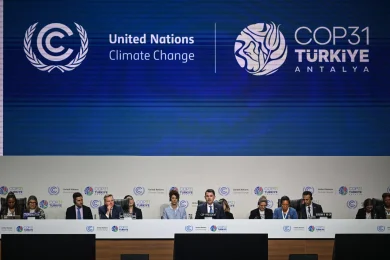
The failure of the general pact at COP31 did not annul the Paris Agreement. In Antalya, a political negotiation ended without consensus, while the treaty organizing climate cooperation remained in force. To understand what governments must do next, the treaty’s obligations, the decisions adopted to implement it, and the initiatives to which countries join voluntarily must be distinguished.
Key points
1-The Paris Agreement does not need annual reconfirmation. Its objectives and the parties’ obligations continue; withdrawal from the treaty follows a procedure distinct from blocking a text at a conference.
2-Parties must prepare, communicate, and maintain nationally determined contributions and take domestic measures to achieve them. Contributions are communicated every five years; the treaty does not impose the same emissions-reduction percentage on everyone.
3-Reporting and verification of progress continue. The agreement’s Implementation and Compliance Committee may identify problems and recommend solutions, but it is not an enforcement mechanism for imposing sanctions.
4-COP31 also adopted decisions distinct from the general pact. However, a timeline for operationalizing a mechanism does not mean that it is already fully functional, just as a voluntary global target does not automatically become an identical obligation for each participant.
The Paris Agreement is a binding international treaty that entered into force on 4 November 2016. It seeks to hold the increase in the global average temperature to well below 2°C above pre-industrial levels and to pursue efforts to limit it to 1.5°C. These objectives do not disappear when a conference fails to agree on a new pact.
The British Government stated, after the close of COP31, that the Paris Agreement and existing commitments remain valid. The treaty allows a party to notify its withdrawal after three years from the date the treaty entered into force for that party. Withdrawal takes effect one year after the depositary receives the notification or on a later date indicated in it. The rejection of a draft decision in Antalya does not trigger this procedure.
Document type ┃What effect does it have after COP31
Paris Agreement ┃The treaty and its obligations continue.
General pact of Antalya ┃The draft did not obtain consensus and did not become the conference’s collective political outcome.
Adopted sectoral decisions ┃They apply according to their content, the authority of the body that adopted them, and the stages provided for.
Voluntary commitments┃They express the participants’ intentions; by simply joining, they do not create the same legal obligation for all countries.
Nationally determined contributions, called NDCs, are the plans through which parties present their climate efforts. Article 4 requires their preparation, communication, and maintenance, as well as the taking of domestic emissions-reduction measures to achieve the objectives undertaken. They are communicated every five years. Successive contributions must represent progress and reflect the highest possible level of ambition, taking into account different responsibilities and capabilities.
The obligation to submit a plan and act on it should not be confused with an international legal guarantee that every announced percentage will be achieved. This does not make the plans optional. In addition, certain objectives may become obligations of result under national or European legislation.
Biennial transparency reports show emissions and progress in implementing contributions. The general rule is that they are submitted every two years, with flexibilities for developing countries that need them. Least developed countries and small island developing States may submit these reports at their discretion. The information is examined by experts, and progress is discussed in a multilateral process; the assessment does not rewrite the level of ambition chosen through the national contribution.
The Implementation and Compliance Committee may intervene, for example, when a party has not communicated or maintained its contribution or has not submitted mandatory information. Its mandate is facilitative, not punitive. It may make recommendations and help identify solutions, taking into account the country’s capabilities and circumstances.
The list of the United Nations Framework Convention on Climate Change (UNFCCC) confirms that separate decisions from the general pact were adopted at COP31. Some belong to the meeting of the parties to the Paris Agreement, called the CMA. They may organize the implementation of the treaty within the limits of its mandate; they are not all new treaties, nor are they merely voluntary declarations.
The just transition mechanism illustrates the difference between adoption and operation. The decision provides for phased operationalization, and its functions and working methods are to be developed in 2027. Secretariat actions are conditional on available financial resources. The existence of the decision is not equivalent to the immediate opening of a fund from which workers or communities can request money.
The “35-by-35” commitment aims for electricity to account for 35% of final energy consumption worldwide by 2035. The text defines it as a global objective and leaves each participant authority over its own policies, plans, and strategies. Countries have different starting points and rates of electrification.
This type of initiative can support investment and cooperation outside the negotiation of the general pact. However, it does not automatically assign each state a mandatory 35% share, and its endorsement does not prove that the announced investments have already been financed or carried out.
In the European Union, climate neutrality by 2050 is a binding objective established by the European Climate Law. It concerns the Union as a whole, and the EU institutions and Member States must take the necessary measures. Its basis is European legislation, which continues to apply independently of the outcome of the Antalya pact. Changing these rules requires the competent legal procedures, not simply the absence of an agreement at COP.
Latest News
19:47
19:32
19:18
19:08
18:54
See more news
NEWS ON THE SAME TOPICS