The EU and 77 states from Africa, the Caribbean and the Pacific set six common priorities for COP31 negotiations



Always see our news on Google
Partners are calling for simpler access to climate finance, clean electrification and adaptation measures for vulnerable countries. The declaration supports the transition away from fossil fuels and the collective goal of at least 300 billion dollars annually by 2035, without allocating new funds.
The European Union, its 27 member states and 77 partners from Africa, the Caribbean and the Pacific have agreed on six priorities for climate cooperation, ranging from adaptation and finance to electrification and ocean protection. The joint declaration, published by the Council of the EU on 9 November, on the day COP31 opened in Antalya, calls for commitments to be transformed into investments and projects, with support for the most vulnerable countries. The partners reaffirm the goal of limiting warming to 1.5°C and support the transition away from fossil fuels, but the document does not announce any new financial allocations.
In brief
1.The partnership between the EU and the Organization of African, Caribbean and Pacific States (OACPS) brings together 104 countries. The joint declaration sets out six areas: adaptation, climate finance, clean electrification, data and scientific capacities, the resilience of food systems and ecosystems, and ocean governance.
2.The partners support the collective goal of at least 300 billion dollars annually by 2035 for developing countries, with developed countries in a leading role and voluntary contributions from developing countries. They also support efforts to triple adaptation finance by 2035; these are not new funds allocated through the declaration.
3.Access to grants, highly concessional finance and loss-and-damage funds should be simplified for vulnerable countries. Direct access through national and regional institutions, guarantees and investments that do not compromise debt sustainability are supported.
4.Electrification is explicitly linked to a just, orderly and equitable transition away from fossil fuels. Cooperation would cover renewables, low-emission energy, storage, energy efficiency, interconnections and local solutions.
5.The document proposes using Copernicus data for early warning and investment planning, support for agriculture and water, and better coordination between climate and ocean policies. It is a political position of the partners, not an outcome already adopted at COP31.
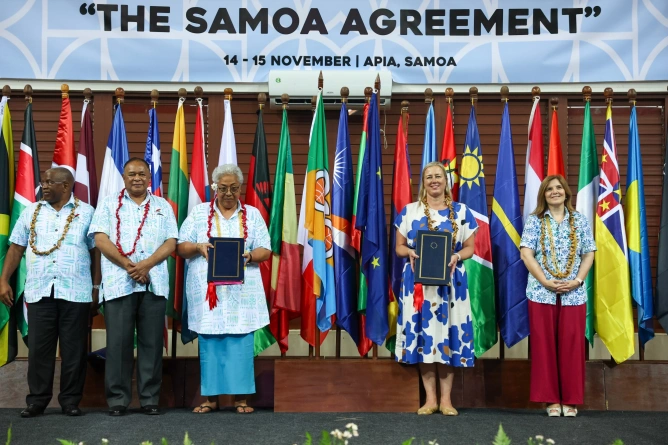
The declaration, entitled Towards COP31 and beyond: from priorities to delivery, forms part of the partnership established by the Samoa Agreement. The 104 countries represent approximately two billion people and more than half of UN members, according to the Council. Their coordination seeks to advance both climate negotiations and the projects through which international commitments can be implemented.
The agreed text, dated 6 November, calls for deep, rapid and sustained emissions reductions and ambitious, science-based national contributions. The partners warn that exceeding the 1.5°C threshold risks irreversible consequences for small island states. They call for limiting both the scale and duration of the overshoot and returning to a trajectory compatible with this objective.
Finance is one of the central stakes. The declaration supports the collective goal of mobilizing at least 300 billion dollars annually by 2035 for developing countries, with developed countries in a leading role and with the participation of all actors able to contribute, including voluntary participation by developing countries. Resources would come from public and private, bilateral and multilateral sources. This is not a fund established through the declaration or contributions apportioned among the 104 partners. The document also supports efforts to triple adaptation finance by 2035.
For the most vulnerable countries, the partners emphasize grants and highly concessional finance. They call for simplified access to climate funds, including direct access through national and regional entities and faster accreditation. They support new contributions and the full operation of the loss-and-damage fund. The declaration also proposes guarantees, risk-sharing and the combination of public and private resources, while protecting debt sustainability. The Global Gateway and Team Europe initiatives are identified as instruments for mobilizing investment.
In the area of adaptation, cooperation would support the development and implementation of national plans, project preparation and vulnerability assessments. This includes mountain ecosystems, transboundary river basins and oceans, as well as landscape restoration and afforestation compatible with sustainable forest management. The aim is for the priorities identified by each country to become funded and implemented programs, including through private investment where appropriate.
The energy priority links clean electrification to a just, orderly and equitable transition away from fossil fuels. The partners support the development of renewable and low-emission energy, grid connectivity and flexibility, storage and energy efficiency. Cooperation would include cross-border interconnections, mini-grids, community-based solutions and clean cooking technologies. The document also links investment to energy access, skills, decent jobs and local economic opportunities.
Climate data and institutional capacity form another area of focus. The partners want to use tools such as Copernicus for risk assessment, early warning, resilience planning and investment decisions. The declaration mentions initiatives for early warning in Africa and EU–Caribbean cooperation on Copernicus services. It provides for support for emissions inventories and tracking the implementation of national contributions, alongside research, technology and training.
The resilience of food systems, water and ecosystems is addressed through concrete measures: climate-smart agriculture, drought-resilient irrigation, agroforestry, sustainable fisheries and coastal management. The partners also support halting and reversing deforestation and forest degradation by 2030. For vulnerable communities, these measures aim to protect food, water and income sources in the face of climate risks.
International ocean governance completes the six priorities. The declaration calls for better integration of the ocean–climate nexus into national contributions, adaptation plans and finance. It also supports the ability of states to maintain their established maritime zones in accordance with the UN Convention on the Law of the Sea, despite physical changes caused by sea-level rise. This position is particularly relevant for island states.
The Samoa Agreement, signed on 15 November 2023 and provisionally applied from 1 January 2024, provides the general political and legal framework for EU–OACPS relations. Cooperation also covers human rights, peace and security, sustainable development and joint action in international organizations. The six climate priorities in the new declaration should not be confused with the agreement’s broader areas.
COP31 is taking place in Antalya from 9 to 20 November. The EU–OACPS declaration is a joint political position for the conference and subsequent cooperation; it does not amend the Paris Agreement, establish new national contributions or constitute a negotiating outcome already adopted. Implementing the priorities will depend on the projects, financing and partnerships that states and institutions put into practice.
Sources


Latest News
15:43
15:38
15:29
15:26
15:24
See more news
NEWS ON THE SAME TOPICS