ANALYSIS The Mecca Pact: between discouraging Iran, American uncertainty, and the regional atmosphere



Always see our news on Google
Saudi Arabia, Turkey, and Pakistan have created a defense alliance with a solidarity clause inspired by Article 5 of NATO, at a time when drone and missile attacks, Iranian-Israeli rivalry, and uncertainty regarding American commitment are pushing regional states to build their own security guarantees. The agreement could become the core of a new strategic architecture — but also an additional source of tension and miscalculations.
An alliance born from insecurity
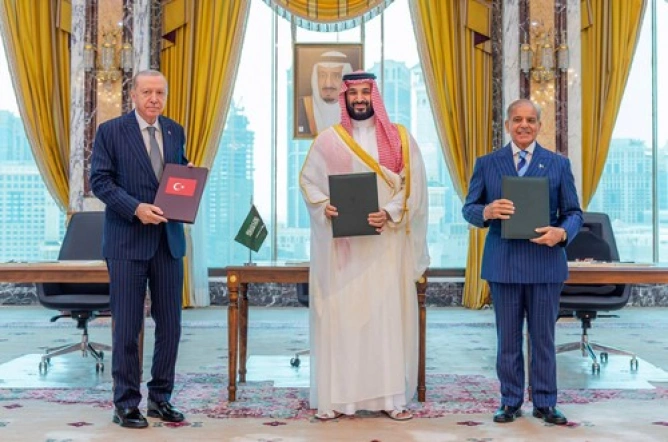
The joint defense agreement signed in Mecca by Saudi Arabia, Turkey, and Pakistan stipulates that an armed attack against one of the three states will be considered an attack against all. The formula recalls Article 5 of the North Atlantic Treaty, but the essential difference is that the document does not seem to automatically establish the type of military response that each signatory must provide.
The emergence of the pact must be understood against the backdrop of the deteriorating regional security environment. Gulf states face threats from ballistic missiles, drones, attacks on energy infrastructure, and actions by groups allied with or supported by Iran. At the same time, the intensification of the confrontation between Iran and Israel has shown that states in the region can quickly become theaters or collateral victims of an escalation they do not control.
For these countries, the issue is not just the existence of threats, but also the effectiveness of external guarantees. In recent years, the United States' regional partners have begun to wonder whether Washington will always intervene quickly and decisively to defend their territories. The Mecca alliance is thus both a deterrent tool and a policy against strategic uncertainty.
The stakes for the three signatories
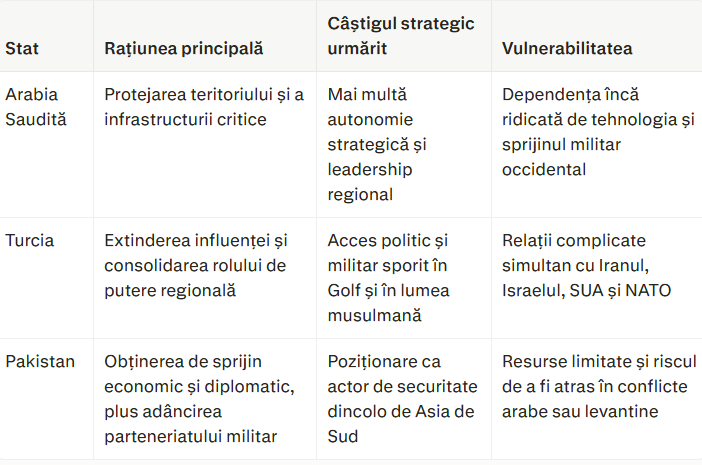 For Riyadh, the pact offers a way to reduce dependence on a single protector. Saudi Arabia can diversify its security relationships, gain access to new military capabilities, and project the image of a power capable of organizing regional stability, not just demanding it from Washington.
Turkey pursues a combination of objectives. Ankara is strengthening its role as an indispensable actor in the Muslim world, expanding its political presence in the Gulf, and leveraging its defense industry, including experience in drones, electronic warfare, and air defense. Participation in the pact also allows it to present itself as one of the centers of a more autonomous regional order vis-à-vis the West.
For Pakistan, the agreement opens an opportunity to transform its traditional relationship with Saudi Arabia into a more institutionalized and broader partnership. Islamabad can benefit from military cooperation, joint exercises, information exchange, and potential industrial projects, while also raising its diplomatic profile in a region vital to its economy and security.
Why air defense matters
One of the most important lessons from recent conflicts in the Middle East is that classic air superiority is no longer sufficient. Ballistic missiles, cruise missiles, cheap drones, and saturation attacks can overwhelm even the defense systems of wealthy states equipped with modern weaponry.
In this context, any credible alliance must go beyond political statements. It needs:
compatible detection and command systems;
rapid exchange of radar data and information;
common procedures for warning the population and protecting infrastructure;
coordinated stocks of interceptors;
regular military exercises;
clear plans for drone, missile, or cyber attacks.
NATO's experience shows that integrated defense means not only acquiring high-performance systems but also building a common network of command, communication, doctrine, and training. Analyses of NATO's preparedness for air and missile threats highlight this dimension: effectiveness depends on the integration of capabilities, not just their mere existence.
Here lies one of the limitations of the Mecca pact. The three states have significant armies, but they have different geographies, priorities, and technological levels. Turkey has a significant defense industrial base, Saudi Arabia has financial resources and access to Western equipment, and Pakistan has strategic and military experience, but the effective interconnection of these capabilities will require time, money, and political will.
Iran and Israel, the absent presences
Although the signatories assert that the agreement is defensive in nature and does not target any specific country, the pact is inevitably read through the lens of rivalries with Iran and Israel. Any mechanism that brings together Saudi Arabia, Turkey, and Pakistan into a collective defense structure changes how Tehran and Jerusalem calculate risks.
For Iran, the alliance may seem like an attempt to limit its regional influence and create a counterbalance to its networks of partners and allied organizations. However, Tehran might avoid a direct military reaction and prefer diplomatic pressure, indirect operations, information warfare, or strengthening ties with states and groups that contest the new bloc.
For Israel, the situation is more ambivalent. On one hand, a regional alliance capable of limiting Iran could serve Israeli interests. On the other hand, the inclusion of Turkey and Pakistan — two states with distinct political positions towards Israel — could create a military structure that complicates Israeli freedom of action and diminishes the role of Washington-supported cooperation formats.
The pact does not automatically produce an anti-Israeli or anti-Iranian alliance. However, in security policy, perceptions matter almost as much as legal formulations. If adversaries believe that the new structure restricts their options, they may react preemptively, increasing the risk of a spiral of deterrence and counter-deterrence.
A more multipolar regional order
The agreement reflects the shift in the Middle East from rigid alliances to flexible networks of partnerships. States no longer seem willing to choose a single protector and subordinate their entire foreign policy to an axis. Saudi Arabia, for example, can maintain cooperation with the United States, dialogue with China, and relations with other powers while adding the Mecca pact to its security portfolio.
This multipolarity can have advantages. It offers regional states more maneuvering freedom, reduces the monopoly of a single power over security, and can encourage the development of local mechanisms for dialogue and crisis management. Recent analyses of Gulf security describe this period as a possible turning point, in which regional actors seek to take on a greater share of responsibility for their own defense.
But multipolarity can also produce instability. The more overlapping agreements exist, the harder it becomes to anticipate who will intervene, under what conditions, and against whom. A network of partnerships without transparent rules can generate rivalries, contradictory interpretations, and competition for influence.
NATO or just a promise?
The comparison to NATO is politically strong but must be treated with caution. NATO is the result of decades of institutionalization, military standardization, joint planning, exercises, command structures, and repeated political commitments. The Mecca pact is, at least at this stage, a trilateral agreement whose enforcement mechanism remains less clear.
Its credibility will depend on a few concrete questions:
What exactly does "attack" mean and how will responsibility be established?
Is consensus among all necessary for a common response?
What types of support are mandatory: military, logistical, informational, or diplomatic?
How will the alliance function if one of the signatories is attacked by a non-state actor?
What happens if the interests of the three governments do not align?
How will the relationship with the United States and NATO be managed?
If the answers remain ambiguous, the pact will mainly function as a political signal. If followed by common structures, budgets, exercises, and operational procedures, it could become a real mechanism for collective defense.
Global consequences
For Washington, the emergence of the pact is simultaneously a problem and an opportunity. It is a problem because it indicates partners' dissatisfaction with the limits of American guarantees and could reduce U.S. influence over the regional security architecture. It is an opportunity because partner states are taking on a greater share of defense costs, reducing pressure on the American military.
However, the United States will need to decide whether to support, integrate, or limit the new construction. American support could transform the pact into a regional complement to the existing alliance system. Distancing, on the other hand, would accelerate the strategic autonomy of states in the region and could push Ankara, Riyadh, and Islamabad towards more intense cooperation with China or other powers.
For Europeans, including Romania, the evolution has indirectly relevant but important implications. An extended crisis in the Gulf or in the vicinity of Iran could affect energy prices, maritime transport, supply chains, and migratory pressure on Europe. Additionally, any transformation of the relationship between Turkey and its regional partners has implications for NATO and the security of the southeastern flank.
Three scenarios
Gradual consolidation
In the optimistic scenario, the pact develops into a practical cooperation structure. States create common command centers, exchange radar data, organize exercises, and establish response procedures for drone and missile attacks. The alliance would become a deterrent tool and could reduce the temptation of actors to test the vulnerabilities of one of the signatories.
Political bloc without operational force
In an intermediate scenario, the agreement remains a symbol of solidarity but does not produce deep military integration. Differences between the priorities of the three states, high costs, and fears of escalation limit cooperation. The pact would count diplomatically, but would not provide the same certainty as a mature military alliance.
Escalation and rival blocks
In the negative scenario, Iran or Israel interprets the alliance as a direct threat, and a regional incident activates the political obligations of the pact. If one of the signatories is attacked or if a non-state actor launches a major operation, the lack of clear rules could lead to disputes over the appropriate response. Instead of stabilizing the region, the pact could contribute to the formation of antagonistic blocks.
The real stake
The Mecca pact should not be evaluated solely by the question of whether it will become the "NATO of the Middle East." The more important question is whether Saudi Arabia, Turkey, and Pakistan can transform a reaction to insecurity into an institution capable of managing crises, not just promising retaliation.
The agreement marks a directional change: regional states are trying to no longer be mere objects of competition between the United States, Iran, Israel, Russia, and China. They want to become architects of their own security. The outcome could be a more autonomous and balanced region — or one in which overlapping alliances make each crisis harder to control.
For now, the pact is more the beginning of an architecture than a finished structure. Its strength will be measured not by the solemnity of the signing in Mecca, but by what will happen at the first real attack.
Analysis conducted with the support of Perplexity
Latest News
23:08
22:58
22:57
22:55
22:54
See more news
NEWS ON THE SAME TOPICS

 în Kidal, la 26 aprilie 2026 FOTO AFP AFP Profimedia.webp)