ANALYSIS How the war in Iran redraws Romania's security map between Deveselu, the Strait of Hormuz, and the new Cold War



Always see our news on Google
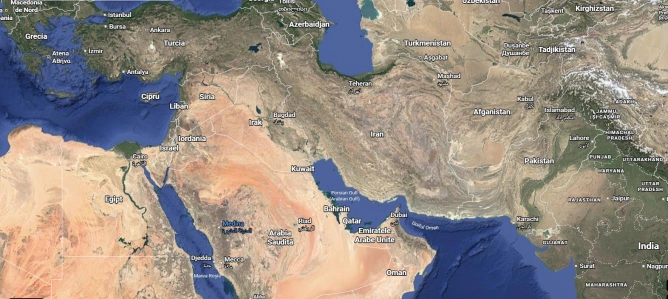
The war in Iran has become the central node of a system reconfiguration: it connects the competition of great powers, the fragility of the global energy order, the future of the Middle East, and the political and military resources of the West in relation to Ukraine and the Indo-Pacific. Beyond tactical strikes, the strategic stake is whether Iran will remain a pillar of a pro-Russia/China "multipolar" order or enter a phase of collapse/transformation that could redraw the balance in Eurasia, the Persian Gulf, and the extended Mediterranean.
The stakes of the war in Iran in the architecture of global conflict
The US and Israel have shifted from deterrence to a campaign of "decapitation" of the leadership and massive degradation of Iranian military and nuclear infrastructure, transforming the conflict from a shadow war into an open high-intensity war.
Iran's response – missile and drone attacks on targets in the region and the use of the proxy network (Hezbollah, Iraqi militias, Yemenis, etc.) – has regionalized the conflict, directly putting at risk the security of the Gulf, energy routes, and the stability of neighboring states.
The collapse of the regime or a prolonged war could produce a "Syria effect on a larger scale": internal fragmentation, wars between factions, waves of refugees towards Turkey, the Persian Gulf, and Europe, plus a power vacuum exploited by state and non-state actors.
The interests and objectives of the US
The US simultaneously seeks: the neutralization of Iranian nuclear and ballistic capabilities, a drastic reduction of Tehran's influence in the Levant and the Persian Gulf, securing Israel, and maintaining control over the main maritime energy corridors (especially the Strait of Hormuz).
In the medium term, Washington wants to prevent Iran from remaining a "strategic platform" for Russia and China, connecting them infrastructurally (INSTC, Belt and Road) and energetically outside the Western-dominated system.
In the long term, the stake is the architecture of the global order: if the US demonstrates that it can win and manage a new war in the Middle East without abandoning Ukraine and the Indo-Pacific, and strengthens its credibility as a security guarantor; if not, Russia and China can argue that the Western order is overstretched and in decline.
Example of a strategic collateral effect: the diplomatic, military, and political attention resources dedicated to Iran reduce Washington's maneuvering room in negotiations regarding Ukraine, where Moscow bets on the exhaustion of the West and on US "strategic fatigue."
The interests of Europe
Europe is primarily exposed through energy, migration, and strategic proximity: any prolonged blockage in the Strait of Hormuz or attacks on Gulf infrastructure could generate price shocks and recession, and a destabilized Iran would fuel new flows of refugees and radicalization networks.
European states, as a whole, remain aligned with the US and Israel politically, but seek to limit escalation, insisting on a ceasefire, civilian protection, and the role of the UN, precisely to avoid a new "endless conflict" at their borders.
In the medium and long term, Europe wants: to maintain NATO cohesion and the capacity to simultaneously support Ukraine and the southern front; to reduce dependence on Gulf energy and flows through Hormuz, accelerating the energy transition and diversifying supply; to avoid the emergence of a new arc of failed states between the Mediterranean and the Caspian Sea.
The interests of Russia
Russia sees Iran as one of the last bastions against "Western hegemony" in Eurasia and as a key partner for a multipolar order, including through military cooperation (Iranian drones in Ukraine) and through North-South trade corridors.
In the medium term, Moscow wants the Iranian regime to survive strong enough to: continue arms and ammunition deliveries to Russia; keep Western strategic resources occupied in the Middle East, thus reducing the intensity of support for Ukraine.
In the long term, Russia aims to strengthen an Eurasian axis with Iran and China, which would offer them alternative export routes (Iranian ports in the Persian Gulf, INSTC) and a platform for projecting influence in the Levant and South Asia. At the same time, a completely collapsed Iran would be a major risk: refugee flows to the Caucasus and Central Asia and the loss of a strategic ally against the West.
The interests of China
China has a fundamental interest in the stability of Iran for energy security: a significant portion of its oil imports comes from Iran, often at reduced prices, through mechanisms that bypass the Western financial system.
Beijing has integrated Iran into the Belt and Road architecture and into long-term strategic agreements, being interested in land and maritime corridors that reduce dependence on US-controlled routes.
In the medium term, China seeks to: avoid a collapse of Iran that would destabilize the Gulf and raise energy prices; present itself as a "responsible" mediator capable of discussing with all parties (Iran, Gulf monarchs, Israel), thus enhancing its global image.
In the long term, Beijing wants a Middle East sufficiently stable for trade and investment, but sufficiently geopolitically fragmented to reduce local regimes' dependence on Washington and increase their openness to Chinese capital and technology.
The interests of Middle Eastern states
The Gulf monarchies (Saudi Arabia, UAE, Qatar, etc.) find themselves in an ambivalent position: they fear Iran and its proxy network, but they fear just as much a chaotic collapse of the Islamic Republic that would plunge the region into widespread conflict, with bombing of energy infrastructure and massive flows of refugees.
After the wave of Iranian attacks on Gulf targets, these states must choose between neutrality and more active involvement alongside the US/Israel, risking becoming officially "belligerent" and legitimate targets for Tehran.
Israel seeks to take advantage of the moment to significantly degrade Iran's military and nuclear capabilities and to weaken the proxy network (especially Hezbollah), considering that a strong and nuclear Iran would irreversibly change the regional balance of power.
Turkey views the conflict through the lens of internal security and its role as a regional power: it fears a wave of Iranian refugees and a power vacuum at its border, and sources already indicate plans for buffer zones and refugee camps at the border. At the same time, Ankara wants to maximize its role as a mediator and energy hub between East and West.
Where Romania stands and what interests it has
Romania, as an EU state and NATO member, has aligned with the Western position: political support for the US and Israel, calls for de-escalation and civilian protection, plus support for the Iranian people's right to decide their future.
The main interests of Romania are:
energy and economic security: avoiding a major energy price shock that would hit an economy already affected by the war in Ukraine and inflation;
regional security: preventing an additional wave of instability that, combined with the Russo-Ukrainian conflict, could strain NATO's eastern flank and the Black Sea;
maintaining Euro-Atlantic solidarity and maximizing Romania's role as a "logistical platform" and security for NATO operations and for the reconstruction of Ukraine.
In the medium term, Bucharest aims to strengthen its profile as a loyal ally of the US, capable of contributing to operations and security in the extended neighborhood, and to leverage its geographical position for alternative logistical flows in case of prolonged disruptions in the Middle East (corridors via the Black Sea and the Balkans).
Predictable scenarios for evolution and conclusion
Imposed ceasefire and "isolation" of the conflict
Under the pressure of economic costs and escalation risks, great powers (US, EU, China, Russia) converge towards a negotiated ceasefire, with security guarantees for Israel, strict limitations on the Iranian nuclear program, and a calibrated sanctions regime, but without immediate regime change.
This would result in a militarily and economically weakened Iran, with reduced regional influence, but still functional, and with a fragile regional order, based on balances of power and increased Western military presence in the Gulf.
Prolonged war with internal fragmentation in Iran
Repeated strikes and internal succession struggles after Khamenei's death lead to the fragmentation of power centers, the emergence of ethnic/political enclaves (Kurds, Baluchis, etc.) and an internal conflict of the "Syria plus" type.
The region would be flooded with refugees, smuggling networks, and armed groups, while great powers would operate through proxies to control portions of territory or strategic corridors; the Gulf would remain in a state of semi-war, with a constant risk of attack on energy infrastructure.
Controlled regime change or negotiated transition
Under the combined pressure of sanctions, military strikes, and internal protests, part of the Iranian elite may accept a negotiated transition – either through the emergence of a new, more pragmatic leadership or through constitutional reforms under international mediation.
In this scenario, Iran could remain an Islamic republic, but with a less aggressive foreign policy, paving the way for a gradual reintegration into the global economic system, with massive investments promised by Europe and Asia in exchange for abandoning military nuclear ambitions.
Major regional escalation
If Iran decides to "drag the region after it" – through prolonged blockage of the Strait of Hormuz, massive strikes on Gulf energy infrastructure, and maximum activation of proxies against Israel and US bases – the conflict could degenerate into a regional war involving direct participation from several Arab states.
This scenario would trigger a global energy shock, push Europe into recession, and force the US to choose between resources dedicated to Iran, Ukraine, and deterring China in the Indo-Pacific, with direct consequences for its global credibility.
Romania stands to gain the most from a relatively controlled isolation of the conflict and to lose the most from a major regional escalation, which would simultaneously amplify energy, security, and migration crises in its immediate neighborhood.
Analysis conducted with the support of Perplexity
Latest News
21:05
20:53
20:50
20:40
20:34
See more news
NEWS ON THE SAME TOPICS