ANALYSIS What Romania would gain and what it would lose if it accepted the US request to become a "gateway" to Iran



Always see our news on Google
Romania is about to decide whether to transform the Mihail Kogălniceanu base into a European link in an American military campaign in the Middle East. A potential green light from the CSAT for the temporary deployment of fighter jets and American troops, in the context of the war with Iran, would bring clear security gains and political capital in relation to Washington, but would also amplify the risks of the country being perceived as a legitimate target in the logic of Iranian reprisals and asymmetric attacks.
According to G4Media, discussions have started informally, but come against the backdrop of the long-standing interest of the US to use Kogălniceanu for potential interventions in the Middle East, after the base was already discreetly used in the "Midnight Hammer" operation in June 2025 against Iranian nuclear facilities.
Lessons from other bases: Cyprus, Turkey, and the European model
Recent experience in Cyprus and Turkey shows that NATO or Western bases automatically become targets in the logic of Iranian reprisals or nearby actors (militias, proxies, affiliated groups).
The British base Akrotiri in Cyprus has been targeted by drone and missile attacks from Iran, in a context where London has provided infrastructure for the US for "specific defensive operations", and the pressure on this infrastructure has intensified as it has been used for airstrikes.
In the same vein, the American base at Incirlik (Turkey) has previously been explicitly included in the rhetoric and retaliation scenarios of Tehran and allied groups, even though Ankara has strictly calibrated the way it allows the use of its infrastructure. Additionally, two missiles entered Turkish airspace last week and were destroyed by NATO.
In Europe, reactions are divergent: Germany has stated, through Vice Chancellor Lars Klingbeil, that "we will not participate in this war", expressing doubts about the compatibility of the campaign with international law and rejecting direct military involvement. France, through Emmanuel Macron, has stated that "it will not get involved in this war" against Iran, limiting itself to defending its citizens and allies, without offensive engagement.
However, the United Kingdom has made military bases available to the US for defense missions, while Italy has announced the deployment of air defense capabilities in the Gulf and has mobilized a ship towards Cyprus, but with the explicit restriction that its bases should not be used for bombings.
This European fragmentation creates a window of opportunity for states willing to offer higher-profile infrastructure, and Romania is already being profiled in analyses such as that of Sabina Fati (Deutsche Welle) as a state that "is trying to return to the wake of the United States" precisely by being willing to provide bases and logistical corridors.
What does Romania gain if it accepts US planes and troops at Kogălniceanu
From a military perspective, the first gain is the strengthening of security on the eastern flank. The US request to deploy fighter jets and troops at Mihail Kogălniceanu comes in the context where Washington has mobilized over 150 aircraft in Europe and the Middle East, preparing an extensive response to the escalation of the conflict with Iran. The CSAT has exactly this connection on its agenda: "the situation in the Middle East. Implications for Romania" and "the analysis of the temporary deployment on Romanian territory of military capabilities", which shows that Bucharest treats the American presence as an integral part of its own security architecture.
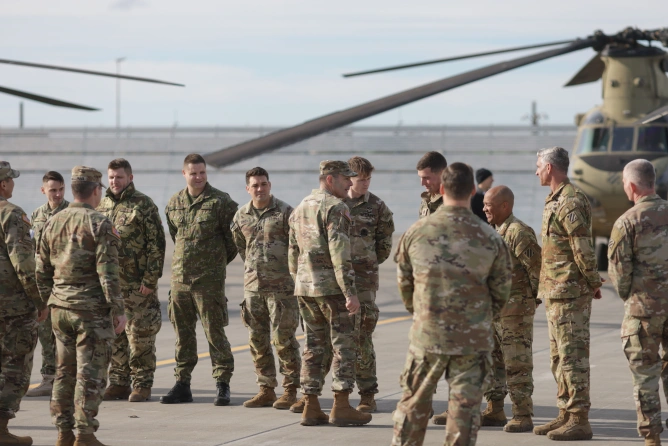
The Mihail Kogălniceanu base is already one of the main points of American presence in Romania, modernized under a program of about 2.5 billion lei until 2030 and prepared to host thousands of troops. A Deutsche Welle analysis reminds that this infrastructure has been used in almost all major US campaigns over the last two decades – from the second war in Iraq and Afghanistan to the 2025 operations related to the Israel-Iran conflict, Midnight Hammer – and that the plan is for it to function, in perspective, as the largest NATO base in Europe, with approximately 10,000 troops. In this context, a new deployment related to the war in Iran would not be a break, but a continuation of a role already assumed.
The second major gain is the political capital in relation to Washington. Former Foreign Minister Adrian Cioroianu synthesizes this stake, at Digi24, in a direct formulation: "This means a capitalization of our place on the map and a partnership with the United States, manifested concretely through the base at Kogălniceanu. This means that the US is preparing for the eventuality of the prolongation of the conflict in the Middle East."
For Cioroianu, a refusal would be hard to justify strategically: "We gain nothing if we say no," he states, suggesting that Romania strengthens its status as a credible ally precisely by being willing to provide infrastructure to a partner in crisis.
This argument is reinforced by the analysis of Deutsche Welle, which speaks about Romania's "old military loyalty" to the US and the ambition to transform Kogălniceanu into the military pivot of the strategic partnership. Under the conditions where Germany or France clearly delimit their military participation in the conflict with Iran, preferring defensive and political formulas, a favorable decision from the CSAT would consolidate Romania's profile as a frontline ally, with potential dividends in other files – from defense to energy or critical infrastructure.
Last but not least, Romania can gain militarily and technologically. Any additional deployment comes with investments in infrastructure, command and control systems, air defense and anti-drone capabilities, following the model of Deveselu or the training ranges used for training with American technology. The experience of Cyprus, where the RAF Akrotiri base has been massively modernized to cope with the wave of Iranian drones, shows that host states are obliged to accelerate the modernization of their defenses, which can leave behind useful capabilities even after the end of the campaign.
What does Romania risk if it becomes the American "gateway" to Iran
The gains, however, come with clear risks. The first is the higher profile of being a target, even if Romania remains under NATO's umbrella. The war in Iran has already set a historical precedent: for the first time, a Western base in Europe – RAF Akrotiri in Cyprus – has been hit by drones and missiles in the context of Iranian reprisals. The British and international press notes that the attack came after London explicitly made the base available to the US and Israel for support operations, turning Cyprus into a target in Tehran's logic.
In parallel, timelines created by American think tanks show that, only in 2024–2025, pro-Iranian militias executed over 160 drone, missile, and cruise missile attacks on American bases in Iraq, Syria, and Jordan, precisely to "degrade" the US military presence and force local governments to reduce cooperation.
Military analyst Sandu Valentin Mateiu summarizes this doctrine in an interview for Euronews Romania: "At the moment it is attacked, Iran will respond by attacking all American bases in the region, as well as the Arab countries in the region. This would degrade the military capabilities of the US. The second, politically. Politically, it means forcing the leadership of that country to no longer support the US."
Even if Romania is not "in the region" in the strict sense, the Cyprus model shows that geography becomes flexible when a European base is effectively used in the operational chain against Iran. Local military expertise considers a direct Iranian attack on a NATO base, such as Deveselu, "unlikely", precisely because it would trigger an escalation with the entire Alliance, but warns that the gray area – cyber attacks, sabotage, credible threats – remains open.
A Romania hosting American planes involved in the conflict with Iran automatically enters this risk zone.
Internally, there are also perception and security vulnerabilities. The Kogălniceanu base is already a privileged target for disinformation and speculation, from Russian narratives about the "gateway to war" to conspiracy scenarios circulated in the public space.
A more visible role of the base in the conflict with Iran will fuel them, providing propaganda material for anti-NATO and anti-US campaigns, but also for exploiting the legitimate fears of the population regarding the risk of attack. Political analyst Bogdan Chirieac recently warned, in an analysis about the Iranian crisis, that "we have every reason to be concerned about everything that is happening", insisting that Romania must be present in the security architecture, but extremely careful about the costs of too visible involvement in a war in which "it has nothing to seek" as a belligerent.
Above all looms the economic risk. The presidential administration has explicitly put on the CSAT agenda the evaluation of the impact of events in the Middle East on the Romanian oil market. Against a backdrop where transport routes and energy prices are already volatile, a more direct involvement in supporting US operations can amplify pressures on the economy, from fuel costs to export logistics chains. Additionally, the heightened dependence on the American umbrella may accentuate the perception, in certain European capitals, that Romania defines its relevance almost exclusively through its role as a host for US capabilities, complicating its positioning in the debate about European strategic autonomy.
Strategic implications: between loyalty to the US and the risk of becoming a target
In strategic terms, a favorable decision in the CSAT would enshrine Romania as a structural hub in the American military infrastructure oriented towards the Middle East, not just as an occasional transit base. The Kogălniceanu base would practically enter the same conceptual category as Akrotiri or Incirlik: a space from which air power can be projected towards Iran, with all the consequences that arise from this positioning.
Deutsche Welle observes that Bucharest has been betting on this card for years, trying to turn military loyalty into a strong argument in dialogue with Washington and in negotiations within the EU.
Former Foreign Minister Cristian Diaconescu, in a recent interview, describes Romania as a state at "the intersection of two wars" – the one with Russia to the east and the one with Iran in the Middle East – and suggests that this position makes any decision regarding Kogălniceanu have multiplied effects.
Cioroianu adds an important nuance: he explicitly acknowledges that "of course, we must also weigh the risks", but returns to the idea that a refusal would not bring real benefits, either in security or political terms. In contrast, acceptance – with clear conditions and transparent communication – can strengthen Romania's status in NATO and in bilateral relations with the US, while the risks can be managed through strengthening air defense, anti-drone defense, and critical infrastructure, lessons learned also from the attacks on the base in Cyprus.
In reflection, commentators and political-media consultants, with partisan profiles like Bogdan Chirieac or Dan Andronic warn, from different angles, that transforming Kogălniceanu into an "alternative to Incirlik" and a gateway for American forces to Iran could complicate Romania's situation significantly in the event that the war prolongs or expands. Andronic emphasizes that the base "has been and is an alternative to the base in Turkey at Incirlik, the flight difference being very small", which means that, in the hypothesis of a prolonged conflict with Iran, the pressure on Kogălniceanu will increase.
In essence, Romania gains security, influence, and political capital if it says "yes" to the US request, but also assumes a calculated risk: it enters deeper into the circle of states considered by Iran and its surrounding actors when the list of retaliation targets is drawn. The CSAT decision is not just about how many planes or how many troops will temporarily stay at Kogălniceanu, but about the strategic status that Bucharest is willing to assume in the next decade.
Last but not least, a positive response from the CSAT would inevitably have a dimension of political legitimization of US actions. The fact that Romania provides a base used in the operational chain can be read, especially in Washington, Tehran, and the region, as a signal that Bucharest considers the American narrative of self-defense/prevention at least acceptable, if not explicitly legitimate – unlike Spain, which refuses precisely on the grounds that the strikes are "outside international law."
****Synthesis made with the help of a data monitoring flow provided by the media monitoring platform NewsVibe Romania. The analysis, data, and images presented have been enhanced with the help of Machine Learning and Artificial Intelligence tools.
Latest News
21:47
21:35
21:27
21:15
21:01
See more news
NEWS ON THE SAME TOPICS