ANALYSIS Andrew Mountbatten Windsor, in the back seat of history: the photograph that rewrites the story of the former prince and the moment when the elites find out that they are no longer untouchable



Always see our news on Google
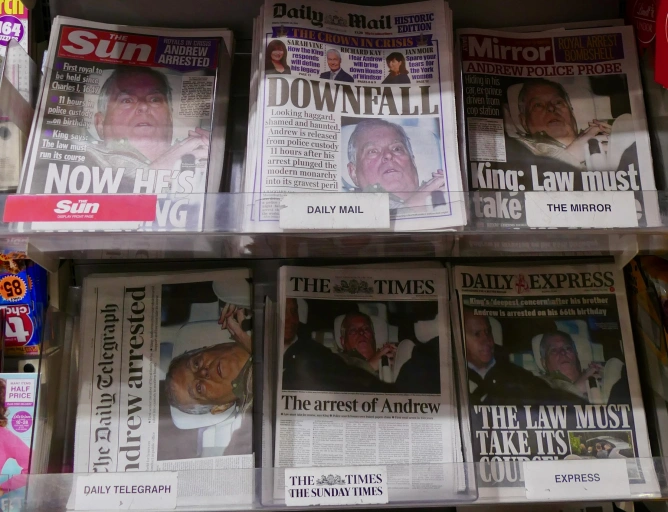
From tabloids to quality press, British publications had on Friday morning on the front page of their print editions the photograph of former prince Andrew in the back seat of the car with which he left police custody. Several international newsrooms frame the case in three axes: historical precedent, accountability of elites, and the Epstein effect.
The fall of Andrew Mountbatten-Windsor, from "the queen's favorite" to the man with a stunned look in the back seat of the police car, concentrates the most serious scandal of the British monarchy in modern times. His decline – the loss of titles, discreet exile, and, ultimately, arrest on suspicion of "misconduct in public office" related to the Epstein files – transforms this image into a visual verdict on an elite that believed it would not be touched by the law. For the monarchy, the photograph marks a turning point: we are no longer talking just about a "rotten apple," but about the fragility of the entire symbolic construction, now obliged to demonstrate that the principle of "no one is above the law" applies even within its own family.
The photograph that will remain in manuals – how an image rewrites the story of a former prince
Andrew Mountbatten Windsor emerged from custody on Thursday evening and was captured in a photograph that became an instant symbolic image: a visibly disturbed man in his sixties, "stunned," in the back seat of the car, an image that dominates the front pages and the narrative architecture of the scandal.
In this photograph, Andrew no longer appears as a member of a royal family, but as a "man from Norfolk, in his sixties," just released after hours of interrogation. The tight framing, the frozen expression, and the harsh lights transform the image into a visual summary of status collapse: from "His Royal Highness" to suspect of misconduct in office. The fact that the same photograph is obsessively reproduced, from The Guardian to tabloids, fixes it as the dominant frame through which the public will remember the episode.
How did the international and Romanian press cover the arrest of former prince Andrew
It is without a doubt a "precedent-setting event." The fact that the monarch's brother, a former prince, is arrested and criminally investigated as a former dignitary (specially sent for trade) is marked as a moment without recent equivalent in Great Britain (NYT, CBC, Euronews, Hotnews, Economica).
The international press covered the subject with the narrative pivot being the accusation of misconduct in office: emphasis on the accusation that he allegedly transmitted confidential government documents to Jeffrey Epstein, in the context of his official function.
The connection to the Epstein files: articles reiterate the older context (civil lawsuits, agreements, the BBC interview) and suggest that the new wave of American documents has created additional pressure on British authorities.
Another angle addressed by the international press was the crisis for the monarchy: many texts speak of "the most serious crisis of the monarchy in recent times," emphasizing that the issue can no longer be managed as a simple image scandal, but as a criminal case with institutional effects.
Analysis of a "turning point": the international press (e.g., Axios, NYT) connects Andrew's case with other scandals hitting global political elites (e.g., the Yoon case in South Korea), talking about a "global reassessment" of elite impunity.
What were the reactions around the world
Global reactions are divided between political comments, messages from survivors, and geopolitical interpretations.
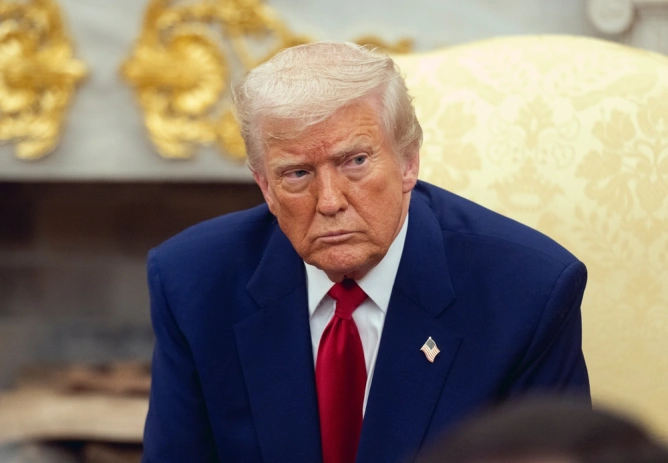
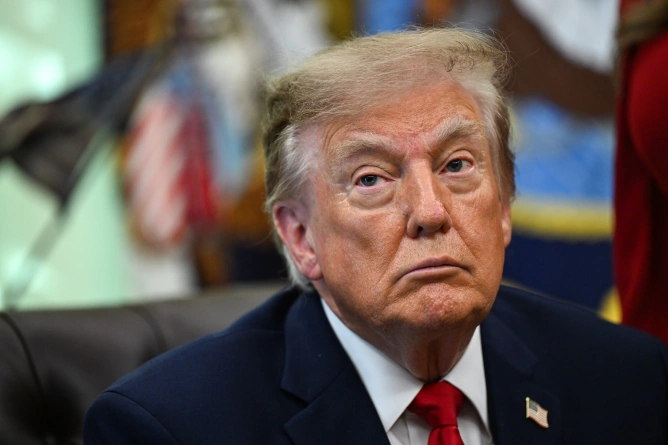
Donald Trump calls the arrest "devastating for the monarchy" and "very sad" for the royal family, while reiterating his own "exoneration" in the Epstein case, using the occasion for self-justification. Western leaders and officials made cautious statements, but with the same refrain – the necessity for justice to do its job and for the allegations related to misconduct and the Epstein revelations to be taken seriously, regardless of rank.
Survivors and lawyers or family members of Epstein's victims (Virginia Giuffre, Maria Farmer, etc.): welcome the arrest as a "beginning of accountability" and present it as a validation of their efforts, even though the allegations are technically related to misconduct in office, not to the actual sexual assaults.
Several American congressmen (e.g., Thomas Massie, Ro Khanna, Robert Garcia, Melanie Stansbury) used Andrew's arrest to call for the acceleration of the declassification of Epstein documents and tougher investigations in the U.S., stating explicitly that "if Great Britain could arrest a former prince, there is no excuse for inaction in the United States."
The reaction of King Charles to his brother's arrest
King Charles III, whose statement had global weight, says he received the news "with deep concern," that he fully supports the investigation, and that "the law must take its course," avoiding any appearance of protecting his brother.
How British newspapers headlined Andrew's arrest
The general landscape in Great Britain showed that most publications chose to open with a large photograph of Andrew in the police car, leaving custody, plus explicit statements about the arrest, his age, and connections to Epstein.
Daily Express, The Times: emphasis on "Andrew's arrest" and on the Palace's / King's message that "the law must take its course."
The Sun: a hard tabloid headline, with a pun on the famous phrase from the 2019 BBC interview ("Now he’s sweating"), in which Andrew claimed he could not sweat due to a medical condition, plus descriptions like "stunned and with wild eyes," highlighting personal humiliation.
<
The i, The National, other tabloids: underline the "precedent-setting" nature, the fact that he was detained even on his birthday (66 years old), and explicitly mention "misconduct in public office" and the connection with Jeffrey Epstein.
Quality press (FT, etc.): emphasizes the constitutional and institutional dimension – the monarch's brother, criminal investigation, implications for trust in the institution, and the idea of equality before the law.
The Guardian and Metro use the same photograph, accompanied by the key quote: "King says ‘law must take its course’ after Andrew arrested."
The final test for the monarchy and the rule of law – between historical precedent and equality before the law
Commentators emphasize that the arrest of a king's brother has no precedent in recent history, being evoked as a distant reference to the detention of Charles I in the 17th century. In this context, the phrases "law must take its course" and "nobody is above the law" become more than clichés: they are invoked by the prime minister, opposition, and the Palace to demonstrate that the mechanisms of the rule of law function, at least formally, in relation to a former royal figure. On the other hand, the question of whether Andrew received preferential treatment remains open and feeds a critical debate about how far one can go when justice reaches the symbolic center of the monarchy.
The global wave: when elites discover they are no longer untouchable
From Australia to the United States, Andrew's arrest and subsequent release are read as part of a broader wave of cases in which top figures – members of royal houses, presidents, magnates – are forced to respond to investigations related to the Epstein network. The reactions of political leaders and victim lawyers converge around the same message: allegations of misconduct and cover-ups of sexual abuses can no longer be neutralized by prestige or noble titles. In this new framework, Andrew's photograph in the back seat of the police car becomes not just the image of a personal collapse, but the emblem of an era in which power discovers that symbolic immunity no longer guarantees legal impunity.
Read also:
Analysis conducted with the support of NewsVibe and Perplexity
Latest News
22:57
22:53
22:42
22:30
22:28
See more news
NEWS ON THE SAME TOPICS
.webp)
.webp)