ANALYSIS The Scenarios for Ending the War in Iran / How Experts in the Gulf View Trump's Warrior Initiative



Always see our news on Google
The US–Israel war against Iran opens three main scenarios in the vision of experts: a limited strategic victory with a "neutralized" Iran, a chaotic transition like Libya, or a prolonged conflict that undermines Trump's presidency and destabilizes the entire Middle East.
The strategic premises of "Trump's war"
The initiation of massive air operations against Iran, culminating in the assassination of Supreme Leader Ali Khamenei, is described as "a huge gamble" by Donald Trump, with a very wide spectrum of possible outcomes.
American reporter Stephen Collinson, specializing in the White House, highlights in CNN that the official reasoning of the administration changes from day to day – from "regime change" and "liberating the Iranians" to destroying the nuclear program or avenging previous Iranian attacks – which suggests the absence of a coherent strategy. Democratic Senator Jeanne Shaheen warns that "there really isn't a clear strategy" and that the lack of a precise definition of objectives risks turning the conflict into a lost opportunity for an "inflection point" for the Middle East.
This ambiguity is, however, seemingly intentional, according to the American journalist: Trump deliberately leaves the objectives vague to create political space to declare victory "whenever he wants," learning from the failures of long-term ground wars in Iraq and Afghanistan. In parallel, he gradually narrows the declared goals to the elimination of the Iranian navy, missile capabilities, and the nuclear program, shifting the focus from regime change to the sustainable "neutralization" of Iran's military power. Historian and analyst Max Boot synthesizes this mix of hubris and cold calculation: "This war that Trump has launched is unjustified and illegal. That doesn't necessarily mean it will be successful."
The "best case" scenario: a strategically weakened Iran, but without state reconstruction
Experts see a relatively optimistic first scenario: a short and devastating air campaign that massively degrades Iran's internal repression tools and external military capabilities. Collinson notes three possible outcomes, of which the "rosiest" is that the days of bombing trigger a popular uprising and the regime's fall, opening the way to "a new Iran" capable of transforming the balance of power in the Middle East. An intermediate scenario, which he considers more plausible, is the survival of a remodeled regime, but with the nuclear arsenal, missile capabilities, and a good part of the conventional army destroyed, which would represent a strategic gain for the US and an "acceptable" objective for Israel.
Elliott Abrams, senior fellow for Middle East studies at the Council on Foreign Relations, explicitly anticipates a deeply "castrated" military Iran: "This will be a state, to a large extent, without the ability to use force. (...) They will have no nuclear program at all. They probably won't have missile launchers and maybe not even missiles. They won't have a navy." Such an outcome would have global geopolitical reverberations: it would deprive Russia and China of the "third member" of the anti-Western axis and could slow the flow of Iranian drones and missiles to the Russian front in Ukraine.
From Israel's perspective, Shalom Lipner notes that "the stars have never been better aligned for a change with impact in Iran," many Israelis cautiously hoping for the disappearance of the "belligerent Shiite axis" and the emergence of a more cooperative Middle East.
However, even this "best case" remains fragile and conditioned by difficult-to-anticipate internal Iranian factors. The regime penetrates every level of society, and even if the security apparatus were severely hit, it would still have net firepower far superior to the poorly organized opposition.
Collinson notes that "the chances of the regime collapsing into a repressive state" are rather "remote," and the sacrifice of Khamenei could further radicalize the hard core of loyalists. Moreover, Trump has not offered Iranian leaders an honorable "off-ramp" in previous negotiations, preferring the logic of total capitulation, which has dramatically reduced the chances of a negotiated transition.
The "worst case" scenario: Libya reloaded, civil war, and chaos export
On the opposite end, experts warn of a Libyan scenario: the rapid collapse of the Iranian state, a power vacuum, and the violent fragmentation of the country. Collinson explicitly compares the risk to "Libya in the mirror," in a state "destroyed by years of authoritarianism," where factional fighting or even civil war could erupt, with the potential to generate a new wave of refugees and leave "vulnerable uranium stocks" in front of extremist groups. From a regional perspective, the Atlantic Council analysis already shows the outlines of a "post-rapprochement era" between Iran and the Gulf monarchies, in which diplomacy is replaced by "calculated militarization."
Khalid Al Jaber, a Gulf specialist, believes that Iran has made a "serious strategic error" by broadening the confrontation to the Cooperation Council states, even though they have clearly stated that they reject war and do not allow their territory to be used for operations against Tehran. Iranian attacks have hit civilian infrastructures – airports, hotels, residential areas – in Saudi Arabia, Qatar, the UAE, Bahrain, Kuwait, and Jordan, "far exceeding" the logic of strictly military targets and undermining the basic principles of international law and good neighborliness. Aziz Alghashian, a researcher from Saudi Arabia, observes that both Iran and the Gulf states, especially mediators Oman and Qatar, have come to consider that "mediation has generated more insecurity," after being stymied despite de-escalation efforts.
As a consequence, there is an acceleration of regional arms races and a deep erosion of the "credibility credit" that Iran enjoyed in some Arab capitals. Gulf states are also reorienting their strategy towards building their own deterrence "through capabilities, not alliances," which in the medium term could lead to a more fragmented but also more armed region, and less willing to compromise. Victory J. Taylor, a researcher specializing in Iraq at the Atlantic Council, notes that a weakened Iran offers an opportunity to reaffirm Iraqi sovereignty, but in the short term the risk is of a "cycle of retaliation" between pro-Iranian militias and American forces, with the potential for internal escalation.
The prolonged conflict scenario: erosion of Trump's presidency and the effect on Palestinians
A third scenario, considered by many analysts to be the most likely, is that of a prolonged conflict, without a clear victory, in which Iran is weakened but not defeated, and the war gradually shifts into the realm of asymmetric attacks and the internal political front in the US. Trita Parsi emphasizes that, from the Iranian perspective, the strategy has become: not necessarily "winning" the war, but getting as close as possible to "destroying Trump's presidency before losing the war." This involves prolonging the conflict, maintaining a constant level of human and economic costs for the US, and stimulating internal American opposition to the war.
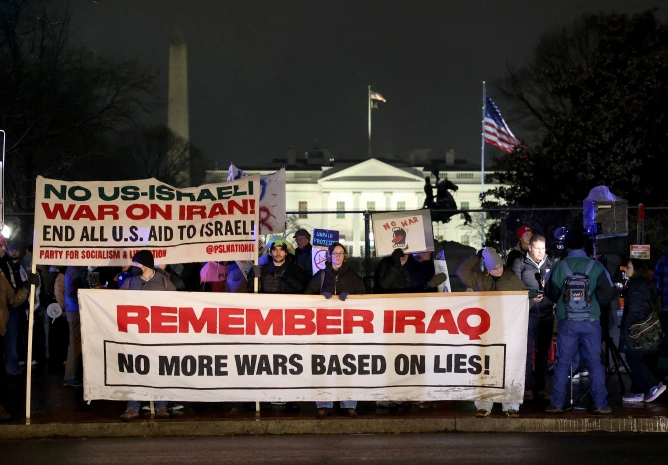
A CNN poll already shows that "almost 6 out of 10 Americans" disapprove of Trump's decision to launch attacks on Iran and believe it is likely a long-term conflict. Trump has avoided seeking authorization from Congress and has provided little detailed explanation to the public, which may fuel legal and political challenges to the intervention. Collinson recalls the "curse" of American foreign policy post-1945: wars "do not just bog down on the battlefield, but are lost at least as often in the face of domestic public opinion."
Regionally, a prolonged conflict would amplify economic shocks – from energy prices and inflation in countries like Turkey, to the decreasing investment attractiveness of the Gulf monarchies, which relied on stability for economic diversification. Turkey, with a 330-mile border with Iran, fears first and foremost a massive wave of Iranian and Afghan refugees, in a context where it already hosts over 3.5 million Syrians and faces inflation of about 31%. Additionally, Ankara is caught between its role as a NATO member, which hosts essential bases, and its refusal to allow the use of its territory for offensive strikes, maintaining a declared position of "non-alignment" and trying to keep a mediating role.
Such a war of attrition could, however, "engulf" many parallel issues in the Middle East. Gina Abercrombie Winstanley, a former ambassador, shows that Palestinians in Gaza and the West Bank are once again losing international attention, after having already been largely left alone in the face of a devastating military campaign in Gaza. The total closure of crossing points to Gaza, alongside the lack of progress regarding humanitarian aid and reconstruction, is exacerbated by the new Iranian crisis, further diminishing the chances for a political solution to the Israeli-Palestinian conflict.
How a Romanian journalist specializing in the Persian Gulf sees the end of the war
Romanian journalist Carmen Gavrilă says on Digi24 that "the Islamic Republic is playing its survival", not reforming, and the absolute priority of the elite is to maintain the regime, even at the cost of a long and devastating war for the population.
She warns that predictions about a rapid collapse of power are hasty, as the security apparatus and power networks are deeply entrenched in society, and the opposition is very divided and currently unable to offer a coherent alternative.
The Iranian response is, in her view, calibrated: Tehran has prepared continuity plans for leadership for years and doses its strikes to avoid total isolation, for example by avoiding direct attacks on key Gulf states or mediators like Oman and Turkey. She describes a regime that "asserts the opposite of what it thinks and does the opposite of what it asserts," deliberately keeping options open, including for indirect negotiations.
The end she sees as the most realistic is not a spectacular capitulation, but a war of attrition: a weakened regime, but still in power, that continues to export influence through the Quds Force and regional proxies, and a possible negotiated political exit only if internal pressure increases and a credible alternative emerges within Iranian society.
Possible "endings" of the war
Starting from these three major scenarios, experts and journalists specializing in the Gulf and the Middle East outline several possible "endings" of Trump's war against Iran:
1.Limited political military agreement, with a "neutralized" Iran and a reconfigured regime
The air campaign ends after weeks, not months, with the Iranian nuclear and missile infrastructure destroyed and the navy annihilated, confirming Abrams' projection.
The regime survives, but with a more fragmented leadership and an irreversible loss of external military projection capability, which drastically reduces the threat to Israel and the Gulf states. In this context, Trump can declare "victory" based on achieved military objectives, while the internal reconstruction of Iran and any democratic developments are left "to the Iranian people," as he himself has conveyed to the Iranians: "When we finish, you take over your government. It will be yours to take."
2.Violent and internal fragmentary transition, with regional expansion
Assassination of Khamenei and destruction of command centers could trigger succession struggles and fragmentation of the security apparatus, with the risk of the emergence of rival "power centers" and uncontrolled radical militants.
Such an Iran would look more like post-Gaddafi Libya: internal war fronts, territories outside state control, smuggling routes for weapons and nuclear materials, massive flows of refugees to Turkey and Central Asia.
In the neighborhood, the fragile balance in Lebanon, Iraq, and Syria could be "pulled down" by pro-Iranian networks caught between local survival instinct and loyalty to Tehran, as shown by the Hezbollah dilemma analyzed by Nicholas Blanford.
3. Ambiguous "ceasefire" and return to war through substitutes
Internal pressure in the US (negative polls, economic costs, possible shocks in energy markets) may force the Trump administration to accept a ceasefire before achieving maximum political objectives (regime change).
Iran, even weakened, could continue to pursue Parsi's strategy – maximizing costs for Trump – by relaunching asymmetric attacks through militia networks in Iraq, Syria, Lebanon, or Yemen.
In the absence of a negotiated regional security architecture, the logic of "shadow war" returns: pinpoint strikes, sabotage, cyber warfare, with the periodic risk of short but very violent escalations.
4. Narrow window for a new regional order
A less capable Iran to sustain its axis of influence could create opportunities for a "re-anchoring" of Iraq in its relationship with the West and its Arab neighbors, reducing dependence on pro-Iranian militias, as Taylor suggests.
The Gulf states, now forced to align with the US–Israel position, could, over time, leverage this convergence to negotiate a more robust regional security framework, in which Western guarantees and their own deterrent capabilities are articulated more clearly.
However, as both Alghashian and Al Jaber warn, the current experience of attacks on mediating states makes the appetite for new broad diplomatic initiatives "seriously diminished" in the short term.
Many progressive analysts warn that bombing nuclear facilities actually pushes Iran closer to the decision to pursue a military nuclear capability as the only guarantee of survival, which means a prolonged conflict, not a "quick victory."
In the absence of a credible post-conflict political strategy, the common conclusion of many experts is that the end of the war will not be determined solely by the military balance, but by Washington's ability (or inability) to avoid repeating the "Afghanistan–Iraq curse": a tactical victory followed by a strategic failure. Depending on how quickly the Trump administration can articulate a clear "endgame" – combining realistic military limits, diplomatic pressure, and openings for internal transition in Iran – the war may enter history either as the moment when the Iranian threat was decisively reduced, or as yet another episode in a long string of interventions that "destroyed more nations than they built."
Synthesis made with the help of a data monitoring flow provided by the media monitoring platform NewsVibe Romania. The analysis presented has been enhanced with the help of Machine Learning and Artificial Intelligence tools.
Latest News
23:08
22:58
22:57
22:55
22:54
See more news
NEWS ON THE SAME TOPICS