Valérie Hayer proposes a pact with Canada for a joint response to trade coercion



Always see our news on Google
Renew Europe’s president calls for the EU and Canada to respond together through tariffs to the trade pressures of the United States, China, or other countries. Her proposal includes the full ratification of CETA and deepening strategic cooperation, but does not establish an obligation of joint retaliation or the conditions for activating it.
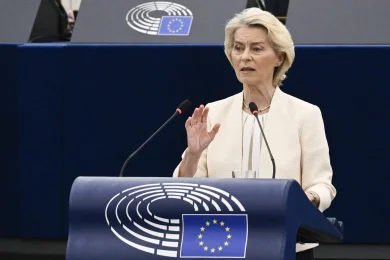
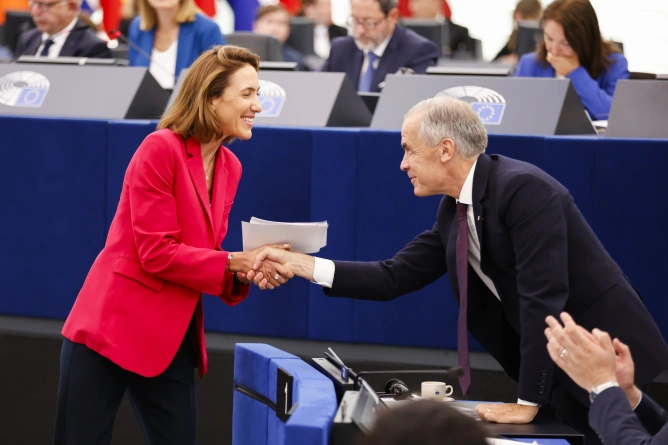
The president of the Renew Europe group, Valérie Hayer, proposed an economic security pact between the European Union and Canada, through which the two sides would respond jointly to trade coercion. In the debate on the state of the Union in Strasbourg, she called for a joint tariff response if Donald Trump imposes tariffs and advocated applying the same approach toward China or other countries.
In brief
1. Hayer proposes coordinating the EU and Canada’s response to trade pressures, including through tariffs. The intervention puts forward a political initiative without announcing a negotiated agreement or an operational mechanism.
2. The Renew leader calls for the full ratification of the Comprehensive Economic and Trade Agreement, CETA. Most of the agreement is already being applied provisionally, so the appeal does not concern starting bilateral trade from scratch.
3. The proposed cooperation also covers rare earths, defence, the Arctic, energy, and research. These areas complement the tariff-response component of her intervention.
4. The EU already has an instrument against economic coercion, with an assessment procedure and last-resort measures. Hayer did not explain how the bilateral pact would fit into this framework.
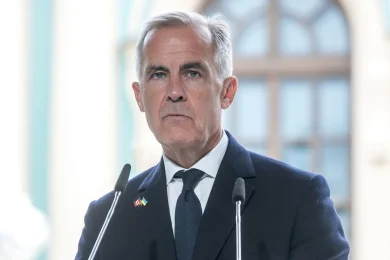
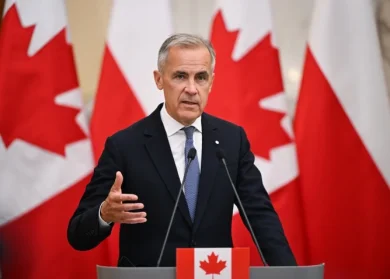
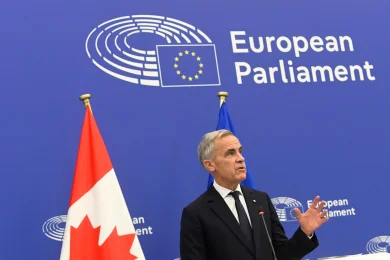
Addressing Canadian Prime Minister Mark Carney, Hayer argued that Europe must defend its interests more firmly and use its economic power. The example she offered was a joint response through tariffs to US tariffs. She did not specify their level, the products targeted, or whether a joint response would be triggered automatically in the event of a measure against one of the partners.
In her plenary intervention, she associated this closer relationship with expanding university exchanges and closer strategic cooperation in areas where the EU and Canada could leverage each other’s capabilities.
Ratifying CETA and organising a joint response to external pressures entail different actions. According to the European Commission, most of the trade agreement has been applied provisionally since 2017, while its full entry into force requires the remaining national approvals. Hayer’s appeal therefore seeks to complete an existing trade framework while building the proposed pact in parallel.
The bilateral relationship already includes commitments concerning economic security. At the EU–Canada summit in June 2025, leaders agreed to diversify supply chains and strategic investments, explore joint investment in raw materials, and deepen cooperation in security and defence. These commitments provide a precedent for the cooperation sought by Hayer, without amounting to acceptance of her formula for a joint tariff response.
Under the European framework against economic coercion, the Commission examines pressure exerted through trade or investment to influence a political choice, while the Council establishes the existence of coercion. Response measures are a last resort, after attempts at resolution. A tariff does not automatically trigger this procedure, and cooperation with other partners is already provided for.
For the pact proposed by Hayer, it remains to be defined who would establish the existence of coercion, how the two sides would decide on joint measures, and what obligations they would undertake. The intervention provides no negotiating timetable and does not announce acceptance of the proposal by the Canadian government. It places closer coordination of the trade response on the debate agenda, with its rules still to be negotiated.
Latest News
10:23
10:11
10:02
09:58
09:50
See more news
NEWS ON THE SAME TOPICS