60 countries support the commitment against illegal fees and restrictions in straits used for international navigation



Always see our news on Google
All 27 EU Member States and 33 other countries support the “No Fees/No Tolls” initiative, opposing illegal fees, charges, prior authorizations, and discriminatory restrictions that hinder lawful navigation through international straits. The commitment is political, not a new treaty, and does not prohibit port fees or payments for services permitted under maritime law.
A group of 60 states now supports the “No Fees/No Tolls” commitment, launched by the European Union to defend lawful navigation through straits used for international traffic. The list published by the European External Action Service includes all 27 EU Member States and 33 non-EU countries, which undertake to oppose illegal fees, charges, discriminatory restrictions, prior authorizations, and other conditions incompatible with the international maritime legal framework.
In brief
1.The commitment is supported by the 27 EU states and 33 third countries, meaning 60 states in the official published list.
2.The document concerns straits used for international navigation and transit rights established by the law of the sea, as reflected in the UN Convention on the Law of the Sea, UNCLOS.
3.Supporters oppose illegal fees and charges, discriminatory restrictions, prior authorizations, and other conditions that would hinder or limit lawful navigation.
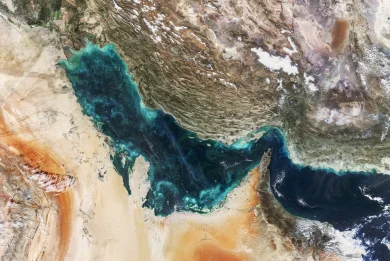
4.The initiative was promoted against the backdrop of tensions in the Gulf and the Red Sea and disruptions to freedom of navigation, including in the Strait of Hormuz and Bab al-Mandab.
5.“No Fees/No Tolls” is a political commitment. It does not create a new international treaty, amend UNCLOS, or constitute a general ban on all port, canal, or maritime service fees.
The 33 non-EU countries appearing on the official list are Australia, Bahrain, Benin, Cabo Verde, Cambodia, Cameroon, Canada, Cook Islands, Fiji, Gabon, Honduras, Iceland, Japan, Jordan, Kiribati, Lesotho, Liberia, Mauritania, Montenegro, New Zealand, North Macedonia, Norway, Oman, Palau, Philippines, Republic of Korea, São Tomé and Príncipe, Singapore, Sri Lanka, Switzerland, Turkmenistan, United Kingdom, and Yemen. The composition of the group thus extends beyond European or transatlantic alliances and includes states from Asia, the Pacific, Africa, and the Gulf region.
The document is based on the principle that straits used for international navigation have a global function, even when they lie between the territories of states. Disrupting traffic at such points can affect energy and food transportation, trade costs, supply chains, and the movement of goods between continents.
The immediate context is the deterioration of maritime security in the Middle East. At the Foreign Affairs Council on 12 October, EU ministers discussed tensions in the Gulf and the Red Sea, attacks on Saudi Arabia, and disruptions to navigation in the Strait of Hormuz and Bab al-Mandab. In this context, several ministers supported the European initiative against unilateral fees and restrictions on maritime routes.
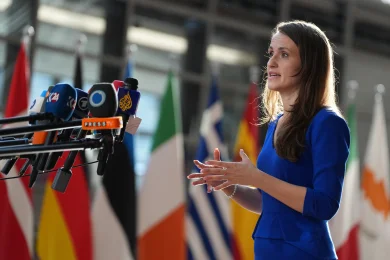
Kaja Kallas, High Representative for Foreign Affairs and Security Policy, presented the European argument in economic and strategic terms. For the EU, international maritime routes are essential infrastructure for the European economy, and access to them should not be conditioned by measures incompatible with international law.
The “No Fees/No Tolls” text is nevertheless formulated more broadly than the situation in the Strait of Hormuz. It does not name a state against which it is directed, nor is it limited to a single strait; instead, it establishes a general position regarding sea routes used for international navigation.Supporters state that they will support the international and regional institutions responsible for maritime governance, safety, and security, particularly the International Maritime Organization. They also support defensive and non-escalatory multilateral initiatives intended to preserve freedom of navigation.
A second principle is the rejection of coercive or unilateral actions that seek to modify or circumvent the existing legal order at sea. The document explicitly links this position to international law as reflected in UNCLOS and to the existing framework for navigation through straits.
The UN Convention establishes different regimes depending on the legal characteristics of the waters. For straits to which the transit regime applies, ships and aircraft enjoy the right of transit passage for continuous and expeditious passage between two parts of the high seas or exclusive economic zones.
Coastal states may adopt certain rules concerning navigational safety, maritime traffic, pollution prevention, fishing, and the enforcement of customs, fiscal, health, or immigration regulations. However, these powers do not permit the rules to be used in a discriminatory manner or in such a way that the right of transit is, in practice, denied, impeded, or impaired.
This distinction precisely explains the wording used in the commitment. The states are not saying that every fee charged in connection with a ship is illegal; rather, they oppose illegal fees and charges that hinder lawful navigation or alter the transit regime established by international law.
A ship may, for example, pay for a specific service provided in a port or in other situations permitted by the applicable legal framework. “No Fees/No Tolls” cannot be interpreted as the universal elimination of port fees, service costs, or all special regimes applicable to canals and other waterways.
Nor does the initiative’s political name create a new rule of the law of the sea. UNCLOS and the other applicable rules continue to establish the rights and obligations of states, while the commitment seeks to defend the existing framework, not replace it.
The document does not establish its own sanctions mechanism for situations in which a state introduces a measure deemed incompatible with international law. Nor does it create a new structure that would automatically determine whether a particular fee or restriction is illegal.
The response in a specific case would depend on the nature of the measure, the legal regime of the strait, the states involved, and the diplomatic or legal instruments available. However, the supporters are adopting a common political position that can be used to coordinate responses and attract other states to the same coalition.
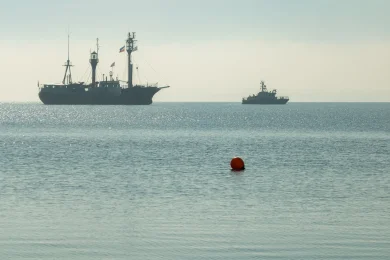
The initiative thus operates in parallel with the EU’s operational response to maritime security problems. In the Red Sea, Operation EUNAVFOR ASPIDES protects commercial vessels from attacks, while “No Fees/No Tolls” concerns the rules and principles that should govern access to maritime routes.
The two instruments are not equivalent. ASPIDES is a maritime security operation involving vessels and other resources provided by states, whereas the commitment published by the EEAS is a diplomatic coalition centered on respect for the law of navigation.The list of 60 states may continue to grow. Kallas has invited other countries to join, and the open nature of the initiative seeks to turn the principle into a broader international position ahead of new disputes over the control or conditioning of strategic maritime routes.
Latest News
23:08
22:57
22:55
22:54
22:45
See more news
NEWS ON THE SAME TOPICS