The European Commission will ask member states to ban conversion practices.



Always see our news on Google
The European executive has responded to the citizens' initiative supported by 1.1 million people and will prepare a recommendation for 2027. Hadja Lahbib states that conversion practices must be banned now and that member states have an essential role, as the field largely falls under their responsibility.
The European Commission will adopt a recommendation in 2027 calling on member states to ban conversion practices, following a citizens' initiative supported by 1.1 million people.
In short
The European Commission has adopted a formal response to the European citizens' initiative regarding the ban on conversion practices.
The initiative was supported by 1.1 million citizens and called on the Commission to propose a legal ban on conversion practices targeting LGBTQ+ individuals.
The Commission intends to adopt a recommendation in 2027 requesting member states to ban these practices.
According to the EU Agency for Fundamental Rights, 24% of LGBTIQ+ individuals in the EU have undergone such practices, with the percentage nearly doubling for transgender individuals.
The recommendation will be prepared through dialogue with member states and will be supported by a dedicated study on the scope and impact of conversion practices in the EU.
The European Commission has announced that it will adopt a recommendation in 2027 calling on member states to ban conversion practices, in its formal response to the European citizens' initiative "Ban on conversion practices in the European Union".
The initiative was supported by 1.1 million citizens of the European Union and called on the Commission to act for the legal ban of conversion practices targeting LGBTQ+ individuals.
The Commission states that conversion practices are based on the false idea that LGBTIQ+ individuals are sick. The European executive says that these interventions can produce lasting psychological and physical effects.
According to a report by the EU Agency for Fundamental Rights, 24% of LGBTIQ+ individuals in the Union have undergone such practices, including physical and sexual violence, verbal abuse, and humiliation. The Commission specifies that the percentage is nearly double for transgender women and men.
The Commission's response comes four days before the International Day Against Homophobia, Transphobia, and Biphobia, marked annually on May 17.
The Commission states that it has analyzed the legal possibilities and intends to adopt a recommendation addressed to member states. This will not represent a direct ban at the EU level, but a tool through which the Commission will ask national governments to ban conversion practices.
"Today we commit to adopting a recommendation to member states, asking them to ban conversion practices throughout the EU. They have no place in our Union. The EU proudly stands with the LGBTIQ+ community and reaffirms the vision of a Union of equality, a place where everyone can live freely, openly, and authentically," said European Commission President Ursula von der Leyen.
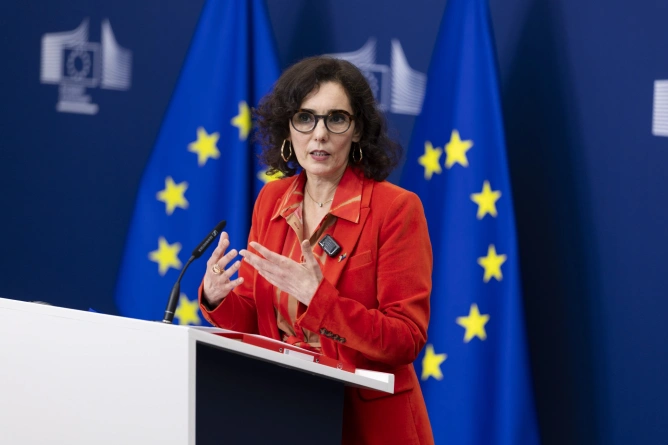
Hadja Lahbib, Commissioner for Equality, Preparedness, and Crisis Management, described conversion practices as forms of violence falsely presented as therapy.
She reported that in December, at Berlaymont, she met victims of these practices and heard testimonies about shame, abuse, isolation, forced medication, verbal and physical violence, electric shocks, moral and psychological harassment, sexual abuse, and rape.
Lahbib said that individuals subjected to these practices may come to believe that they are sick or that they need to be "cured," after receiving this message even from close individuals.
The Commissioner recalled the case of a victim she named Sarah, a borrowed name, who described the experience as a "horror movie" and "a nightmare" from which she could not escape and who said she had thought about suicide.
"This is not about care, it is not about helping someone, it is about violence and disguised violence," said Lahbib.
She linked the citizens' initiative to the mobilization of young Europeans, including a young man named Matteo, who used the democratic mechanism of the European citizens' initiative to gather over a million signatures.
"Conversion practices are built on a lie. The lie that LGBTIQ individuals need to be fixed, that there is something wrong with who they are. And, of course, there is nothing to fix, nothing to heal, and no one to change," said Lahbib.
The Commissioner stated that these practices are not a marginal problem and cited data indicating that one in four LGBTIQ+ individuals and nearly half of transgender individuals report having suffered such practices.
"You cannot torture a person's identity until it disappears, and you cannot eliminate it by law," said Lahbib.
According to the Commissioner, the Commission sends a clear message to member states, without ambiguity: conversion practices must be banned. She stated that member states have an essential role, as the field largely falls under their responsibility.
Lahbib stated that eight member states have already banned these practices and that the Commission's recommendation will ask others to follow this example.
The Commissioner said that the recommendation will protect all LGBTIQ+ individuals, especially the most vulnerable, and will target practices that attempt to change or suppress a person's sexual orientation, gender identity, and gender expression.
The Commission will also support the recommendation with complementary measures. These include awareness campaigns to prevent abuses, better access to justice for victims, and training to strengthen medical and psychological support.
The recommendation will be supported by the LGBTIQ+ Equality Expert Group, which brings together member states and the Commission. The first LGBTIQ+ policy forum with civil society will focus on combating conversion practices.
The Commission has also launched a dedicated study to understand the scope and impact of these practices in the European Union. Lahbib stated that the European executive needs facts and evidence, not assumptions.
The Commission will begin work on the recommendation after this formal response. The text will be prepared through a structured dialogue with member states, within the LGBTIQ+ Equality Expert Group, and will take into account best practices from member states that already have bans in place.
The recommendation will also be based on an in-depth study of conversion practices, the results of which are expected at the beginning of 2027.
The Commission states that social acceptance of LGBTIQ+ individuals has increased in recent years in the EU, but they continue to face discrimination, hatred, and violence.
Combating conversion practices is included as a key objective in the LGBTIQ+ Equality Strategy 2026-2030, which aims to protect LGBTIQ+ individuals against violence, abuse, and hate.
Lahbib reminded that this year marks 30 years since the first Brussels Pride and that Sunday marks the International Day Against Homophobia, Biphobia, and Transphobia.
"To Sarah, to Matteo and his friends, and to each of the over a million people who signed this petition: we have heard you, and this is our response. We stand with you," said Lahbib.
She also addressed LGBTIQ+ individuals who have undergone such practices.
"There was nothing wrong with you. You never needed to be fixed. You are perfect, just as you are, and the European Union stands with you," said the Commissioner.
The European citizens' initiative was introduced by the Lisbon Treaty as a tool for citizens to influence the agenda of the European Union. The tool was officially launched in April 2012.
Since then, the Commission has registered 129 initiatives, of which 14 have managed to gather a million signatures and have been submitted to the Commission for examination.
To be formally accepted, a European citizens' initiative must propose a legal action in an area where the Commission has competence and gather verified signatures from one million citizens, with minimum thresholds reached in at least seven member states.
After submitting a successful citizens' initiative, the Commission has six months to adopt a formal response. The initiative to ban conversion practices is the 13th for which the Commission has adopted a formal response.
The International Day Against Homophobia, Transphobia, and Biphobia marks the decision of the World Health Organization on May 17, 1990, to no longer classify homosexuality as a mental disorder.
For the European Commission, the response to this initiative is linked to the broader goal of the Union of equality and to the European policy on fundamental rights, non-discrimination, and the protection of LGBTIQ+ individuals.
Latest News
15:43
15:42
15:34
15:29
15:22
See more news
NEWS ON THE SAME TOPICS














.webp)