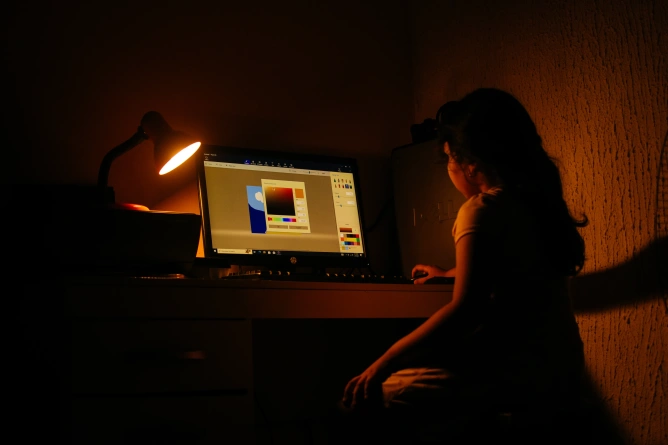
Europeans are calling for stricter rules for the online safety of children and age restrictions on social media.



Always see our news on Google
A new Eurobarometer shows that 71% of Europeans are concerned about cyberbullying and harassment on social media, while 70% fear online grooming and the sexual exploitation of children. Almost two-thirds of respondents want European rules to limit children's access to social media based on age, either through a ban below a certain threshold or by delaying access.
Europeans are calling for stronger measures to protect children online, especially on social media, where cyberbullying, harassment, online grooming, sexual exploitation, and exposure to harmful content are seen as major risks. A new Flash Eurobarometer published by the European Commission shows that nearly two-thirds of respondents support European rules that would restrict children's access to social media based on age.
In short
Cyberbullying and harassment are the main perceived risks for children on social media, mentioned by 71% of respondents. This is followed by online grooming and sexual exploitation at 70%, exposure to violence, self-harm, or extremism at 69%, and the abusive use of children's personal data, also at 69%.
Almost two-thirds of Europeans, 63%, want EU rules to limit children's access to social media based on age. Of these, 36% support a ban below a certain age threshold, while 27% prefer delaying access.
Two-thirds of Europeans, 66%, use social media daily for information about current events or politics. In this context, respondents are calling for harsher penalties for illegal online content, stronger rules for platforms, and clear labeling of content generated or manipulated with artificial intelligence.
The survey also shows what Europeans consider essential for democracy: freedom of expression, free and fair elections, the rule of law, and fundamental rights. Almost half of the respondents see direct participation as an effective way to influence EU decisions.
Outside the digital realm, significant majorities are calling for strengthening the EU's defense capacity and accelerating the energy transition. 68% believe that the EU should enhance its ability to defend itself autonomously, while 56% say that renewable energy can help the Union move away from fossil fuels.
The survey shows a strong concern for children's safety on social media. Cyberbullying and harassment are the top concerns, with 71% of respondents worried. Online grooming and sexual exploitation are mentioned by 70%, while exposure to harmful content such as violence, self-harm, or extremism is cited by 69%.
Also, 69% of respondents fear the abusive use of children's personal data. Other significant risks include recruiting children for illegal activities, mentioned by 64%, and exposure to addictive platform design, mentioned by 60%.
The results come at a time when the EU is discussing several files related to the protection of minors online, platform safety, and the responsibility of digital companies. The survey shows that public support for European intervention is high: 63% of Europeans want EU rules to limit children's access to social media based on age.
Of these, 36% support a ban below a certain age threshold, while 27% prefer a delayed access model. In contrast, 15% of respondents would prefer to strengthen resources for law enforcement, while 13% would leave supervision to parents and schools, without additional EU intervention.
The survey links child protection to the broader issue of online information. Two-thirds of Europeans, 66%, say they use social media every day to stay informed about current events or politics. This dependence on platforms makes misinformation, illegal content, and manipulated materials public interest issues, not just digital consumption matters.
To combat false or misleading information, the most supported measure is harsher penalties for illegal online content, mentioned by 44% of respondents. This is followed by stronger rules for platforms at 40%, and clear labeling of content generated or manipulated with artificial intelligence at 38%.
A significant portion of respondents also links combating misinformation to minors' access to social media. 37% indicate a minimum age threshold for access, while 29% support greater investments in media education and independent fact-checking.
The Eurobarometer also includes a component on democracy. Europeans consider freedom of expression, mentioned by 34%, free and fair elections at 32%, and respect for the rule of law and fundamental rights at 31%, as the most important elements of a democratic society.
The fight against corruption is mentioned by 28% of respondents. Transparency and accountability of political leaders, along with an independent judiciary, are indicated by 26%, while citizen participation in public debate and decision-making processes is mentioned by 22%.
Regarding influencing EU decisions, respondents do not limit themselves to voting. 46% see more direct forms of participation as an effective way to influence European decisions, while 42% mention participation in political movements, parties, or unions.
On security and defense, the survey shows clear support for a stronger European capacity. 68% of Europeans agree that the EU should enhance its ability to defend itself autonomously against potential external threats. At the same time, 56% say they trust the EU to strengthen security and defense and better protect citizens, four percentage points more than in January 2026.
On energy, Europeans see renewables and energy efficiency as responses to pressure on prices and dependence on fossil fuels. 56% of respondents believe that developing greater renewable energy capacity can help the EU move away from fossil fuels, while two-fifths point to energy efficiency measures. 32% see nuclear energy as a possible solution.
Rising energy prices have also changed household behavior. 31% of respondents say they have reduced their overall electricity consumption. 27% have started to monitor their consumption more closely, while 26% have reduced their use of heating or cooling.
Other measures include adjusting consumption to different times of the day to benefit from lower prices, mentioned by 20%, investments in more energy-efficient appliances at 16%, comparing or changing energy suppliers or contracts at 14%, and installing or considering renewable energy solutions, also at 14%.
The survey outlines four public priorities that overlap with the EU's political agenda: online child protection, democratic resilience, European defense, and the energy transition. In all four areas, respondents call for greater capacity for action at the European level, either through rules for platforms or through security, clean energy, or democratic engagement.
Flash Eurobarometer 584 on the challenges and priorities of the EU was conducted online between June 19 and 24, 2026. A total of 25,904 citizens from all 27 member states were interviewed.
Latest News
22:52
22:34
22:28
21:56
21:29
See more news
NEWS ON THE SAME TOPICS
.webp)