


Rail transport reaches a record in the EU in 2025, but Romania has the largest decline in the number of journeys



Always see our news on Google
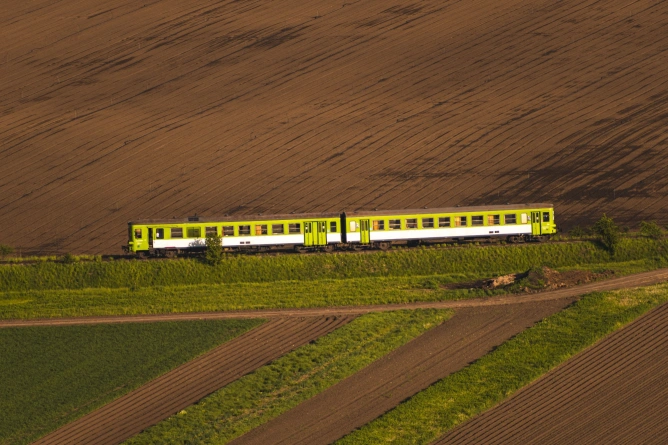
Passengers travelled 457 billion kilometres by train in the EU, 2.6% more than in 2024. In Romania, the number of journeys fell by approximately 9%, while the volume expressed in passenger-kilometres decreased by 10.4%, according to Eurostat data.
Passenger rail transport in the European Union reached a record 457 billion passenger-kilometres in 2025, up 2.6% from the previous year, according to Eurostat data published on 30 October. Romania moved in the opposite direction: the number of journeys fell by approximately 9%, the largest decrease among the reported EU Member States, while the cumulative distance travelled by passengers decreased by 10.4%.
In brief
1.EU volume increased from 445 to 457 billion passenger-kilometres, the highest level in the series collected for the main operators since 2004.
2.Romania recorded an approximately 9% reduction in the number of journeys. This is not a count of distinct individuals.
3.In passenger-kilometres, Romania decreased by 10.4%, while Estonia decreased by 10.9%. Romania does not have the largest decline for this second indicator.
4.Romania and Bulgaria each reported 3.3 journeys per inhabitant, compared with 46.1 in Luxembourg.
5.Metro, tram and light rail are excluded. Belgium’s data are not included in the volume aggregate for confidentiality reasons.
The European result exceeds the 2019 level, before the pandemic, by 14.2%. A passenger-kilometre means transporting one person over a distance of one kilometre: a journey of 100 kilometres produces 100 passenger-kilometres. The indicator combines the frequency of journeys and the distance travelled, so it can increase even if the number of journeys decreases.
The annual series available in the Eurostat database indicates 63.256 million journeys in Romania in 2025, compared with 69.636 million in 2024, representing a decrease of approximately 9.2%. The institution’s statistical article cites 9.1%, 0.1 percentage points less than the result obtained by calculating from these values. Both sources indicate the same downward trend.
Portugal recorded the strongest increase in volume, at 25.7%, followed by Ireland, at 13.1%, and Poland, at 8.6%. At the opposite end were Estonia and Romania. For the number of journeys, the largest increases were recorded in Slovenia, Hungary and Portugal, while Romania had the largest decrease. France and Austria illustrate the difference between the indicators: they transported slightly fewer passengers but reported more passenger-kilometres.
Germany and France accounted for almost half of the European volume, with 111.8 and 110.6 billion passenger-kilometres, respectively. Germany also recorded the highest number of journeys, approximately 2.95 billion, ahead of France and Italy. However, population size and the structure of services make a comparison based solely on national totals insufficient.
When measured against population, train use in Romania and Bulgaria was low, with 3.3 journeys recorded per inhabitant. Luxembourg had 46.1, Hungary 35.9, and Denmark 35.6. The indicator includes the activity of residents and non-residents; it does not mean that every inhabitant made exactly that number of journeys. Repeated journeys by the same person are counted separately.
In Romania, the average distance of a national rail journey was 81 kilometres, one of the highest values in the EU, after Lithuania, at 86 kilometres. The average must be interpreted in the context of the country’s size, the share of suburban and long-distance services, and counting methods. It does not, by itself, establish the quality of services or the causes of the decline in demand.
The detailed statistics mainly cover operators with at least 100 million passenger-kilometres annually and may include, depending on national reporting, other operators reported in detail. They do not include metro, tram or light rail. Belgium is excluded from the volume aggregate for confidentiality reasons. Separately, passenger train traffic, measured in train-kilometres, increased in the EU by 1.6%; this indicator describes the movement of trains, not the distance travelled by each passenger.
Latest News
08:45
08:27
08:12
08:03
07:45
See more news
NEWS ON THE SAME TOPICS







.webp)


