Immunity, fraud and power in the European Parliament



Always see our news on Google
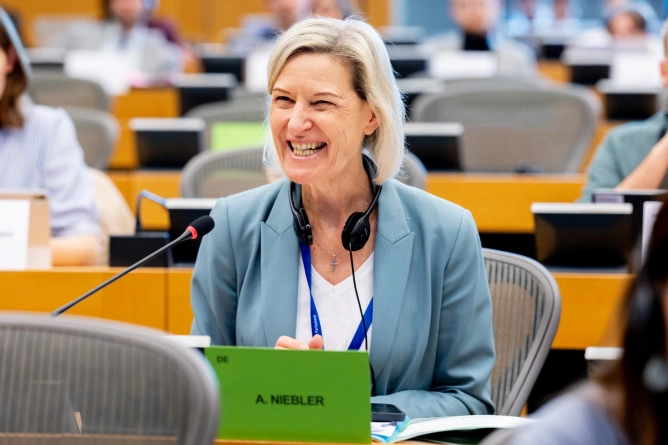
The European Parliament voted to maintain the immunity of German MEP Angelika Niebler, thus blocking, at this stage, an investigation by the European Public Prosecutor's Office regarding suspicions of fraud with parliamentary funds. The decision, adopted by secret ballot and with a narrow majority, opens a major institutional tension between Parliament and the EPPO: how far can the protection of parliamentary mandate go and where does the obligation to allow investigation of suspicions regarding the use of European funds begin.
The European Parliament voted to maintain the immunity of German MEP Angelika Niebler, a member of the EPP group, thus blocking, at this stage, an investigation by the European Public Prosecutor's Office regarding suspicions of fraud with parliamentary funds. The vote does not establish whether the accusations are founded or unfounded. But it produces an immediate effect: the EPPO says it cannot carry out the investigation beyond the preliminary stage.
This is the central stake of the case. A criminal investigation is not a conviction. It is the mechanism through which suspicions are verified, evidence is gathered, and accusations can be confirmed or dismissed. In the case of a politician, however, a simple investigation can have major reputational effects. That is why the procedures for lifting immunity are delicate: they must protect parliamentarians from possible political persecution without turning immunity into an obstacle to legitimate investigations.
The Niebler case places exactly this tension at the center of European politics. Parliament says it has applied the procedure. The EPPO says the procedure has created a barrier that prevents the investigation. Both statements can be simultaneously true. That is why the file is no longer just about a German MEP or about a decision on immunity. It is about the relationship between the European Parliament and the European institution created to investigate fraud that affects the financial interests of the Union.
In the statement published after the vote, the EPPO announced that it reserves the right to challenge the decision before the competent courts. The wording is diplomatic, but the consequence is clear: an internal vote of the European Parliament can become the starting point of a legal conflict between two Union institutions.
How the deadlock was reached
The chronology of the case extends over almost a year, from July 2025 to May 2026, and follows the path provided by the European Parliament's Rules of Procedure for requests to lift immunity. It is precisely this procedural normality that makes the final result so important. The mechanism functioned formally, but produced, at the end of the process, a blockage of the criminal investigation.
The sequence begins on July 21, 2025, when the European chief prosecutor, Laura Codruța Kövesi, sends a formal request to the European Parliament to lift Angelika Niebler's immunity. The request is formulated under Article 29 of the EPPO Regulation, which establishes how the European Public Prosecutor's Office acts when a targeted person benefits from privileges or immunities. A confirmation letter follows on September 1, 2025, and the case is announced in the plenary session of the European Parliament on September 10, 2025. From that moment, the file enters the responsibility of the Committee on Legal Affairs, JURI.
Angelika Niebler is heard by the JURI committee on April 15, 2026. The designated rapporteur, Polish MEP Marcin Sypniewski, drafts the decision proposal, and the committee adopts it on May 5, 2026. The recommendation is clear: immunity should not be lifted. The vote in committee, 16 in favor of maintaining immunity, 3 against, and 3 abstentions, shows a wide majority, but not unanimous.
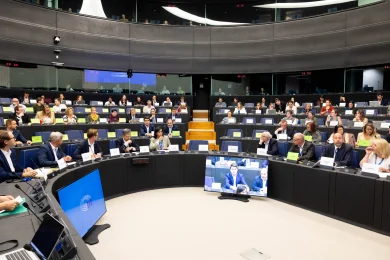
The file reaches the plenary session of the European Parliament on May 19, 2026. The Niebler case stands out from other immunity procedures on the agenda due to the secret ballot and the narrow result. The plenary votes with 309 votes in favor of maintaining immunity, 283 against, and 53 abstentions. The JURI committee's proposal is adopted. Parliament decides not to lift immunity.
The difference of 26 votes, in a vote in which 645 MEPs participated, shows that the decision was not a comfortable one. Almost 44% of those who voted opposed the recommendation of their own legal committee. For a procedure usually treated as a technical exercise, this division is significant.
The EPPO's reaction comes on the same day. The European Public Prosecutor's Office states that Parliament's refusal creates a "procedural barrier" that prevents the investigation from going beyond the preliminary stage. In practice, the delegated European prosecutor cannot carry out the necessary investigative acts to verify the accusations.
What the EPPO wants to investigate
The request from the European Public Prosecutor's Office is based on information provided by a private party, a former collaborator of Angelika Niebler, employed in her office between August 2021 and September 2023. Based on this information, the EPPO considered that there was an initial suspicion sufficient to request the lifting of immunity and to be able to start an investigation. It was not about an indictment, nor about an indictment. It was about permission to verify whether the accusations can be supported by evidence.
The accusations cover an extended period, from 2017 to 2025, and span three legislative terms of the European Parliament. They concern how funds made available to an MEP for the exercise of parliamentary mandate may have been used.
The first line of suspicion concerns the reimbursement of travel expenses. According to the EPPO's request, Angelika Niebler allegedly requested irregular reimbursement for trips to Strasbourg and Brussels. The request does not indicate the exact amounts involved, and this lack of precision will later become one of the arguments used by the JURI committee to question the solidity of the approach.
The second line of accusations concerns the use of parliamentary assistants. The MEP allegedly used accredited parliamentary assistants and local assistants temporarily for private activities or for activities not directly related to her mandate as an MEP. If confirmed, such an accusation would indicate an improper use of resources paid from the European Parliament's budget, resources intended for the exercise of parliamentary mandate.
The third line is the most specific and, at the same time, the hardest to assess without an effective investigation. The EPPO claims that a local assistant worked exclusively for a former MEP from the same party, even though his salary was paid from the parliamentary budget allocated to Angelika Niebler. In simple terms, the suspicion is that funds intended for the office of a sitting MEP would have financed, in fact, the activity of another political person.
The legal framework indicated by the EPPO refers to Article 263 paragraphs 1 and 3 of the German Penal Code, which regulates the crime of fraud, including its aggravated forms. In European parliamentary terms, the request also refers to the rules regarding the use of allowances for parliamentary assistance, established by the European Parliament Bureau Decision of September 11, 2023, regarding the implementation measures of the Statute of Members of Parliament.
Two elements are essential. The first is that the accusations remain, at this stage, suspicions. Niebler has not been convicted, has not been sent to trial, and there is no verdict regarding the substance of the accusations. The second is that this is precisely what makes the investigation important. Without lifting immunity, the EPPO cannot verify whether the suspicions are real, exaggerated, or unfounded.
The JURI argument and the procedural circle
The report adopted by the JURI committee on May 5, 2026, builds a legal reasoning in favor of maintaining immunity. The arguments rely on Protocol No. 7 on the privileges and immunities of the Union, on the Rules of Procedure of the European Parliament, and on the jurisprudence of European courts. Read separately, they fit into the usual logic of an immunity procedure. Read in the specific context of this file, they raise, however, a more difficult question: can the same procedure that protects the independence of the parliamentary mandate completely block an investigation by the European Public Prosecutor's Office?
The central piece of the JURI reasoning is the concept of fumus persecutionis, meaning the suspicion that the judicial procedure does not primarily seek to establish the truth, but to affect the political activity of the targeted MEP. The JURI committee considered that, in the case of Niebler, there are elements that can support this suspicion.
The first argument invoked is the anonymous nature of the initial complaint. The report notes that the information at the origin of the EPPO's request comes from a private party whose identity is not disclosed. In the committee's reading, this lack of transparency makes substantial evaluation of the complaint difficult and does not allow the exclusion of the possibility that the action was initiated by a person with a direct political motive.
The argument has weight, but it also has a limit. The initial complaint and the request to lift immunity are not the same thing. The complaint can be anonymous, incomplete, or even politically motivated. The request addressed to Parliament was, however, formulated by the European chief prosecutor, after a preliminary assessment by the EPPO and in exercising a competence provided by the European Public Prosecutor's Regulation. The question is not just whether the initial whistleblower could have an agenda. The question is whether the EPPO acted as a mere vehicle for that agenda or as an independent institution that considered that the suspicions deserve to be verified. The JURI report does not sufficiently develop this distinction.
The second argument concerns the prominent political role of Angelika Niebler. The committee suggests that the visibility and influence of the MEP could explain the emergence of a politically motivated complaint, aimed at affecting her reputation or activity. It is a reasoning that can make sense in certain cases. But, applied too broadly, it becomes dangerous. If political prominence becomes, in itself, an indication of persecution, then the more influential an MEP is, the harder it may be to investigate.
The third argument is the lack of precision of the EPPO's request regarding the exact amounts and the concrete circumstances of the alleged fraud. The observation is relevant, but raises a problem of procedural logic. The EPPO was precisely in the phase of requesting permission to investigate in order to obtain documents, verify financial flows, interview people, and clarify circumstances. If immunity blocks the investigation before prosecutors can gather evidence, then the lack of complete details cannot be automatically used as a decisive argument against the investigation. Otherwise, the procedure becomes circular: you cannot investigate because you do not have enough evidence, but you cannot obtain evidence because you are not allowed to investigate.
The JURI report also invokes two correct general principles. Parliamentary immunity is not a personal privilege of the MEP, but a guarantee of the independence of Parliament as an institution. Moreover, Parliament should not substitute itself for a court and should not treat the targeted MEP as an accused person in the immunity procedure.
But this is precisely where the main tension arises. If Parliament is not a court and cannot assess the substance of the accusations, and the EPPO cannot investigate without lifting immunity, then who can determine whether the suspicions are founded or not? The vote on May 19 does not provide a legal answer to this question. It produces, rather, a procedural void. The accusations are neither confirmed nor dismissed. The MEP is not declared guilty, but neither can the investigation verify whether the suspicions have a real basis.
This is the structural difficulty of the case. JURI treated the EPPO's request through the classic lens of protection against political persecution. The EPPO viewed the same file through the lens of its mandate to investigate fraud with European funds. Both logics have their own coherence. But placed face to face, they produce a blockage: Parliament protects immunity, while the European Public Prosecutor's Office remains without the possibility of verifying the suspicions.
Why the case exceeds Angelika Niebler's immunity
The vote on May 19 was not followed by a public debate in plenary. The immunity procedure does not function as an ordinary political debate, and Parliament does not discuss in plenary the substance of the accusations. But the reactions that emerged in less than 24 hours showed that the decision cannot be reduced to a simple technical episode.
On the morning of May 20, at the EPP group press briefing, Manfred Weber presented the case as a procedural matter. The president of the largest political group in Parliament explained that the members of the JURI committee analyzed the file, had access to documents, and adopted a recommendation with a clear majority. From his perspective, the political group should not substitute itself for legal experts and should respect the conclusion of the competent committee.
It is an effective political position, as it shifts responsibility from the political group to the parliamentary procedure. Weber did not delve into the substance of the accusations nor did he discuss in detail the implications of the vote for the EPPO. He also did not answer the substantive question raised by this case: why should an investigation by the European Public Prosecutor's Office be blocked before prosecutors can verify the accusations?
In this context, the interview given by Laura Codruța Kövesi to G4Media.ro, published a day before the vote, gains additional relevance. The interview is not formally related to the Niebler case. Kövesi does not mention the German MEP, does not comment on the vote, and does not refer to the immunity procedure. But she describes a broader institutional framework in which, in her opinion, the EPPO has faced resistance to increasing its investigative capacity.
Kövesi speaks about what she calls a "clear political decision not to increase the investigative capacity of the European Public Prosecutor's Office." She also recounts that a former European commissioner allegedly asked her not to publish statistical data on fraud with European funds, on the grounds that the public might conclude that the Union is corrupt. Kövesi does not link these statements to the Niebler case, but they provide relevant background for the debate about institutional resistance to strengthening the EPPO and regarding the public visibility of its findings.
Read in this light, the vote on May 19 cannot be presented merely as an isolated decision regarding the immunity of an MEP. It enters a broader debate about how far the European Union is willing to go when its own elected officials or its own internal mechanisms come under the scrutiny of an anti-fraud investigation.
This is the central tension. Parliament defends the independence of the parliamentary mandate. The EPPO defends the possibility of investigating suspicions regarding the use of European funds. The EPP invokes respect for the procedure. Kövesi describes what she considers to be resistance to strengthening the European Public Prosecutor's Office. Together, these positions show that the Niebler file is no longer just about a request to lift immunity. It is about the European Union's ability to apply its own integrity rules when the test reaches within its own legislature.
What follows after the vote on May 19
The vote on May 19, 2026, produced a decision, but it did not produce a resolution. The European Parliament maintained Angelika Niebler's immunity, and the EPPO announced that this decision creates a procedural barrier for the investigation. From this moment, the case enters a zone where each option has costs.
For the EPPO, the first option is to challenge the decision before the competent courts. The statement from May 19 explicitly leaves this path open. Such an action would be important not only for the Niebler case but for the entire relationship between the European Public Prosecutor's Office and Parliament. Courts could be called upon to determine whether Parliament's decisions regarding immunity can be legally reviewed or whether they belong to a zone of parliamentary autonomy that is very difficult to control.
This path would, however, be difficult. A lawsuit could take a long time and place the EPPO in direct conflict with the European Parliament. For an institution that depends on political support, budget, and cooperation from other European institutions, such a conflict is not without risks. But avoiding conflict also has a cost. If the EPPO accepts without reaction a refusal that blocks its investigation, the message sent would be that Parliament can close, through a vote, the European Public Prosecutor's Office's access to investigations targeting its own members.
The second option is to wait. In theory, if Angelika Niebler no longer holds a European mandate in the future, the immunity associated with the mandate would cease to block the investigation. The EPPO could resume verifications without needing a decision from Parliament. Legally, it is a possible exit. Institutionally, however, it is a weak solution. It would mean that the European Public Prosecutor's Office can effectively investigate an MEP only after that MEP is no longer an MEP.
The third option is to give up. The EPPO could consider that the procedural barrier is too difficult to overcome and could close the file. This would be the simplest administrative solution, but also the most symbolically costly. For the European Public Prosecutor's Office, it would mean accepting a dangerous precedent: a file concerning the alleged improper use of European funds by an MEP cannot be verified because Parliament refused to lift immunity.
The European Parliament faces, in turn, its own dilemma. Until now, the vote has been presented by the EPP as a procedural decision, based on the analysis of the JURI committee. But if the EPPO challenges the decision, Parliament will have to explain more than just that the procedure was followed. It will have to defend the reasoning that led to the finding of the risk of fumus persecutionis.
There is also an external credibility problem. The European Union builds a significant part of its political discourse on the rule of law, public integrity, and the protection of the European budget. A European Parliament that blocks, even through a legal procedure, the investigation of one of its members for suspicions of fraud with European money creates a political vulnerability. Governments criticized by Brussels can use such episodes to accuse double standards.
The Niebler case should not necessarily be described as a crisis. It is rather a stress test. It shows what happens when two legitimate mechanisms collide: parliamentary immunity, meant to protect the independence of the mandate, and the EPPO's mandate, meant to protect the financial interests of the Union. The problem is that the current rules do not seem to provide a clear solution when the two block each other.
At this point, the question is no longer just what happens to Angelika Niebler. The question is who will clarify the rules for the future. Political institutions can do this through a reform of immunity procedures and clearer rules for requests coming from the EPPO. Or it can be done by European courts, through a lawsuit that could set jurisprudence for many years.
Whichever path is taken, the Niebler case has moved the discussion into a zone that the European Union can no longer avoid. The European rule of law is tested not only in national capitals or in member states accused of democratic backsliding. It is also tested within its own institutions, where the protection of parliamentary mandate meets the obligation to investigate possible fraud with European money. And this test is, for the European Parliament, much more uncomfortable than a procedural vote.
https://2eu.brussels/ro/analize-si-opinii/imunitate-frauda-si-putere-in-parlamentul-european
Latest News
23:04
22:36
22:16
22:01
21:44
See more news
NEWS ON THE SAME TOPICS
.webp)