The EU supports the UN agreement on future pandemics but rejects provisions on technology transfer and funding



Always see our news on Google
Industrial subsidies granted in China can largely be challenged through existing World Trade Organization (WTO) instruments, but the international trading system alone does not have solutions for all the imbalances produced by the Chinese economic model. This is the main conclusion of an analysis published on October 15, 2026, by Bruegel, the Brussels-based economic research center. The author, Petros C. Mavroidis, a Bruegel research fellow and specialist in international trade law, considers that an effective strategy must combine enforcement of subsidy rules with action on macroeconomic imbalances, through cooperation with the International Monetary Fund (IMF).
In brief
WTO rules allow many industrial subsidies to be challenged, but they cannot by themselves correct China’s low domestic consumption or all the effects of its currency policy.
According to data cited by the author, grants and direct aid in China exceeded 2.5% of value added in 2023, compared with approximately 0.6% in the European Union.
The study recommends using WTO procedures more systematically, including to challenge measures affecting foreign companies.
The author proposes strengthening international disciplines on subsidies granted beyond the borders of the state that finances them and closer cooperation between the WTO and the IMF.
The recommendations represent the analysis of the Bruegel researcher. They do not constitute decisions adopted by the EU, WTO or IMF.
Petros C. Mavroidis starts from three issues frequently raised in trade relations between China and its main partners: the scale of public support for industry, relatively low domestic consumption and the effects of currency policy on export competitiveness. In the study Is there a 'China problem' and how can the World Trade Organization address it?, the author examines whether these problems can be addressed through existing international agreements and where the limits of the WTO’s powers lie. The distinction is relevant because a trade measure can counteract a subsidy that meets the applicable legal criteria without automatically changing the economic mechanisms that lead a country to produce and export very large quantities of goods.
In his analysis of subsidies, Mavroidis refers to economic research indicating a high level of aid granted to Chinese producers. According to data cited from Rotunno and colleagues, grants and direct aid accounted for more than 2.5% of value added in China in 2023, compared with approximately 1.3% in the United States, 1% in Canada and 0.6% in the European Union. For certain strategic Chinese sectors, the indicated value reached approximately 3%. These figures are taken by the author from external research and describe the categories of support measured under its methodology. They do not represent the value of all Chinese state interventions in the economy and cannot be interpreted as an exhaustive measurement of subsidies.
The difference between the estimated levels of public support helps explain European trade concerns. A company benefiting from grants, preferential financing or other advantages granted by authorities may have production conditions different from those of a competitor financing itself at market rates. However, the effect depends on the nature of the measure, the actual beneficiary, how the support influences production and prices, and the competitive conditions in the sector concerned. Not every cost difference between Chinese and European producers demonstrates the existence of a subsidy prohibited by international trade rules.
The WTO Agreement on Subsidies and Countervailing Measures provides tools for examining these situations. It defines the conditions under which public support constitutes a legally relevant subsidy, prohibits certain forms of aid, particularly those contingent on export performance or the use of domestic products instead of imports, and allows other measures to be challenged when they cause injurious trade effects. States may use the dispute-settlement mechanism to challenge measures incompatible with WTO obligations and, in the circumstances provided for by the agreement, may impose countervailing duties after carrying out the necessary investigations.
These instruments do not mean that every industrial subsidy is illegal. WTO law distinguishes between different forms of support and establishes requirements concerning the existence of a subsidy, its specificity and its effects on competition. Some measures can be challenged only if the consequences provided for in the relevant agreements are demonstrated. For trade authorities, obtaining information about support programs, beneficiary companies and financing conditions is an essential component of investigations. Lack of transparency can complicate both economic assessment and proof of a legal violation.
Mavroidis also examines how frequently China has been involved in WTO disputes. According to the inventory used in the paper, China appeared as a respondent in 53 of the 645 disputes registered by August 2026. The author descriptively compares this number with China’s share of approximately 15% of world exports, which would correspond, under a simplified proportional calculation, to a benchmark of around 97 cases. The comparison does not demonstrate that China should have been a respondent in 97 disputes, nor that the difference represents undetected violations. The number of disputes depends on states’ decisions to bring actions, the structure of trade relations, the applicable rules and the possibility of obtaining evidence.
From this perspective, the author supports more systematic use of the multilateral dispute-settlement mechanism. For the European Union, such an approach would involve identifying Chinese measures that can be legally challenged, documenting their effects and using the available international procedures. Disputes can clarify existing obligations and lead to changes in practices incompatible with WTO agreements, but they are not a general mechanism for imposing a change in a state’s economic model.
The experience of trade disputes between the EU and China shows both the possibilities and the limits of this mechanism. In case DS611, concerning respect for intellectual property rights, the European Union challenged Chinese courts’ practices regarding injunctions against continuing certain proceedings in other jurisdictions. The procedure included an appeal stage through the interim multilateral arbitration mechanism, used by participating states to preserve the possibility of appellate review in the absence of the normal operation of the WTO Appellate Body. The arbitral ruling was issued in July 2025, and China subsequently stated that it had implemented the recommendations resulting from the procedure.
Another dispute, DS632, concerns the jurisdiction of Chinese courts to set worldwide licensing conditions for certain portfolios of standard-essential patents. The EU requested consultations in January 2025, and a dispute-settlement panel was established in 2026. The dispute shows that European trade concerns also extend to intellectual property rights and the conditions under which companies can use standardized technologies. However, the existence of the procedure does not amount to a definitive finding that the challenged measures violate China’s obligations.
Regarding industrial subsidies, Mavroidis also identifies the need to develop multilateral rules on support granted beyond the territory of the state that finances it. The issue arises when public interventions can affect competition through cross-border financing structures, investments or economic operations, while traditional rules do not always provide a sufficiently clear response. The author recommends adapting international disciplines to these forms of support while retaining the multilateral framework as the main instrument for negotiation and dispute settlement.
A deeper limitation of international trade law concerns macroeconomic imbalances. If domestic consumption accounts for a relatively small share of production in an economy, a larger quantity of goods may be directed toward exports. Savings levels, investment, fiscal policy and financial conditions influence these developments. WTO rules are not designed to directly determine the level of consumption in a country or to compel a state to restructure its overall economic policies in order to reduce its trade surplus.
Currency policy raises similar difficulties. Changes in a currency’s exchange rate can influence the price of exports and imports, but assessing the effects on competitiveness must take account of monetary conditions, financial flows and domestic economic developments. The WTO and the International Monetary Fund have distinct powers, and Mavroidis considers that addressing these issues requires cooperation between the two organizations. The paper also examines the possibility of a new international agreement on currency coordination, described by analogy with the 1985 Plaza Accord. Such a scenario, informally called “Plaza II,” represents an advanced negotiating option discussed in the analysis, without any international decision to launch it.
The argument for WTO–IMF cooperation points to an important limitation of unilateral trade protection. Anti-dumping or countervailing duties can influence market-entry conditions and counteract certain injurious practices, but they do not automatically change consumption, savings or investment levels in the exporting economy. The effects on European industries will also depend on companies’ productivity, access to energy, technology and capital, as well as the EU’s ability to maintain an integrated internal market.
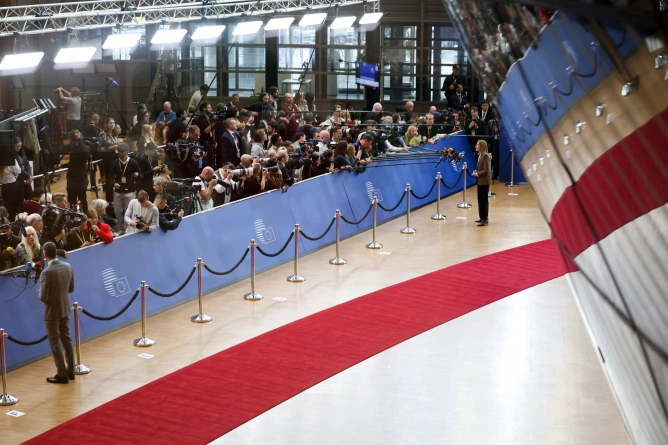
The Bruegel study appears at a time when EU–China trade relations occupy a central place on the European agenda. On October 15, the European Council called on the Commission to use existing trade and economic instruments effectively and urgently strengthen the Union’s capacity to respond to global macroeconomic imbalances. The leaders’ conclusions establish a political orientation without yet identifying a complete set of new instruments. Mavroidis’s analysis offers a perspective on the possibilities and limits of the multilateral framework, without representing Bruegel’s official position on a specific legislative proposal or a decision by EU institutions.
For European companies, the main implication is that protection against subsidized competition requires both legally applicable trade instruments and a broader economic approach to international imbalances. WTO disputes can clarify and enforce existing obligations. Reforming subsidy rules, however, would require negotiations among members, while any macroeconomic coordination mechanisms would involve international financial institutions and agreements between governments. None of these recommendations creates new obligations for companies or EU member states through the publication of the study.
23:01
22:57
22:53
22:50
22:43
See more news
Latest News
NEWS ON THE SAME TOPICS





.webp)