The European Union and Turkey resume high-level discussions on trade, migration, security, and visas



Always see our news on Google
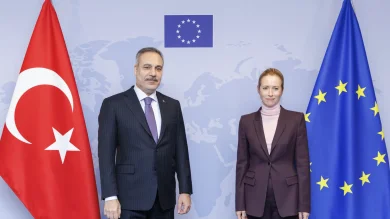
The European Union and Turkey have agreed to relaunch several high-level dialogues following a meeting in Ankara between Turkish Foreign Minister Hakan Fidan, EU High Representative Kaja Kallas, Commissioner for Enlargement Marta Kos, and Commissioner for Home Affairs and Migration Magnus Brunner. The agenda includes economy, trade, migration, security, health, science, innovation, and agriculture, with new meetings expected to take place preferably before the end of the year.
In brief
The EU and Turkey discussed in Ankara the bilateral relationship, trade, migration, security, and foreign policy.
The parties reaffirmed the strategic value of the EU-Turkey relationship and reminded of Turkey's status as a candidate country.
The EU emphasized the need to strengthen the rule of law, protect fundamental rights, and uphold democratic standards.
The discussions included the modernization of the Customs Union, visa dialogue, and Turkey's possible participation in SEPA.
The EU and Turkey discussed Ukraine, sanctions, Cyprus, the South Caucasus, migration, and cooperation in security and defense.
The meeting marks an attempt to bring the EU-Turkey relationship back onto a path of practical cooperation at a time when common files have become more interconnected: Russia's war against Ukraine, migration, regional security, energy, trade, connectivity, and economic competition.
The statement recalls Turkey's status as a candidate country for EU membership, but the tone of the discussion is focused on strategic cooperation and managing concrete files. Turkey remains an important actor for the EU due to its geographical position, role in NATO, relations with the South Caucasus and the Middle East, control of migration routes, and economic ties with the European market.
The European side emphasized, in the context of enlargement, the need to strengthen the rule of law, protect fundamental rights, and ensure high democratic standards. This wording maintains political conditionality in the relationship with Ankara, even though the meeting emphasized cooperation in areas where EU and Turkey's interests overlap.
One of the central economic files is the EU-Turkey Customs Union. The two parties reaffirmed their willingness to improve the implementation of the current framework and prepare for its modernization. A modernized Customs Union could have effects on trade, industrial chains, competitiveness, and economic security, at a time when the EU is trying to reduce risky dependencies and strengthen its industrial base.
The statement also mentions industrial policy, where both parties highlighted the importance of an inclusive and reciprocal approach for the competitiveness and economic security of the EU and Turkey. The wording indicates Turkey's interest in remaining connected to European industrial transformations, including in the context of the green transition, digitalization, and new supply chains.
Another important economic point is Turkey's possible participation in the Single Euro Payments Area, SEPA. Participation in SEPA could simplify euro payments between Turkey and the European area, with effects for businesses, citizens, banks, and cross-border trade. The statement says that such potential participation would be beneficial.
On the visa file, the parties discussed the status of the Visa Liberalization Dialogue and exchanged views on the application and processing procedures for visas for Turkish citizens. This subject carries significant political weight in Turkey, where difficulties in obtaining visas for the European area are often presented as a sign of an unbalanced relationship with the EU.
Migration was discussed in connection with the current geopolitical situation and possible effects on population movements. The EU and Turkey recognized common challenges and expressed a willingness to cooperate more in border management and combating human trafficking.
Cooperation on migration remains one of the most sensitive files in the relationship. Turkey hosts a large number of refugees and migrants, and the EU relies on cooperation with Ankara to reduce irregular crossings and combat trafficking networks. At the same time, migrant rights, reception conditions, and internal political pressure in member states make this file difficult to manage.
Externally, the EU and Turkey discussed Ukraine, Russia, the Middle East, Africa, and the South Caucasus. The two parties reaffirmed their commitment to Ukraine's sovereignty and territorial integrity and support for a just and lasting peace based on international law.
The EU reminded the importance of preventing the circumvention of European sanctions by all states. This clarification addresses one of Brussels' major concerns: goods, technologies, or financial flows that may indirectly reach Russia through third countries and weaken the effect of the sanctions adopted after the invasion of Ukraine.
In the South Caucasus, the EU and Turkey agreed to coordinate complementary efforts for regional peace, prosperity, connectivity, trade, and economic ties. Ankara has a direct influence in the region, while the EU is interested in stability, transport and energy corridors, as well as reducing conflict risks.
Cyprus was mentioned with support expressed for the efforts of the UN Secretary-General. The file remains one of the most difficult political issues between the EU and Turkey, as the Republic of Cyprus is a member state of the European Union, and the Cyprus issue directly affects the Ankara-Brussels relationship.
In terms of security and defense, the parties emphasized the importance of strengthening dialogue and cooperation in complementarity with NATO. This wording allows for discussing EU-Turkey cooperation without presenting it as an alternative to the North Atlantic Alliance, where Turkey is a member, and several EU states are NATO allies.
The statement also mentions cooperation in trade, energy, transport, and digitalization, including in connection with the regional connectivity agenda. The parties welcomed the gradual resumption of operations of the European Investment Bank in Turkey, a signal of economic relevance for investment projects and financing.
The EU-Turkey relationship remains marked by political tensions, but the meeting in Ankara shows that both parties want to keep open channels of cooperation in files where the costs of blockage would be high. Trade, migration, regional security, Ukraine, energy, and connectivity make Turkey a difficult but hard-to-avoid partner for the European Union.
Latest News
12:00
11:59
11:51
11:47
11:21
See more news
NEWS ON THE SAME TOPICS











.webp)