EU warns that China’s nuclear arsenal is expanding rapidly and could approach 1,000 warheads


Always see our news on Google
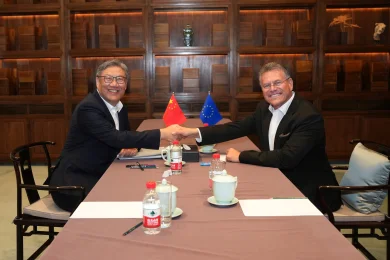
China is expanding its nuclear arsenal at a pace that could bring the number of warheads close to 1,000, while the European Union believes that Beijing will have to be included, sooner or later, in future discussions on strategic arms control. The EU’s Special Envoy for Non-Proliferation and Disarmament, Ambassador Stephan Klement, told the European Parliament’s Committee on Security and Defence that some estimates indicate the addition of approximately two nuclear weapons per week and that the current growth of China’s arsenal can no longer be ignored in a system built primarily around the nuclear relationship between the United States and Russia.
In brief The EU’s Special Envoy for Non-Proliferation and Disarmament says that some estimates indicate a rate of approximately two new nuclear weapons per week in China. The Chinese arsenal could reach several hundred additional warheads in the near future and could approach 1,000, according to estimates cited in SEDE. Beijing continues to develop and test launch systems, including long-range ballistic missiles launched from submarines. The EU is trying to persuade China to enter into a strategic dialogue with the United States and participate in missile transparency mechanisms. Following the expiry of New START without a successor agreement, Brussels believes that any future arms-control architecture must also take into account the rapid growth of China’s nuclear capability.
Ambassador Stephan Klement described the expansion of China’s arsenal as one of the most important changes in the global non-proliferation environment. In the assessment presented to Members of the European Parliament, China is no longer a peripheral actor in a system dominated by the American and Russian arsenals, but a nuclear power whose growth could directly alter the conditions of future negotiations.
Klement said that estimates are circulating according to which China is adding approximately two nuclear weapons per week. He did not present this figure as an EU assessment of its own, but as one of the estimates currently in the public domain; nevertheless, he used it to illustrate the speed of the buildup.
According to him, the Chinese arsenal could reach several hundred additional warheads relatively soon and could approach the threshold of 1,000. For Brussels, this development complicates the traditional model of strategic arms control, which for decades focused on limits negotiated between Washington and Moscow.
The issue became more acute after the expiry of New START, the agreement that imposed quantitative limits on US and Russian strategic nuclear forces. The absence of a successor leaves the current system without one of the main instruments of predictability between the two major nuclear powers, precisely at a time when a third arsenal is expanding rapidly.
In this context, Klement said that it is becoming increasingly difficult for the United States and Russia to discuss new strategic limits without taking China into account. He explained that the difference between a Chinese arsenal approaching 1,000 warheads and the larger arsenals of the United States and Russia would be sufficiently small for Beijing to become relevant to any future arms-control formula.
China has so far refused to participate in this type of trilateral negotiation. The EU envoy said, however, that he sees very cautious signs that Beijing might, at some point, become more open to such a discussion, even though there is currently no formal process indicating that an agreement is approaching.
The EU is trying to encourage China to participate in a strategic dialogue with the United States on nuclear weapons and to become more involved in multilateral transparency mechanisms.
One of the instruments mentioned is the code of conduct on missile transparency, which Brussels is also trying to persuade China to join. The interest concerns not only the number of warheads, but also the development of the means by which they can be transported and launched.
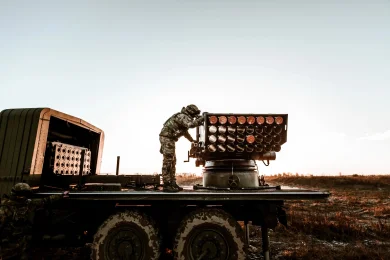
Klement pointed in this regard to the recent testing of a long-range ballistic missile launched from a submarine. The development of such systems can increase the survivability and flexibility of nuclear forces because part of the arsenal can be moved at sea and becomes more difficult to locate.
The growth of China’s capability comes at a time when other components of the international arms-control architecture are also under pressure. This year’s Review Conference of the Treaty on the Non-Proliferation of Nuclear Weapons failed to adopt a final document, and Klement also mentioned the persistent difficulties surrounding the entry into force of the Comprehensive Nuclear-Test-Ban Treaty and the lack of progress on an agreement regarding fissile materials.
In China’s case, the issue is not only the size of the arsenal, but also the fact that its expansion is taking place at a time when the control mechanisms between the other powers are weakened. From this perspective, Beijing is simultaneously becoming a risk factor and an actor without which a new global architecture could be difficult to build.
Klement nevertheless drew a distinction between China and Russia. He said that Beijing has a strong interest in the functioning of the international order, including for trade and its economic relations, even though it is trying to shape that order in its own interest.
In his view, this dependence on a functioning international system leaves more room for dialogue than the current relationship with Moscow. The EU is therefore trying to work with Beijing not only in the field of arms control, but also to persuade it to use its influence over Russia and not provide material support for the war against Ukraine.
Klement said that China’s influence over Russia’s behaviour is very great, although he declined to confirm claims that Beijing had intervened specifically to prevent Moscow from resorting to nuclear weapons in Ukraine.
The European Union is not itself a nuclear power, but France is a member state with nuclear weapons, and Brussels is trying to build its influence through common positions of the 27 and through multilateral diplomacy.
Klement described the internal negotiations required to adopt a common European position as a kind of “mini-review conference,” because the Member States have different sensitivities and priorities. The compromise reached among them can precisely turn EU wording into a starting point for broader negotiations with other states.
During recent international discussions, he said that common European positions were sometimes used as a basis for compromise and consensus, even though the EU is not the actor capable of imposing limits on the arsenals of the major powers.
The current international nuclear architecture was built during a period when the United States and the Soviet Union, and later Russia, numerically dominated the strategic arsenals. China’s rapid growth is gradually altering this structure and making it more difficult to negotiate new limits exclusively on a bilateral basis.
The EU does not present the figure of nearly 1,000 warheads as an official inventory verified by Brussels, but as an estimate relevant to understanding the pace at which the nuclear balance is changing.
The message presented in SEDE is that Beijing must be encouraged to enter a more transparent system and a broader strategic dialogue before the gap between the arsenals of the major powers narrows even further.

Latest News
11:59
11:52
11:51
11:41
11:41
See more news
NEWS ON THE SAME TOPICS