EPPO dismantles a tobacco smuggling network in five countries and confiscates over 40 tons



Always see our news on Google
The European Public Prosecutor's Office announces the dismantling of a transnational tobacco smuggling network operating through Italy, France, Poland, Switzerland, and the United Kingdom, in a case with estimated tax losses of over 10 million euros and confiscations of approximately 41 tons of cigarettes.
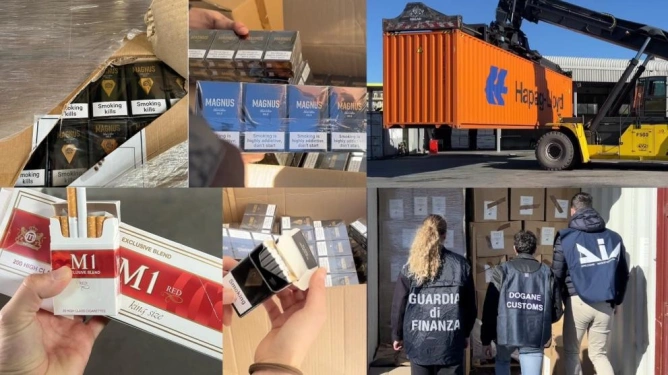
The European Public Prosecutor's Office, through its office in Turin, has announced the dismantling of a tobacco smuggling network operating in Italy, France, Poland, Switzerland, and the United Kingdom, following a coordinated action that led to several arrests and the confiscation of over 40 tons of illicit tobacco products. According to the EPPO, the case, codenamed "Borotalco", started from the analysis of suspicious movements of containers arriving at the Port of Genoa and allowed the identification of a transnational criminal organization with an operational base in the United Kingdom and connections in Europe, Africa, and Asia.
In short 1. The EPPO announced the dismantling of an active tobacco smuggling network in Italy, France, Poland, Switzerland, and the United Kingdom.
2. The investigation led to the confiscation of nearly 41 tons of manufactured cigarettes and preventive arrest measures for five suspects.
3. Estimated losses from customs duties, excise taxes, and VAT exceed 10 million euros, and the seized goods are valued at approximately 2.5 million euros.
4. The network used false customs documents, indirect trade routes, fake websites and email addresses, as well as encrypted communication platforms to avoid checks and surveillance.
The investigation started from containers arriving in Genoa and led to the outline of a network that declared the goods originated from Armenia, Dubai, and Spain. According to the EPPO, the products entered Italian territory through the Port of Genoa, using maritime and trade routes designed to avoid customs inspections. These routes passed through Georgia, Kenya, the Netherlands, and Turkey, precisely to hide the true origin of the illicit goods. The final destination was the black market in several European states.
Investigators claim that the organization built a logistical and administrative infrastructure meant to give the appearance of ordinary commercial operations. A company in the Genoa area was allegedly used for transport notifications in customs procedures, in order to avoid checks. The same company allegedly provided warehouses in the province of Alessandria, near the Port of Genoa, for unloading and storing smuggled tobacco before transport to other destinations, but also for keeping materials used to camouflage the goods.
According to the EPPO, the goods were declared as construction materials, used as cover cargo for cigarette cartons. Additionally, the containers had false bottoms, used as hidden compartments for transporting tobacco. To hide the identity of the recipients listed in the customs documents, an IT specialist from the Campania region allegedly created and managed fake websites and fictitious email addresses. The European Public Prosecutor's Office also shows that the organization used encrypted communication platforms to avoid surveillance by authorities.
Following a request made by the EPPO, the preliminary investigation judge at the Genoa Court ordered the preventive arrest of five suspects, detained in Italy, the United Kingdom, and Poland. In parallel, goods valued at approximately 2.5 million euros were seized. The EPPO specifies that, prior to this phase, law enforcement activities at the Port of Genoa had already led to the confiscation of nearly 41 tons of manufactured cigarettes.
The estimated financial impact of the network is significant. According to the EPPO, the loss from customs duties, excise taxes, and VAT exceeds 10 million euros. The market value in Italy for the confiscated goods is estimated at approximately 15 million euros, and this value could have doubled or even tripled if the shipments had reached their final destination. From this perspective, the case is relevant not only as an organized crime investigation but also as a case concerning the harming of public financial interests through tax and customs fraud.
The EPPO emphasizes that the investigation was supported by the international operational anti-mafia network @ON and by Europol, as well as by national authorities from several states. The institution explicitly mentions cooperation with the British authorities HM Revenue & Customs and the Federal Office for Customs and Border Security in Switzerland, along with the involvement of the Metropolitan Police in the United Kingdom, the economic crime units in Poland, the customs authorities in Paris, the Anti-Mafia Investigation Directorate, and the Financial Guard in Genoa, as well as the Customs and Monopolies Agency in Italy. The case is thus presented as an example of extensive cross-border cooperation against organized crime.
The institutional context is as important as the operation itself. The European Public Prosecutor's Office reminds that it is the independent criminal prosecution office of the European Union, responsible for investigating, prosecuting, and bringing to trial crimes that harm the financial interests of the EU. In this framework, the "Borotalco" case illustrates how smuggling of excise goods is treated as a problem of European economic crime, not just as a national customs offense. The EPPO also specifies that all targeted individuals benefit from the presumption of innocence until a final decision is made by the competent courts in Italy.
Latest News
23:12
22:53
22:53
22:25
22:06
See more news