Dragoș Benea calls for dedicated funding for eastern regions and opposes cuts to cohesion funds


.webp)

Always see our news on Google
Benea calls for 95% co-financing, 20% pre-financing and a dedicated allocation for the eastern regions. These are requests for the future budget, with no funding already approved.
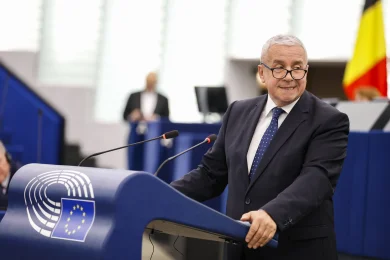
Dragoș Benea, chair of the European Parliament’s Committee on Regional Development (REGI), called on Tuesday, 24 November 2026, for preferential financial conditions for regions on the EU’s eastern border and opposed reducing cohesion funds in the 2028–2034 budget. In the Strasbourg debate on the security of states on the eastern border, the Romanian S&D MEP argued that investment in these territories contributes to the security and competitiveness of the entire Union.
Key points
Benea called for 95% European co-financing, 20% pre-financing and a dedicated allocation of 10% from the relevant European instruments for the eastern regions. These are political requests for future funding, not financial entitlements already granted.
The MEP was the rapporteur for the REGI opinion on the 2028–2034 budget, adopted on 25 February 2026 with 31 votes in favour, no votes against and two abstentions.
The 2025 regulation for the current cohesion programmes separately provides for additional pre-financing of 9.5% in 2026 for eligible programmes covering regions bordering Russia, Belarus or Ukraine, under the conditions established by the act.
The compromise presented by António Costa reduces the total volume of the Commission’s budget proposal by approximately 10%. The percentage does not describe a uniform reduction of every programme or of Romania’s allocations.
Benea referred to the economic, social and security pressures on regions supporting Ukraine and the Republic of Moldova. The MEP, who originates from Bacău, argued that these territories cannot be assessed solely through traditional regional development indicators, as they also bear costs related to Russia’s war against Ukraine and the protection of the Union’s border.
The conditions he requested are a European co-financing rate of 95%, 20% pre-financing and a dedicated allocation of 10% from the relevant European instruments. Co-financing establishes the share of eligible expenditure covered by European funds, while pre-financing provides liquidity before expenditure is reimbursed. These percentages cannot be added together into a single allocation and do not represent amounts obtained for Romania.
The intervention precedes the extraordinary European Council meeting of 26–27 November. On 21 November, the President of the European Council, António Costa, presented a compromise that reduces by €204 billion in current prices, approximately 10%, the total volume initially proposed by the Commission for the future budget. The reduction in the total does not mean that every cohesion programme or every national allocation would decrease by the same percentage.
Benea’s position continues earlier parliamentary efforts. As rapporteur for the REGI Committee’s opinion on the 2028–2034 budget, adopted on 25 February, he supported a document warning that the repeated redirection of cohesion funds towards other priorities undermines predictability and long-term regional investment. The opinion calls for crisis instruments to provide additional funding without permanently consuming the resources of existing programmes.
The same opinion identifies pressures on authorities on the eastern border in the areas of mobility, infrastructure, security and migration, as well as the risk of reduced private investment. REGI calls for specific financial support and a programme with a dedicated budget for regions bordering Ukraine, Russia and Belarus. The opinion is a parliamentary committee’s contribution to negotiations and does not itself establish binding funding rules.
On 28 April, Parliament adopted its mandate for the future multiannual financial framework, prepared by co-rapporteurs Siegfried Mureșan and Carla Tavares. It calls for a budget of 1.27% of the EU’s gross national income, with repayment of the NextGenerationEU debt, estimated at an additional 0.11% of GNI, accounted for separately outside this ceiling.
Benea was also the S&D group’s shadow rapporteur for the resolution on the regions on the eastern border, whose lead rapporteur was Jacek Protas (EPP). Adopted on 22 October with 414 votes in favour, 79 against and 90 abstentions, the resolution calls for an additional dedicated allocation for these territories in the future cohesion policy. It expresses Parliament’s political position and does not directly amend the fund regulations.
There is, however, also a completed legislative file for which Benea was rapporteur: the mid-term review of the rules for the European Regional Development Fund, the Cohesion Fund and the Just Transition Fund. Regulation (EU) 2025/1914 allows some resources to be redirected towards strategic priorities and provides, for eligible programmes, facilities distinct from the requests now formulated for the period after 2027.
For programmes covering NUTS 2 regions bordering Russia, Belarus or Ukraine, the one-off additional pre-financing may reach 9.5% in 2026. Approval of the reallocation of at least 10% of the programme’s resources towards the specified priorities and submission of the amendment request by 31 December 2025 are required. In principle, the increased percentage does not apply to programmes covering the entire country; the regulation provides for an exception when border regions are included only in such programmes.
In Romania, the North-West, North-East and South-East regions include territories directly bordering Ukraine. Connections with the Republic of Moldova, the Danube and the Black Sea increase the relevance of investment in transport, logistics, public services and critical infrastructure. However, these connections do not automatically establish a project’s eligibility or funding amount.
The Commission’s communication of 18 February 2026 on the eastern regions identifies trade disruptions, pressures on housing and medical and social services, as well as additional demands for transport. The approach covers nine Member States, including Romania and Bulgaria, and takes account of the maritime dimension of the eastern border.
Adoption of the multiannual financial framework requires unanimity in the Council and approval by the European Parliament. The specific conditions for the eastern regions will also depend on the legislation governing the funds for 2028–2034. Benea’s intervention supports these requests in the negotiations without being equivalent to approval of a new allocation.
Latest News
20:12
19:55
19:49
19:34
19:18
See more news
NEWS ON THE SAME TOPICS