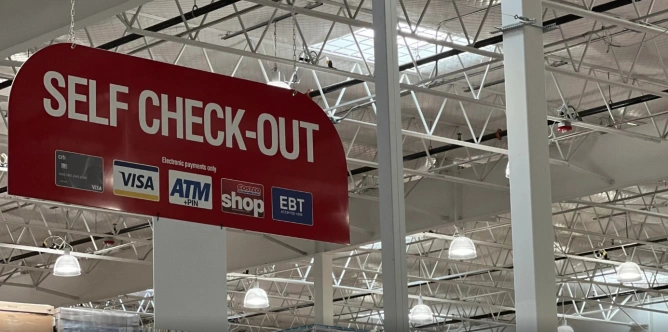
Almost half of the companies with self-checkout do not accept cash at the automated terminals.



Always see our news on Google
13% of the companies in the euro area analyzed by the ECB have introduced self-checkout terminals, but in 48% of these, none of the automated terminals accept cash. The ECB warns that automation can effectively reduce the ability to pay cash even in stores that continue to declare that they accept banknotes and coins.
Payment automation can make cash more difficult to use even in companies that continue to accept it. A survey by the European Central Bank shows that 13% of companies in the euro area have introduced self-checkout terminals, but in almost half of these, cash payment is not available at any automated terminal.
In short
1. 13% of the companies analyzed by the ECB have introduced self-checkout terminals at physical points of sale.
2. Only 52% of companies with self-checkout allow cash payment at least at some of the automated terminals, which means that 48% do not accept cash at any of them.
3. The ECB warns that a merchant may continue to accept cash in general, but offer fewer practical possibilities for its use as they automate payment.
4. 25% of companies have introduced measures to encourage digital payments or reduce cash usage.
5. 92% of companies that currently accept cash still intend to continue accepting it in the next five years.
Self-checkout terminals are still present in a minority of the companies analyzed by the ECB, but the way they are configured shows one of the ways in which digitalization can change the actual payment possibilities for consumers. Of the 13% of companies that have introduced such terminals, only just over half allow cash usage at least at some of them.
For the remaining 48%, the automated terminals operate exclusively with cashless methods. The consumer may still have the option to pay cash at a traditional checkout, which allows the company to declare that it accepts cash, but the actual number of points where this option is available may be lower.
The ECB highlights this difference between declared acceptance and practical access. At the euro area level, 92% of companies that receive payments at physical locations say they accept cash, but this indicator does not show how easy it is for a customer to actually find a checkout where they can use banknotes and coins.
Automation can reduce this availability without a merchant officially giving up cash. If an increasing portion of shoppers is directed towards self-checkout, and these terminals only accept cards or mobile payments, cash remains formally available but may become harder to use in the usual shopping experience.
For this reason, the ECB believes that the development of automation should be monitored so that it does not inadvertently reduce cash to the status of a difficult-to-access option. Maintaining a high acceptance rate is not sufficient if the payment infrastructure used by consumers practically limits the possibility of choosing cash.
Self-checkout terminals represent only a part of the digitalization process. A quarter of companies in the euro area report that they have taken measures in the past year to encourage digital payments or to reduce cash payments.
The most common changes concern the infrastructure at the cash registers. Among the companies that have introduced measures to stimulate digital payments, 37% have purchased cash registers that allow cashless payments or have reduced the number of cash registers that accept cash, while 30% have promoted and advertised cashless payment methods.
These changes occur simultaneously with the strong expansion of mobile payments, now accepted by 68% of companies with physical payment points, compared to 36% two years ago. Cards are accepted by 88%, which means that an increasing number of merchants can offer more digital options in parallel.
However, the survey does not indicate a widespread intention to eliminate cash. Among the companies that currently accept it, 92% say they expect to continue accepting it in the next five years, while 6% anticipate that they will give it up and 2% are unsure.
The tension between the two trends is visible in the payment infrastructure: cash remains widely accepted, but companies are simultaneously investing in terminals and processes that favor digital methods. For the consumer, this combination may mean that the possibility of paying cash still exists, but not necessarily at all available payment points.
Cash automation also exists in the opposite sense. Among the companies that accept cash, 38% use automated cash management systems at the point of sale, and 37% use secure "smart safe" devices that automatically count, validate, and monitor the deposited money.
These technologies show that the digitalization of operations does not necessarily imply the elimination of banknotes and coins. A company can automate both electronic payments and cash management, the difference being whether the infrastructure provided to the customer retains both options.
Access to banking services is another factor that can influence merchants' decisions. Among the companies that do not accept cash, 35% say that depositing or withdrawing cash is difficult or inconvenient, an increase from 22% in 2024.
This evolution can make digital methods more attractive to merchants even if cash continues to be used by customers. Handling money involves collecting, storing, transporting, and depositing, and more difficult access to the necessary services can increase operational costs.
The ECB survey included 8,205 companies from all 21 euro area countries, focused on retail, restaurants and cafes, hotels, and the arts, entertainment, and recreation sector. The results regarding self-checkout refer to companies that accept cash and have physical points where customers can make payments.
Cash remains the most widely accepted payment method in the sectors analyzed by the ECB, but the 2026 survey shows that the simple acceptance rate does not fully describe the consumer experience. The configuration of terminals, the number of cash-accepting registers, and the expansion of self-checkout systems can modify the actual availability of banknotes and coins.
The ECB warns in the conclusions of the study that payment automation should not inadvertently hinder the use of cash. This issue becomes more relevant as companies expand digital infrastructure, even if the majority declare that they intend to keep cash in the next five years.
Latest News
17:53
17:42
17:33
17:31
17:22
See more news
NEWS ON THE SAME TOPICS