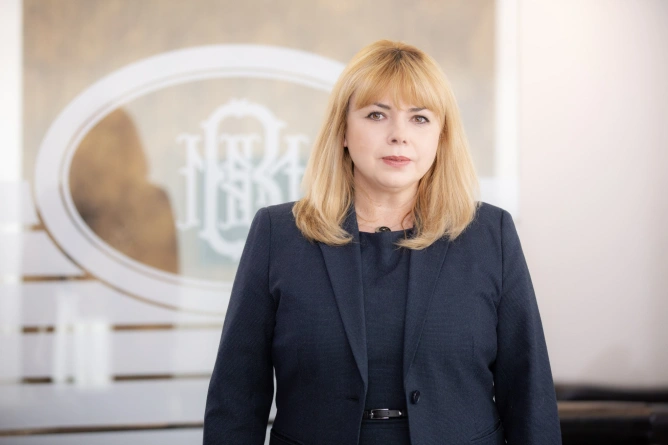
Anca Dragu says that the Republic of Moldova belongs to the European Union and that accession is a matter of alignment, trust, and values.



Always see our news on Google
The Governor of the National Bank of the Republic of Moldova, Anca Dragu, told us about her career in national and European institutions, about the concrete impact of the Republic of Moldova's accession to SEPA, about the role of women in leadership positions, and about Moldova's European stakes.
The Governor of the National Bank of Moldova, Anca Dragu, participated in an online discussion with young people interested in the European Union, public policies, and institutions. The dialogue was organized as part of the EYOUROPE project, carried out by Law&Lead and published by 2EU.brussels.
In the conversation with the students, Anca Dragu spoke about the responsibility of economic decisions, about her experience at the National Bank of Romania, the Ministry of Finance, the European Commission, and the National Bank of Moldova, but also about how the Republic of Moldova is building its European path.
You have worked at the European Commission, at the IMF, you have led the Fiscal Council, you were the first female president of the Romanian Senate, and now you lead the National Bank of Moldova. What was the moment in your career when you truly felt that you made a difference?
I believe that every moment in my career has been important in a certain way.
My first job was at the National Bank of Romania. I was a young graduate and I felt very important because every morning, every day, at 11:00 AM, I had to finalize and send to the top management a document, an analysis based on which the Board of Directors made decisions regarding certain market operations, either for injecting or withdrawing liquidity.
For me, as a young professional, it was a huge responsibility. I must admit that there were many nights when I couldn't fall asleep easily because of this responsibility.
The idea is that you build your career step by step. Every task I had, I considered it the most important thing I could do at that moment.
Of course, different positions and different responsibilities have a different impact. If we think, for example, about the impact of a decision made by a Minister of Finance, increasing or decreasing a tax has a direct and immediate impact on thousands or millions of people. It has a significant impact.
But you cannot reach such decisions if you do not build your career step by step. From the perspective of impact, probably the most important position was that of Minister of Finance, because you have the power to influence directly and indirectly, quickly, many companies, many citizens, and the economy as a whole.
But other moments have been equally important. Now, as the governor of a central bank, decisions are made together, at the level of the Executive Committee, but we have a major responsibility. Our main objective is to maintain price stability as much as possible.
For example, recently, on a Thursday, we had a monetary policy decision. We significantly raised the monetary policy rate by 1.5 percentage points, from 5% to 6.5%.
This was a decision we analyzed for over two weeks. I went to bed and woke up every day with this decision in mind, trying to find all the arguments for the best decision I could propose and take. It is a decision with a significant and immediate impact on the economy, on companies, and on people.
But this was possible, again, due to the career and experience behind me, which gave me confidence for increasingly important responsibilities.
The simplest answer is this: I made sure to grow step by step in my career and in the complexity of decisions. But at every stage, the decisions we made seemed extremely complex to me. I was much younger, I had less experience, but even then, at 24, those decisions seemed extremely important to me.
The Republic of Moldova recently joined SEPA, the European payment system. What does this concretely mean for an ordinary citizen of the Republic of Moldova?
Thank you for the question. It is a question that means a lot.
You are probably very young and do not remember how it was before Romania joined SEPA in 2014. Maybe your parents remember. In 2012 or 2013, I was working at the European Commission and I had to transfer money from Bucharest to Brussels. I wanted to transfer, for example, 5,000 euros for rent, deposit, and other payments, and the fee was 50 euros. That is a lot.
For Moldovans, until October 5 of last year, the situation was similar. Each transfer cost at least 20 euros up to 200 euros, depending on the amount. For transfers of 50 or 100 euros, the fee could be 20 or 30 euros. And why transfer such an amount from Moldova to the European Union or to the SEPA area? Maybe you buy a book, pay a subscription, buy tickets. These are very simple payments.
From October 5, 2025, if someone from Moldova buys a book and pays online, for example from France or Germany, they will no longer pay 20, 30, 40, or 50 euros in fees, but 0, 1, or 2 euros. That means a lot of money that stays in the pockets of citizens and companies.
SEPA means cheaper and faster transfers. Previously, such a payment could take three, four, or even five days. Today it can be done on the same day or the next day, practically within 24 hours. On average, the fee has decreased by 94%.
Previously, the average fee was up to about 30 euros. Now it is 1.26 euros per transaction. It is an extraordinary reduction in costs.
In total, companies and citizens have saved almost 7 million euros in six months of SEPA implementation. Each month, about one million euros in savings is added. Transfers cost a total of about half a million euros, and the savings reached almost 7 million euros.
These figures are very important. The Republic of Moldova is a country with a large diaspora. There are many students who receive maybe 200 or 300 euros a month from their parents. Previously, parents paid 20, 30, or 40 euros for each such transfer. Now they pay 1 or 2 euros, depending on the bank.
But there is also another dimension. The fact that the Republic of Moldova is in SEPA sends an important message to the economic community and foreign partners. It means that the European Commission has conducted a very thorough review of the legislation of the Republic of Moldova in the field of payments.
European directives on payments are implemented in the Republic of Moldova, but also the rules regarding banking supervision and, very importantly, those regarding the fight against money laundering and the financing of terrorism.
This means that the European Union has analyzed the institutions, legislation, and rules in Moldova and said: yes, Moldova is ready. From these points of view, the legislation, institutions, and rules are aligned with those of the European Union. Therefore, the Republic of Moldova can be part of the single euro payment area. It is a very important message for companies, for economic partners, and for the country as a whole.
You were the first woman to lead the Romanian Senate, and now you lead a central bank. What is it like to be a woman in such a field?
It is a very delicate question because I do not know what it is like for men to be in such positions. But, looking at the fact that there are so many men and so few women in such functions, I would say that it is probably easier for men.
There are challenges. We see very few women in very visible positions. In general, women in high positions are evaluated differently. It is not just about substance, about what they say and do. It is also about how they are dressed, how they look, how their hair is styled.
These are things that simply do not matter when we talk about men. No one analyzes the hairstyle of a bank governor or the hairstyle of a Senate president, except in the case where they would wear pink shoes that are visible from the Moon.
Society, in general, is more demanding of women. But for us, as women, this should also be a challenge. If our husbands, our fathers, or our brothers can support us, why can't we?
I believe that mentality matters a lot. If you are told as a child that you can do anything, then you know you can do anything and you do not see the difference. But if you are told "you are a girl, you have to be like this, you have to behave like this, you should not talk too much," then a pattern is created.
When I was a child, I had many very good female classmates at school, intelligent and very capable. But over time, I found myself quite alone. I was increasingly surrounded by men, and my intelligent and talented friends somehow disappeared from careers of such complexity.
I believe that, in general, it is easier for men. But I do not think we should complain. I strongly support the presence of women in political life. This is the key. If you are there, in politics, you can make decisions to allocate more money to kindergartens, care institutions, or services for the elderly.
Society has built this idea that women must take care of everyone. That is why it is important to have institutions that take care of the people around us, so that women can also allocate time for civic, political, and professional life.
Being a CEO is also a very difficult position. It requires a lot of time. That is why I insist that women reach the top of their institutions and especially in politics. In politics, you can decide public policies that help other women.
What would you say to a girl who wants to enter politics or economics but is afraid that the world is too big for her?
No girl should be afraid. Fear is not the right feeling.
If other women and girls can do it, why couldn't every girl? If boys and men can, why couldn't girls and women?
There is no room for fear of failure or fear of making a fool of yourself. The more visible you are, the more you can be attacked, you and your family, but this is part of the game.
The question is whether you are confident enough and determined enough to change things. The unpleasant part, the pressure, and the uncomfortable situations that arise when you are a public person can be compensated by the fact that you have the opportunity to make a difference.
These difficulties should increase your desire to be more convincing and to obtain more. There is a price to pay, but you have to make this game make sense for you and for others.
If you have a position through which you can change the lives of many people, do it in a good way. Do it for good. I encourage girls to take on these challenges.
You work at the National Bank of Moldova at a time when the Republic of Moldova is building its path to the European Union. What is it like to be part of the European story of a country?
This is not the first country in whose European story I am involved. I was also part of the European story of Romania. Then, when Croatia joined the European Union, I was working at the European Commission and I followed this country very closely. It was already 2013, I was working with EU member states at DG ECFIN, and I saw Croatia through the eyes of the European Commission as a new member state.
Now I find myself again in a similar position, as a person who works close to a country in the process of accession, just as Romania was in the 2000s.
After returning from a scholarship in the United States, in 2001 or 2002, I started a master's program in Bucharest about the policies and institutions of the European Union. I felt the need to better understand what the European Union is, what it wants from us, what the story is. This need to learn helps me even today.
The experiences are quite similar. A candidate country must implement the acquis communautaire, align technically with the rules of the European Union, and operate based on a merit-based process. But a country also needs political support. These are two important conditions for a state to become a member of the European Union.
For me, the European Union is a fascinating project. If we think about the period after World War II, we see how destroyed the economies were and how deep the suffering was. But some very intelligent people said: let's do something different. There was World War I, then World War II. Let's try something else. Let's put resources together in a project of peace, peaceful development, and common construction.
It was extremely difficult. There are many stories about how countries that were enemies during the war had to sit at the same table. Colleagues older than me at DG ECFIN told us about the tensions that existed, for example, between the French and Germans in the 1970s, tensions based on history.
That is why, for me, the European Union is a fascinating project. It is a project of peace. It is a project that promotes values and democracy. I lived through the communist period, even though I was very young, and I like to live in democracy and benefit from these principles.
It is a great honor to be able to contribute now to the European project of a candidate country, the Republic of Moldova. Moldova has become a candidate country, and things have moved very quickly. We hope to finalize the negotiations in a year or two, in record time.
It is an honor because I know the European project and I believe it is one of the best projects that have existed. I love democracy, I love the values of the European Union, and I would like to see the Republic of Moldova there. Moldova belongs to the European Union and must become a formal part of the European Union.
Latest News
23:01
22:57
22:53
22:50
22:43
See more news
NEWS ON THE SAME TOPICS




.webp)