Who is Mihai Dimian, the PNL's proposal for the Ministry of Education. The profile of the researcher, "shadowed" by accusations of self-plagiarism.



Always see our news on Google
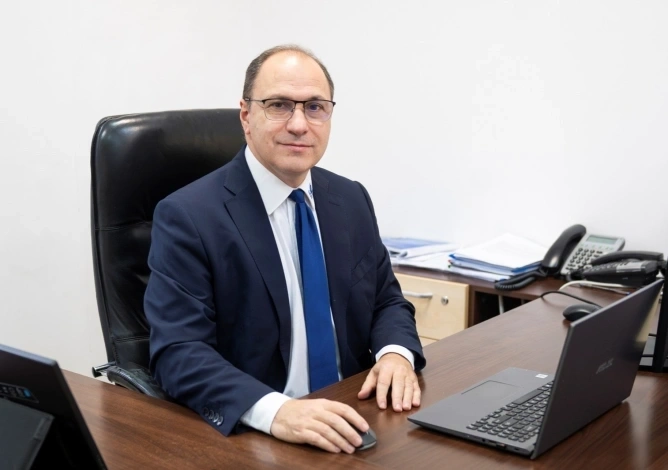
Mihai Dimian, the rector of the "Ștefan cel Mare" University in Suceava, is the PNL's proposal for the Ministry of Education, at a time of crisis marked by austerity, the resignation of Daniel David, and union protests, but also by controversies regarding self-plagiarism and the academic integrity standards in which he himself is involved.
Who is Mihai Dimian
Mihai Dimian is 51 years old, was born in Onești, is married, and has one child. He holds a bachelor's degree in mathematics (1993–1997) and in physics (1997–2001) from "Alexandru Ioan Cuza" University in Iași. He obtained his PhD in electrical engineering in the United States, at a university in Maryland, and has had research internships in France, the USA, and Germany. He was a research associate at the Max Planck Institute for Applied Mathematics in Leipzig, in the field of multi-scale modeling and noise-assisted phenomena. Since 2012, he has been a university professor at "Ștefan cel Mare" University in Suceava, where he is also a doctoral supervisor. His public CV includes numerous research projects and articles in fields such as electrical engineering and signal modeling, published in international journals and volumes. Since 2020, Dimian has been the rector of USV, having previously served as pro-rector responsible for research.
How PNL presents him
Mihai Dimian was proposed for the position of Minister of Education by Prime Minister Ilie Bolojan and unanimously validated by the National Political Bureau of PNL. PNL presents him as a university professor with a doctorate, rector, with international research experience, and as a politically independent candidate supported by the party. In the official statement, the liberals claim that Dimian has a "vision for reforming and developing the educational system" and that he presented a plan to the BPN for continuing the implementation of education laws, dialogue with unions, and modernizing schools.
According to sources cited by the press, Dimian is the only rector who accepted the proposal to take over the ministry, after months of negotiations and refusals. He is promoted as a "technocrat" with an academic profile, not as a career politician, although within the coalition he is perceived as an accepted compromise solution by PSD. PNL supports him as an independent, but the Education portfolio remains a political one, belonging to the liberal quota in the government.
Connection to politics and public positioning
Publicly, Mihai Dimian insists that he has not been and is not a party member, although he states that he sees nothing wrong with professors entering politics. He claims that "I do not consider it wrong for professors to be members of political parties and I even encourage my colleagues (...) to do so, because political parties need quality human resources," but at the same time he maintains that "the politicization of education has exceeded normal limits in Romania." Dimian says he preferred not to get involved "directly politically," but to collaborate with elected officials "regardless of political color" to develop the university and the region. This dual positioning – critical of politicization, but favorable to professors' involvement in parties – has been described in the press as a "confusing message," especially in the context in which his name was already being circulated for the ministry, while civil society was calling for clearer integrity criteria for occupying the Education portfolio.
The self-plagiarism scandal: why Dimian is accused
Mihai Dimian's name appears in an investigation by Emilia Șercan from 2018, published by PressOne, "Minister Valentin Popa self-plagiarized in three scientific articles." The investigation shows that Valentin Popa – then Minister of Education and rector of USV – republished, three times, articles or nearly identical versions of the same work, without clearly mentioning the previous publication, which, according to academic standards, constitutes self-plagiarism. In one of the cases, alongside Popa appears as a co-author Mihai Dimian, his name being added to an article considered "self-plagiarized" from a previous work. Șercan explains that self-plagiarism is "one of the serious forms of violation of university ethics": it refers to situations where an author publishes the same work or substantial parts of it two or more times, "without mentioning that the text has been previously published and without associating it with the identifying elements of the journal or volume in which it first appeared." In the analyzed case, the central issue is that the co-authored article by Popa, Coca, and Dimian does not specify anywhere that it is a rehash of already published research, but presents itself as an original work. The case resurfaced in early 2026, when Dimian's name reappeared in connection with his possible appointment to Education, and Edupedu.ro revisited the subject. The site notes that Dimian builds his defense invoking a decision from CNECSDTI and a resolution from the Ethics Committee of USV, according to which the article would not constitute a case of self-plagiarism. However, Edupedu specifies that it could not identify these documents on the Council's website, nor in public archives, and that the university committee's decision refers to internal interpretations, not negating general integrity standards.
Dimian's statements: "self-plagiarism represents a deviation from certain professional rules"
In an Edupedu article, Dimian is quoted saying that the article in which he appears as a co-author alongside Valentin Popa "has been proven not to be self-plagiarized," based on a decision from the Ethics Committee of USV and some documents from CNECSDTI, which he says he sent to journalists. In a public message quoted by Edupedu and Cotidianul, he clarifies his relationship with the phenomenon: "Plagiarism represents the theft of others' ideas and texts. SELF-plagiarism represents a deviation from certain professional rules, because you cannot steal your own ideas."
Dimian also resorts to a literary example to explain the repeated use of his own texts: "I liked the book by Professor Mircea Cărtărescu 'Why We Love Women,' even though it was a collection of essays previously published in Elle, Dilema, and others." Through this comparison, he suggests that republishing one's own materials can be legitimate, as long as the author is the same. Additionally, in a discussion reported by Cotidianul, Dimian talks about a "colleague" about whom "there was at one point a suspicion that he had stolen his own ideas," insisting that it is not about plagiarism, but about "a certain deviation from professional deontology. Self-plagiarism." In essence, the future Minister of Education draws a line of demarcation: plagiarism is "theft," while self-plagiarism is a procedural deviation, a violation of "professional rules," not of substance.
Emilia Șercan's response and the accusation of double standards
Journalist Emilia Șercan rejects this relativization. In her articles, she emphasizes that self-plagiarism is treated in university ethics codes as a serious violation, not as a mere "deviation," because it allows authors to artificially accumulate points, to "inflate" promotion files, and to obtain material or career benefits without additional work. Șercan draws attention to the fact that, in Popa's case and that of his co-authors, the issue is not that they have reused their own ideas, but that they did not transparently indicate where and when the first version of the research was published.
In a text dedicated to Dimian's reactions, Edupedu quotes Șercan, who states that "Mr. Dimian does not understand what academic integrity means," precisely because, as a university professor and rector, he should know and apply international standards, not reinterpret them. The journalist and Edupedu also make the distinction between the literary case invoked by Dimian and the scientific case: in "Why We Love Women," Mircea Cărtărescu explicitly lists, in the book, the magazines in which the essays were previously published, while the article co-authored by Popa, Coca, and Dimian "does not specify anywhere that it is not an original text." Additionally, PressOne reminds that, in Valentin Popa's case, several articles were published in publishers and journals considered "predatory," which further complicates the discussion about the quality and integrity of the publication process. In this context, Dimian's position – which, on the one hand, defends himself with internal ethics decisions, while on the other hand, redefines self-plagiarism as a minor deviation – is interpreted as a double standard: one set of rules on paper, another in how they are applied when people from his own environment are involved.
The broader context: the Bolojan government and plagiarism scandals
The dispute about the self-plagiarism in which Mihai Dimian is involved does not occur in a vacuum, but against the backdrop of a government already marked by plagiarism accusations at the top. The Minister of Justice, Radu Marinescu, is accused of plagiarizing over 50% of his doctoral thesis, a PressOne investigation showing that approximately 140 of the 247 pages are copied, with entire pages reproduced without proper citation. Prime Minister Ilie Bolojan stated that "plagiarism is theft" and admitted that the accusations are "very serious," but announced that he would wait for the ethics committee's verdict before making a political decision, suggesting that if plagiarism is confirmed, the minister's resignation will be inevitable.
For a future Minister of Education, the portfolio that manages doctorates, evaluation standards, and ethics committees, any ambiguity in dealing with self-plagiarism immediately becomes political. While the prime minister names plagiarism as "theft," Dimian tries to place self-plagiarism in the realm of "deviations from professional rules," and this contrast fuels the perception that academic integrity is negotiable depending on the actor.
Daniel David's resignation and protests in education
The Education portfolio is vacant after Daniel David's resignation at the end of 2025, against the backdrop of disputes regarding austerity in education. Daniel David left the ministry dissatisfied with budget cuts and the reduction of budgeted places at universities and the budget cut for 2026, repeatedly stating that Education and Research have already borne the first wave of cuts to keep the deficit under control and that he does not accept further cuts.
In September 2025, thousands of teachers protested in Bucharest demanding the resignation of the Minister of Education and the repeal of austerity measures assumed through Law 141. Unionists accused the "chaos" in the system, called for the abandonment of the increase in teaching norms, the increase in the number of students per class, and the obligation for directors to teach a larger number of hours, measures they consider devastating for the quality of education. They warn that, in the absence of changes, a general strike and the boycott of exams remain real options.
Mihai Dimian has spoken very cautiously on these issues, avoiding to explicitly promise a review of the austerity package. In interviews, he spoke more about the political instability at the top of the ministry, the need for continuity, and the challenge of managing limited resources, without directly criticizing the increase in norms or other contested measures. This caution explains why some unionists view him with skepticism and condition any "chance" given to the new minister on a clear timeline for correcting austerity.
What problems must Dimian solve
At the time of his appointment, Mihai Dimian takes over one of the most complicated portfolios in the government: a ministry under pressure from the streets, with unions radicalized by austerity and a university system marked by plagiarism and self-plagiarism scandals. In the short term, his main mission is to restore dialogue with the unions and clarify the fate of the measures from Law 141: teaching norms, number of students per class, funding per student, the status of directors, and working conditions in schools. In the medium term, Dimian will have to manage the implementation of the new education laws, coordinate curricular reform, digitalization of schools, and reduce school dropout rates, in conditions where public trust in the ministry is very low. Additionally, he will need to position himself clearly on the issue of academic integrity: the cases of Valentin Popa, Radu Marinescu, and his own self-plagiarism file compel him to show whether the ministry will truly support the strengthening of standards or will continue the practice of double standards.
Synthesis made with the help of a data monitoring flow provided by the media monitoring platform NewsVibe Romania. The presented analysis was enhanced with the help of Machine Learning and Artificial Intelligence tools.
Latest News
23:58
22:56
22:51
22:43
22:28
See more news
NEWS ON THE SAME TOPICS

.webp)
.webp)






.webp)