search icon
search icon
Flag Arrow Down
Română
Română
Magyar
Magyar
English
English
Français
Français
Deutsch
Deutsch
Italiano
Italiano
Español
Español
Русский
Русский
日本語
日本語
中国人
中国人

Change Language

arrow down
  • Română
    Română
  • Magyar
    Magyar
  • English
    English
  • Français
    Français
  • Deutsch
    Deutsch
  • Italiano
    Italiano
  • Español
    Español
  • Русский
    Русский
  • 日本語
    日本語
  • 中国人
    中国人
Sections
  • News
  • Exclusive
  • INSCOP Surveys
  • Podcast
  • EU
  • Diaspora
  • Republic of Moldova
  • Politics
  • Economy
  • Current Affairs
  • International
  • Sport
  • Health
  • Education
  • IT&C knowledge
  • Arts & Lifestyle
  • Opinions
  • Elections 2025
  • Environment
About Us
Contact
Privacy policy
Terms and conditions
Quickly scroll through news digests and see how they are covered in different publications!
  • News
  • Exclusive
    • INSCOP Surveys
    • Podcast
    • EU
    • Diaspora
    • Republic of Moldova
    • Politics
    • Economy
    • Current Affairs
    • International
    • Sport
    • Health
    • Education
    • IT&C knowledge
    • Arts & Lifestyle
    • Opinions
    • Elections 2025
    • Environment
164 new news items in the last 24 hours
  1. Home
  2. Current Affairs

Foskeia pelendonum, a small herbivorous dinosaur discovered in Spain, provokes a rethinking of the evolution of species due to its unique characteristics.

Emese Grancsa
whatsapp
facebook
linkedin
x
copy-link copy-link
4 February 2026, 16:30
main event image
Current Affairs
Credit: Bennekom / Alamy / Profimedia
google-preference

Always see our news on Google

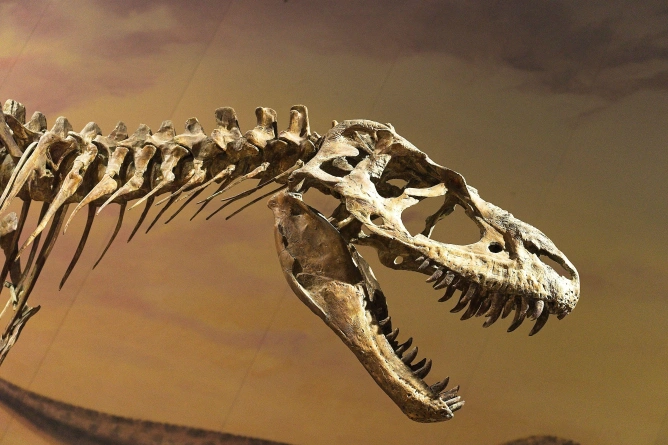
Recently, paleontologists discovered the fossils of a small herbivorous dinosaur, Foskeia pelendonum, in Spain, which measured just over 0.5 meters. This discovery has led to a rethinking of the evolutionary tree of species, considering that the dinosaur had a 'strange and hyper-derived' skull.

Analyzing five specimens from the clade Rhabdodontomorpha from the Late Cretaceous period, researchers found that miniaturization did not lead to an evolutionary simplification. The study, published in the journal Papers in Paleontology, places Foskeia pelendonum close to the origins of the European herbivores Rhabdodontidae.

Experts emphasize that this dinosaur helps fill a gap of 70 million years in the evolution of species, having a distinct anatomy that rewrites our understanding of evolution.

Sources

sursa imagine
G4Media
Fosilele unui mic dinozaur, descoperite în Spania, "rescriu arborele evoluţiei" speciilor
sursa imagine
Stiripesurse
Fosilele unui mic dinozaur, descoperite în Spania, "rescriu arborele evoluţiei"
sursa imagine
Agerpres
Fosilele unui mic dinozaur, descoperite în Spania, 'rescriu arborele evoluției'
sursa imagine
Newsweek
Fosilele unui mic dinozaur, descoperite în Spania, "rescriu arborele evoluţiei" * Newsweek România
sursa imagine
G4Media
Fosilele unui mic dinozaur, descoperite în Spania, "rescriu arborele evoluţiei"

Latest News

23:57

The Chinese Communist Party restricts IT specialists’ travel abroad, fearing defections and information leaks

23:30

Reuters: More than 20 mercury-based whitening products were available online, despite international bans

23:15

Vladimir Putin calls on Russians to participate in the parliamentary elections to show their support for the war against Ukraine / Donbas and Novorossiya vote for the first time

23:00

Novo collaborates with Anthropic to use artificial intelligence in the research and development of new medicines

22:57

The Deputy Prime Minister of the Republic of Moldova for European Integration welcomes the EU plan for roadmaps dedicated to candidate countries that are advancing rapidly

See more news

NEWS ON THE SAME TOPICS
event image
IT&C knowledge
Forgotten fossil in a drawer: the first vertebra of a Titanosaur discovered in Antarctica
event image
International
A complete T-Rex skeleton was sold at auction for 50 million dollars in New York, a record price.
event image
IT&C knowledge
Researchers at the University of California discovered that Tyrannosaurus rex was warm-blooded
event image
International
Remains of a prehistoric mammoth, discovered in northern Bulgaria after the lowering of the Danube level
event image
IT&C knowledge
Mammoth bones show that people of the Ice Age were organized hunters, not just simple survivors.
event image
Current Affairs
Archaeologists have discovered evidence that Neanderthals in Romania used bone tools at the site Abri 122/1200, dating from the Middle Paleolithic.
app preview
Personalized news feed, AI-powered search, and notifications in a more interactive experience.
app preview app preview
Spain dinosaur discovery Foskeia pelendonum
app preview
Personalized news feed, AI-powered search, and notifications in a more interactive experience.
app preview
app store badge google play badge
  • News
  • Exclusive
  • INSCOP Surveys
  • Podcast
  • EU
  • Diaspora
  • Republic of Moldova
  • Politics
  • Economy
  • Current Affairs
  • International
  • Sport
  • Health
  • Education
  • IT&C knowledge
  • Arts & Lifestyle
  • Opinions
  • Elections 2025
  • Environment
  • About Us
  • Contact
Privacy policy
Cookies Policy
Terms and conditions
Open source licenses
All rights reserved Strategic Media Team SRL

Technology in partnership with

anpc-sal anpc-sol