Vice President of the European Commission Teresa Ribera warns that modular nuclear reactors are still projects, not an immediately available energy solution.



Always see our news on Google
Small modular nuclear reactors can become a component of the European energy system, but they do not yet represent a solution that can be used immediately to reduce emissions or cover the increase in electricity consumption, said the Executive Vice-President of the European Commission, Teresa Ribera. She urged governments not to delay investments and reforms already necessary while waiting for technologies that still need to be demonstrated and commercially implemented.
In short Teresa Ribera says that the choice of the energy mix, including the share of nuclear energy, belongs to each member state. The Commission must ensure compliance with common safety, competition, and public money usage standards. Small modular reactors benefit from European research programs and a Commission strategy aimed at launching the first projects in Europe in the early 2030s. Ribera warns that modular reactors remain, for now, projects in development. Governments should not postpone investments in grids, energy efficiency, renewable sources, or emission reductions until 2035. Building new reactors and extending the operation of existing plants often requires public funding, guarantees, and the state taking on part of the project risk. The Commission will check whether these forms of support produce overcompensations, subsidized prices, or advantages that affect competition among energy technologies and consumer access to electricity.
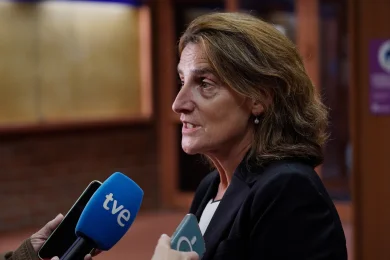
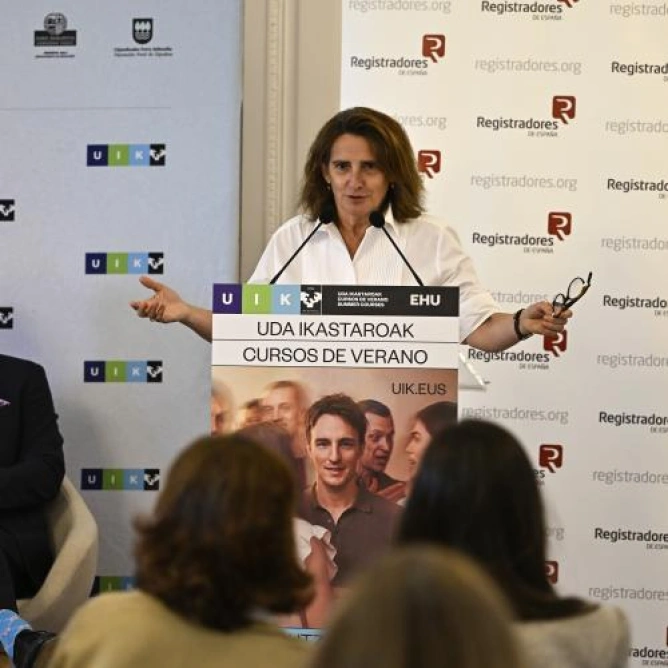
Teresa Ribera responded to a question about the future of nuclear energy and small modular reactors during the inaugural session of the sixth edition of the summer course "The great current challenges of the European Union," held in San Sebastián. The Executive Vice-President said that opinions on nuclear energy differ profoundly among states and that European policy must respect each country's right to establish its own electricity production mix.
Some governments have decided to build reactors, modernize existing plants, or extend their operational lifespan, while others base their strategy on renewable sources, storage, interconnections, and reducing consumption. The role of the Commission is not to impose the same energy structure on everyone, but the institution verifies compliance with European nuclear standards, safety requirements, and state aid legislation.
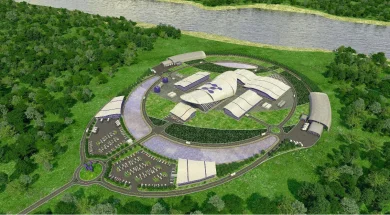
Small modular reactors, known by the acronym SMR, are designed for lower capacities than conventional nuclear plants. Their components are expected to be manufactured to a greater extent in industrial units and transported to the site for installation or assembly, a model that the industry claims can standardize construction and reduce some delays and costs. The Commission estimates that such reactors could provide electricity and heat for industry, urban heating systems, hydrogen production, and large consumers such as data centers.
Ribera insisted, however, on the gap between technological potential and commercial availability. The modular reactors currently being discussed are still projects, and the first European installations are expected for the early 2030s, not to address immediate energy needs. The European strategy adopted in March 2026 aims to accelerate the development and commissioning of the first projects during this period, confirming that the technology is still ahead of extensive commercial implementation.
Waiting for future technological progress cannot replace the measures that need to be applied now, said the Executive Vice-President. States must continue investments in grids, production, efficiency, electrification, and emission reductions, without building policies in which action is suspended until the potential availability of a technology after 2030 or 2035.
The Commission supports research and industrial preparation for SMR through Euratom programs and through the European Industrial Alliance launched in 2024. The 2026 strategy provides new action directions and aims to coordinate states, industry, safety authorities, and investors, so that national projects do not evolve in isolation and can use a European supply chain.
European support does not, however, represent a confirmation that all proposed models will become viable or that they will produce electricity at the costs estimated by developers. Projects must go through authorization, safety assessments, financing, construction, and demonstration of commercial operation. The Commission also emphasizes the need for solutions for protection against radiation, management of spent fuel and radioactive waste, and prevention of the proliferation of nuclear materials.
The issue of public cost occupied an important part of Ribera's response. Building new nuclear plants and extending the operation of existing ones typically required both public funding and guarantees through which the state takes on part of the project risks. These interventions may be necessary to attract capital into a sector with very high initial investments and long timelines, but they raise questions about the advantages granted to the producer and the effect on the market.
The Commission announced that it will create a guarantee of 200 million euros to support private investments in the first commercial units based on innovative nuclear technologies. The guarantee is intended to reduce risk for investors and should be seen as a tool for preparing the first projects, not as sufficient funding for building an entire fleet of reactors.
Any significant national support must also be analyzed from the perspective of state aid. The Commission's competition services check whether the government compensates only the necessary costs and risks or whether the mechanism guarantees excessive revenues, disproportionately transfers losses to taxpayers, or grants a producer an advantage that competitors cannot obtain.
Ribera specifically warned about the possibility that public funding could influence electricity prices. Guaranteed contracts, support schemes, and risk coverage can provide stability to a nuclear project, but they can affect competition with renewable sources, storage, or other technologies if the support is not proportional and transparent.
The Commission's analysis does not start from the idea that nuclear energy should be treated identically to any ordinary investment. Plants involve special safety requirements, very long operating periods, and obligations regarding decommissioning and waste. These characteristics may justify specific mechanisms, but do not eliminate the obligation of states to demonstrate the necessity, proportionality, and effect of support on the market.
The European strategy presents SMRs as a possible internal source of low-emission energy, capable of supporting energy security and decarbonizing hard-to-electrify industries. The Commission estimates that the installed capacity of these reactors in the EU could reach between 17 and 53 GW by 2050, but these figures are development scenarios, not capacities already under construction or guaranteed.
The first projects will need to show whether modular production can reduce the costs and delays that have affected many conventional nuclear plants. The economic advantages depend on the standardization of models, the number of units ordered, the capacity of factories, coordinated authorization, and the existence of a sufficiently large market for repeating the same design.
The debate on SMRs is therefore conducted on two levels. The Commission is investing in preparing a technology that could become important in the coming decades, but warns that projects should not be presented as an already available alternative to the investments that need to be made now.
The message conveyed by Ribera in San Sebastián was that technological neutrality does not mean suspending decisions until all options reach maturity. States can support nuclear energy and modular reactors, but they must continue in parallel to reduce emissions, modernize infrastructure, and expand sources that can produce results before the first European SMRs come into operation.

Latest News
07:29
07:26
07:22
07:16
07:13
See more news
NEWS ON THE SAME TOPICS