ANALYSIS Cernavodă, the test of Romania's unpreparedness: the drought that exposes the lack of adaptation of the energy system



Always see our news on Google
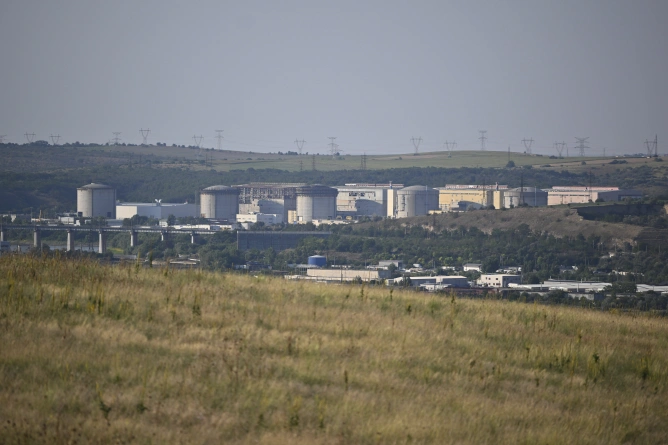
The controlled shutdown of Unit 2 at Cernavodă on Thursday morning is the first materialized effect in Romania of a drought that simultaneously puts pressure on the energy infrastructure in the Danube basin. The system has not entered a supply crisis, but the withdrawal of about 680-700 MW of stable nuclear production increases dependence on weather sources, fossil fuel plants, and regional exchanges—at a time when the nuclear plants at Paks and Kozlodui are also affected by the same hydrological problem.
The Cernavodă plant has shut down
Nuclearelectrica presented the shutdown of Unit 2 as a controlled and preventive measure, given the low level of the Danube and the unfavorable forecast developments in the water intake area necessary for cooling. Today, in the context where the reactor cannot be operated outside the established cooling and water supply parameters for the plant.
The message conveyed by Romanian authorities was that the security of supply is not in danger. State Secretary Cristian Buşoi estimated that the approximately 680-700 MW produced, on average, by Unit 2 will be mainly covered by imports, and in these days the system is also supported by wind production. In practice, this coverage does not mean that nuclear energy is replaced "one for one": the continuous source, with predictable production, is substituted by a portfolio of resources with different availability and cost profiles.
On Wednesday evening, at 7 PM, before the controlled shutdown of Unit 2, the internal production structure showed 2,625 MW from photovoltaics, equivalent to 51.1% of the total, 998 MW from hydrocarbons, 592 MW from coal, 502 MW from wind, 349 MW from hydro, and 51 MW from biomass. The snapshot is relevant for the system's capacity to absorb the imminent loss of the reactor, but it should not be read as proof that solar can constantly replace nuclear: photovoltaic production is only available for a limited window, while Unit 2 has a stable production of about 680-700 MW, including during the critical evening hours.
The Thursday noon update from Monitor Energie confirms the same profile: Romania was producing 5,164 MW on Thursday morning, after the shutdown of reactor 2, with a consumption of 4,898 MW, exporting a surplus of 265 MW, while solar provided 2,626 MW, or 52.4% of internal production. At that moment, Cernavodă showed 0 MW, suggesting that nuclear unavailability should be viewed as a resilience issue for sunless intervals and not as an automatic blackout risk on a day with high photovoltaic production.
Paks: the most exposed case
The situation at Paks has been, in the last two weeks, the closest to a total shutdown. The plant is Hungary's only nuclear unit and provides nearly half of the country's electricity; its cooling depends on water intake from the Danube. Very low river levels have activated operational constraints and raised the prospect of a complete shutdown for the first time in over four decades of operation.
Hungarian authorities have explicitly communicated the seriousness of the situation. In reports from early August, the reference threshold for shutdown was minus 134 cm at Paks, while the anticipated level could drop to minus 144 cm. The government in Budapest then spoke of "the most critical five days," and the public message was that the risk does not stem from a lack of demand or market, but from an indispensable physical condition for the operation of the plant: safe access to cooling water.
Meanwhile, the situation seems to have partially stabilized, allowing the plant to begin gradually recovering capacity. The risk has not disappeared, however: Paks remains the most vulnerable example of dependence on a single nuclear asset, and its evolution must be monitored in relation to Danube flows and water temperature. For Romania, this has a practical consequence: Hungary cannot be automatically considered a robust source of imports during a regional hydrological stress episode.
Kozlodui is operational, and authorities have reassuring messages
Bulgaria officially conveys the most reassuring message among the three states. Bulgarian Energy Minister Iva Petrova stated that there is no risk of shutdown at the Kozlodui plant due to the low level of the Danube and that the two reactors can operate at scheduled parameters in the coming weeks, provided that the hydrological situation does not deteriorate. Bulgarian authorities have also created a working group to monitor the situation.
Beyond this communication, there is an important technical warning. Georgi Kaschiev, former chairman of the board of directors of the Kozlodui plant, estimates that there are about 10-12 centimeters left until the first threshold at which power reduction would become necessary. An additional drop of about 20 cm could push the plant towards shutdown.
The plant has a different configuration compared to the others: it is located about five kilometers from the Danube and is supplied through a canal and a pumping station with 34 pumps. The operational risk is related not only to the available flow but also to the water level above the intakes, necessary to avoid cavitation and damage to the pumps.
Imports are not sufficient
In terms of hours or days, imports can cover a significant part of the deficit. But the regional market is not a guaranteed reserve: its availability depends on the production of neighbors, the capacity of interconnections, and competition for energy in the same consumption intervals. The synchronized drought on the Danube reduces the comfort of this solution, as it can simultaneously affect nuclear and hydro plants in several states.
Romania's dependence on Bulgaria deserves particular attention. In the last nearly 30 days, Romania has imported, on average, 503 MW from Bulgaria, which is 79.1% of the energy drawn from neighbors, compared to an average of only 30 MW from Hungary. Therefore, if Kozlodui were forced to reduce power, the pressure on the Romanian market would increase at a time when Cernavodă already has unavailable capacity.
The system can operate with one less nuclear reactor, but it depends more on weather-dependent energy production. Solar can cover well over the missing 700 MW during midday hours; however, it cannot provide the same power after sunset. Wind can complement production, but it is variable, and hydro plants are constrained by flows and the need to conserve water for high consumption moments.
Alternatives: useful, not magical
The emergency solution remains a combination of gas capacities, available coal, imports, and careful use of hydro resources for peak consumption. In the medium term, the key is flexibility: batteries, modernized distribution and transport networks, demand management, interconnections, and capacities that can respond quickly when solar or wind production decreases. Ana Otilia Nuţu from the think tank Expert Forum proposes the construction of renewable energy and diversification of production and to utilize already anthropized spaces or existing infrastructure, such as expanding photovoltaics, such as agrivoltaics in vineyards, orchards, and pastures; floating panels on reservoirs; solar canopies over commercial parking lots; and pilot projects between railway lines.
The underlying issue: adaptation
Here, Corina Murafa's observation, an expert in the European Economic and Social Committee, in an interview for HotNews fits in: the shutdown at Cernavodă should not be viewed only as an exceptional meteorological episode, but as the effect of a climate risk for which critical infrastructure and energy policy must be prepared. Murafa criticized the lack of Romania's representation in European discussions dedicated to climate adaptation, suggesting that Romanian authorities have not sufficiently internalized the changing environmental conditions in energy planning.
The criticism is not limited to the dispute between nuclear and renewables. Nuclear energy remains a low-emission source with constant production, but plants that use river water for cooling must be designed and operated for more frequent scenarios of high temperatures, low flows, and drought waves. To the same extent, hydro plants cannot be treated as an inexhaustible reserve, and the expansion of solar and wind must be accompanied by networks, storage, and balancing capacity.
The stakes are, therefore, planning. Romania needs public scenarios regarding system operation at extreme flows, redundancy measures for intake and cooling where feasible, transparent rules for water management, and an accelerated calendar for investments in batteries and networks. In their absence, each drought risks producing the same combination: reduced nuclear energy, limited hydro, more exposed imports, and pressure on fossil plants.
A regional vulnerability
The cases of Cernavodă, Paks, and Kozlodui show that the Danube has become a variable of regional energy security. What initially seems like a punctual exploitation problem at a plant can transform into a synchronized shock: less nuclear energy, less hydro flexibility, disrupted river transport, and greater competition for imports.
Romania is not facing an imminent power outage on Thursday. But the shutdown of Unit 2 is a warning about the limits of a system that simultaneously relies on the Danube water, regional imports, and solar available only at certain hours. The sustainable response is a diversified, more flexible technology explicitly planned for the climatic reality that this drought already indicates.
****Synthesis made with the help of a data monitoring flow provided by the media monitoring platform NewsVibe Romania. The analysis, data, and images presented have been enhanced with the help of Machine Learning and Artificial Intelligence tools.
Latest News
14:47
14:46
14:44
14:44
14:39
See more news
NEWS ON THE SAME TOPICS
.webp)





.webp)


.webp)