Ribera warns that AI expansion must not drive up energy costs for households




Always see our news on Google
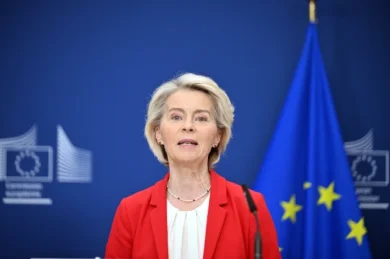
The rapid growth of artificial intelligence must not lead to additional tensions in the energy market or higher bills for households and the wider economy, Teresa Ribera, Executive Vice-President of the European Commission for a clean, just and competitive transition, warned. In a speech delivered in Paris on October 7, Ribera called for the debate on AI to move beyond chips, models and data and include the physical resources required by the technology. The location of data centers, access to the grid, water consumption and the concentration of control over computing capacity are, in this approach, becoming issues of energy policy and competition.
In short, Ribera says that AI development requires large amounts of electricity and water, in addition to existing demand. The location of data centers must be aligned with grid availability and energy prices, without shifting costs onto households and other sectors. The International Energy Agency estimates that global data center electricity use will more than double by 2030. Access to energy, computing capacity and data will influence who can develop AI products and who can compete in the market. Ribera did not announce a tax on data centers or an antitrust investigation. She presented the issue as one of infrastructure, energy and the functioning of markets.
A large part of the global competition for artificial intelligence is described in terms of chip power, access to models, the volume of data and computing capacity. Ribera drew attention to the physical infrastructure behind these elements, saying that AI development requires large amounts of water and electricity that must be available and reliable beyond the economy’s current needs. The issue arises at a time when the EU is simultaneously seeking to electrify industry, transport and buildings, meaning that new data centers will require connections to the same grids on which factories, decarbonization projects and consumers depend. For investors, Ribera identified three decisive factors: energy prices, the possibility of connecting to the grid and the predictability of the public policy framework.
Transparency about available grid capacity is therefore becoming relevant to choosing where data centers can be developed. An investment may have sufficient capital and access to technology, but its location also depends on the existence of an electricity connection capable of serving large and constant consumption. This pressure differs from the issue of total consumption at European level, because data centers tend to be geographically concentrated and can create bottlenecks or additional infrastructure needs in certain regions.
Ribera cited estimates by the International Energy Agency that global data center electricity consumption will more than double by 2030. The IEA estimates an increase from approximately 415 TWh in 2024 to approximately 945 TWh by the end of the decade, with AI the main driver of this development alongside the expansion of other digital services. Worldwide, data centers would remain below 3% of total electricity demand, but this average masks the concentration of consumption in certain local and regional systems. For authorities and grid operators, the challenge becomes the ability to integrate the new demand without excessive connection delays and without disproportionate costs being passed on to other consumers.
Ribera explicitly linked this latter issue to households. The development of Europe’s AI infrastructure must avoid a situation in which competition for electricity creates price pressures or a social burden for the rest of the economy, the Executive Vice-President argued. The speech contains no proposal to cap data center consumption and no announcement of a European tax applied to them. The message concerns how the costs and infrastructure required by AI should be integrated into energy planning so that the development of a strategic sector does not affect energy affordability for other sectors and citizens.
The second part of the issue concerns who controls the resources needed to build AI systems. Ribera included energy, computing capacity and data, arguing that access to these resources will directly influence which companies can innovate and enter the market. If essential infrastructure becomes concentrated in the hands of a small number of companies, smaller firms and the next generation of European developers may face barriers before they can compete effectively. In her view, mobilizing public funds to expand capacity must also create opportunities for new companies, rather than exclusively consolidating the positions of already dominant players.
For this reason, Ribera links Europe’s industrial ambition in AI to the enforcement of competition rules. Merger control and antitrust tools remain relevant in an economy where access to infrastructure can determine market structure, and the Commission is currently updating the guidelines used to assess mergers and acquisitions. The review does not concern AI exclusively, but it must adapt the assessment of concentrations to technological and economic changes, including the role of innovation, strategic assets and markets in which access to resources becomes a condition of entry.
For major digital platforms, Ribera also pointed to the Digital Markets Act as a complementary instrument. The regulation seeks to keep digital markets open and contestable through obligations imposed on companies designated as gatekeepers. Referring to these instruments does not mean that data center operators or companies developing artificial intelligence have automatically breached European law. Ribera did not announce an antitrust investigation in Paris and did not identify a particular merger or company as problematic.
The direction presented by the Commission Vice-President is a preventive one: Europe wants to increase its own artificial intelligence capacity, but this expansion must be prepared alongside energy investments and rules that keep markets accessible. Grids must be able to handle the additional demand, energy production must grow sufficiently to support it, and information on available capacity must enable better location decisions. At the same time, access to electricity, computing and data must not become a barrier preventing the emergence of new European competitors.

Latest News
22:57
22:53
22:42
22:30
22:28
See more news
NEWS ON THE SAME TOPICS
.webp)