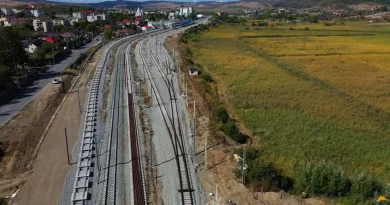
Modernization works on the Bucharest Progresu – Jilava – Giurgiu Nord – Giurgiu Nord Frontieră railway line have reached a physical completion rate of 22%, according to the latest report from CFR Infrastructure, up from 19% on October 13, 2026. The project aims to increase train speeds, reduce travel times, and improve passenger safety and comfort.
Works are under way on the railway embankments, culverts, platforms, reinforcement structures, and utility networks. At Progresu and Jilava stations, existing infrastructure elements are being dismantled and new platforms are being prepared. The passenger building at Progresu is 90% complete, while work continues on the pedestrian overpass and drainage systems.
Between Mihai Bravu, Băneasa Giurgiu, and Tabănu, poles for railway electrification are being installed. On the Mihai Bravu–Băneasa Giurgiu section, installation of the poles and anchors has reached 80%. In the Băneasa Giurgiu–Frătești area, works are being carried out on culverts, embankments, and the viaduct between kilometers 53+600 and 54+600, where foundations, bored piles, and support elements are being constructed.
The contract, worth 2.108 billion lei excluding VAT, was signed on August 14, 2025, by CFR SA with the RailWorks consortium, comprising Arcada Company and Alstom Transport. The contract has a duration of 36 months, including six months for design and 30 months for construction. The investment includes electrification, modernization of signaling and telecommunications, and implementation of ERTMS Level 2 and GSM-R. Completion is estimated for September 2028.
,
Context: The Bucharest–Giurgiu Project Had Previously Surpassed the 12% Threshold and Had Already Involved Scheduled Traffic Interruptions
A few months ago, CFR Infrastructure announced that the modernization of the Bucharest–Giurgiu railway line had reached a physical completion rate of 12% as of July 31, 2026, with full reopening estimated for September 2028. The project (Lot 2) covers the modernization of 93.45 km of railway line, including electrification, modernization of signaling systems, and duplication on the Daia–Frătești section, while funding was secured through the Connecting Europe Facility.
Separately, rail traffic on the Danube Bridge between Bulgaria and Romania was to be completely suspended from April 5 to December 13, 2027, also in the context of electrification and the reconstruction of railway infrastructure on the Bucharest–Giurgiu section. Passenger and freight trains were to be prohibited, while international transport was to be rerouted through the border crossing points at Vidin and Kardam.












 (1).webp)