SPECIAL Informat.ro / When Alexandra Căpitănescu enters the Eurovision final on Saturday and how the artist's performance is perceived in the press in Romania and abroad


Always see our news on Google
Alexandra Căpitănescu will enter the Eurovision 2026 final in Vienna on Saturday, May 16, in the second half of the evening, according to the official program of the contest, after qualifying from the second semifinal on May 14. Her participation with the song "Choke Me" marks one of the strongest Romanian presences at Eurovision in recent years, both in terms of scenic impact and public debate.
Alexandra will sing second to last in the Eurovision 2026 final
Romania is scheduled to take the stage at the Wiener Stadthalle in Vienna in the second part of the show. More specifically, Alexandra Căpitănescu will sing second to last. Romania performed in the second semifinal on May 14 and qualified for the final from an early position in the show, but will be scheduled later in the grand final, after some of the favorites of the edition. This positioning in the second half of the final is generally considered advantageous for the televote, as it keeps the fresh song in the public's memory.
Who is Alexandra Căpitănescu
Alexandra Căpitănescu is from Galați, she is 22 years old and won season 11 of "The Voice of Romania" (2023), a moment that established her before her selection for Eurovision. In the blind auditions, she turned all four chairs, choosing Tudor Chirilă as her coach.
Subsequently, she won the National Selection 2026, thus becoming Romania's representative at Eurovision with the song "Choke Me". According to reports from the Romanian press, she co-wrote the song with Călin-Alexandru Grăjdan, Elvis-Claudiu Silitră, and Ștefan Condrea, proposing a dark-pop sound with rock and dramatic accents. In statements made after her victory in the national final, Alexandra described the song as "a personal manifesto", a story about emotional control and dependency, and insisted that she wants "my music to reach people", thus assuming her potential for controversy from then on.

Alexandra Capitanescu qualified for the Eurovision final FOTO LUKA KOLANOVIC imago stock&people Profimedia
How was Alexandra Căpitănescu perceived after her performance in the semifinal that brought her qualification for the grand final of Eurovision
The NewsVibe report indicates a high volume of mentions for Alexandra Căpitănescu, both in the Romanian press and in the international one, peaking in the interval 21:30–23:00 CEST, immediately after her stage moment. The polarity analysis shows a fragmented landscape: a relatively majority of articles and posts with a positive tone, a consistent block of critical texts, mainly focused on the theme of "Choke Me" as a controversial title, and a core of neutral analyses, of the "technical review" type, published especially by specialized Eurovision sites.
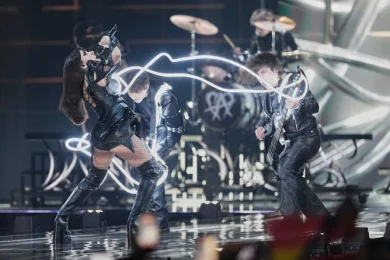
NewsVibe shows that in the international press, the focus fell on three axes: the visual concept (dark, theatrical performance with elements of rock and opera), Alexandra's vocal ability (range, control, endurance at the end of the song), and the moral debate related to the title and lyrics of the song. In the Romanian press, the report highlights a split between enthusiastic articles – especially in mainstream media and public radio – and more skeptical or indignant comments, especially in the opinion sites and conservative commentators' area.
Positive tone in the international press regarding Alexandra Căpitănescu's "Choke Me"
NewsVibe shows that a significant part of the "quality" press from Western Europe received Alexandra Căpitănescu's performance in predominantly laudatory terms, even though some commentators maintained specific reservations. Publications and specialized platforms such as Eurovisionworld and ESCXtra note that Romania brings "one of its strongest and most assertive entries in the last decade", insisting on the mix of voice, drama, and rigorously controlled choreography. In their reviews, journalists emphasize that "Choke Me" stands out through its dark pop construction, with an emotional crescendo and an explosive ending, breaking away from the conventional ballads that often dominate the competition. NewsVibe's analysis shows that several publications from the UK and Scandinavia describe Alexandra's show as "brave" and "atypical", noting that Romania bets on a dark, intense, and very theatrical concept, in contrast to the more cautious songs in the competition.
On social media, reactions aggregated by NewsVibe indicate visible enthusiasm: Eurovision fans praise Romania's "courage" and Alexandra's energy, while content creators note how the artist "commands the stage", alternating vocal registers from pop and rock to almost dramatic accents. Overall, the international press viewing the Romanian moment favorably speaks of a performance that is not afraid to assume an extreme emotional register and a distinct dark aesthetic, in a stylistic area explored much more rarely by other countries in this edition.

Alexandra Căpitănescu and her band on the Eurovision 2026 stage in the semifinal on May 14 / FOTO: GEORG HOCHMUTH / AFP / Profimedia
Negative tone and recurring criticisms
On the other hand, the NewsVibe report indicates a consistent section of articles with a critical tone, especially in opinion press and publications addressing a more conservative audience. The main reproaches target the title "Choke Me" and its potential to be perceived as inappropriate for a family show, broadcast in prime time, in the context where Eurovision also addresses a very young audience. Some voices in the European press have labeled the title as "gratuitously provocative", arguing that the message – although presented by the artist as a metaphor for a personal journey – risks being interpreted superficially in front of a broad audience. NewsVibe also notes a series of texts in tabloid press, which exploited the scandal component more than the musical analysis, titling about "Romanian controversy" or "the most uncomfortable chorus of the edition". Critics in this area have accused a certain "overacting" in the performance and a visual concept they considered "too overloaded", in contrast to the minimalism of some other favorites.
Neutral press and technical analysis
A third block, highlighted in the NewsVibe report, represents publications that adopted a neutral tone, of the "technical review" type, especially in specialized Eurovision press and in the culture section of generalist newspapers. These texts describe Alexandra's performance in the semifinal on May 14 in functional terms: emphasis on the structure of the song, on how the camera follows the artist, on how the scenography is integrated into the storytelling of the moment. From their perspective, "Choke Me" is a "consistent and coherent" entry, which assumes a clear concept, without necessarily writing itself into the "bet safe" area of radio-friendly ballads. Risk elements are also mentioned, such as the vocal difficulty of the song and the dependence on a flawless live performance, but also the fact that the dramatic structure – a continuous build-up to a cathartic ending – can help Alexandra remain memorable in the context of a dense semifinal. In this neutral area, according to NewsVibe, we find analyses from platforms like Eurovisionworld, but also comments from television analysts who provided previews and post-analyses of the second semifinal.
How was the performance received in the Romanian press
In Romania, the NewsVibe report indicates a similar polarization, but with a stronger emotional charge, given that Alexandra represents the country in an international context where Romania is trying to rebuild its reputation at Eurovision. Radio Romania and associated platforms reported that Alexandra Căpitănescu was "overwhelmed" during the jury rehearsal, and the moment was presented as one of the strongest Romanian presences in recent years. These publications emphasized the professionalism of the team, the coherence of the scenic concept, and the fact that "Choke Me" proposes a mature artistic direction, in line with the current standards of the competition.
Reactions from artists and specialists in Romania
The NewsVibe report also captures the reactions of some Romanian artists and specialists, who commented on Alexandra's performance in the semifinal on May 14, either on TV shows or on social media. One of the most well-known Romanian artists who represented Romania at Eurovision, Mihai Trăistariu - quoted by HotNews - declared himself "extremely optimistic" about Alexandra's qualification for the final, emphasizing that "Choke Me" is perhaps Romania's boldest bet in recent years. This positioning was also taken up by other publications, which saw in Alexandra a representative of a new generation of artists capable of combining authenticity with televised show.
Other commentators – including composers and producers – noted that the structure of the song is "risky", but exactly this risk makes it interesting at Eurovision, where "safe" does not necessarily mean memorable. At the same time, there were voices that pointed out that, in the absence of a clear explanation of the message, the international audience might be tempted to reduce everything to a purely provocative gesture, which is why Alexandra's communication in interviews and on social media is essential.
Controversies surrounding "Choke Me"
ESCXtra notes that the debate around the title "Choke Me" began even in the national phase, when questions arose regarding the "appropriateness" of such a phrase in a family contest. According to the article, part of the discussions was fueled by the way tabloids presented the song, isolating the title from the narrative context that Alexandra proposes – that of an inner struggle for regaining control. The artist responded to these criticisms by emphasizing that the song is a personal manifesto and that it refers to experiences related to emotional dependency and reclaiming one's voice, not to glorifying violence. NewsVibe highlights that, after the semifinal on May 14, this controversy did not disappear, but was largely "encompassed" in the general discourse about the show, being surpassed in volume by reactions about performance, voice, and scenic impact. From this perspective, the semifinal functioned as a test: if before the discussion was dominated by the title, after May 14 the focus shifted to "how Alexandra delivers" and how the audience reacted in the hall and online.
Alexandra Căpitănescu between expectations and reality
Odds and pre-ranking analyses, such as those cited by Informat.ro, estimated before the semifinals moderate chances for Romania, placing "Choke Me" in the upper-middle area of the probability ranking. After the second semifinal, the NewsVibe report captures an increase in interest and a slight improvement in perception among fans, without Romania necessarily becoming one of the absolute favorites for the trophy. In this context, Alexandra enters the final with the status of a "dark horse" – an act that can surprise, can rise in ranking, but does not carry the pressure of an "undisputed favorite". With just one day before the Eurovision final, betting houses place Romania in higher positions compared to a week ago, with "Choke Me" by Alexandra Căpitănescu rated in the area of 5th place.
On the other hand, the fact that Romania finds itself in the final with such a discussed song – both artistically and morally – can be interpreted as a sign that the European audience is willing to reward risk and authenticity. Regardless of the final position in the ranking, Alexandra Căpitănescu's performance on May 14 and her presence in the final once again places Romania on the map of relevant discussions at Eurovision, not just as a "filler participant", but as an artistic actor with a distinct identity.
The Eurovision 2026 final can be watched in Romania on Romanian Television, on TVR 1, as well as online on the streaming platform TVR+.
The broadcast starts on Saturday, May 16, at 22:00, Romania time.
*****Summary created with the help of a data monitoring feed provided by the NewsVibe Romania media monitoring platform. The analysis, data, and images presented have been enhanced with the help of Machine Learning and Artificial Intelligence tools.
Read also:
Eurovision 2026. Moldova qualifies for the final alongside nine other countries
Eurovision 2026 faces protests and accusations regarding Israel's participation
Latest News
13:50
13:48
13:48
13:43
13:37
See more news
NEWS ON THE SAME TOPICS