Romania, first in the EU for the real burden of electricity prices




Always see our news on Google
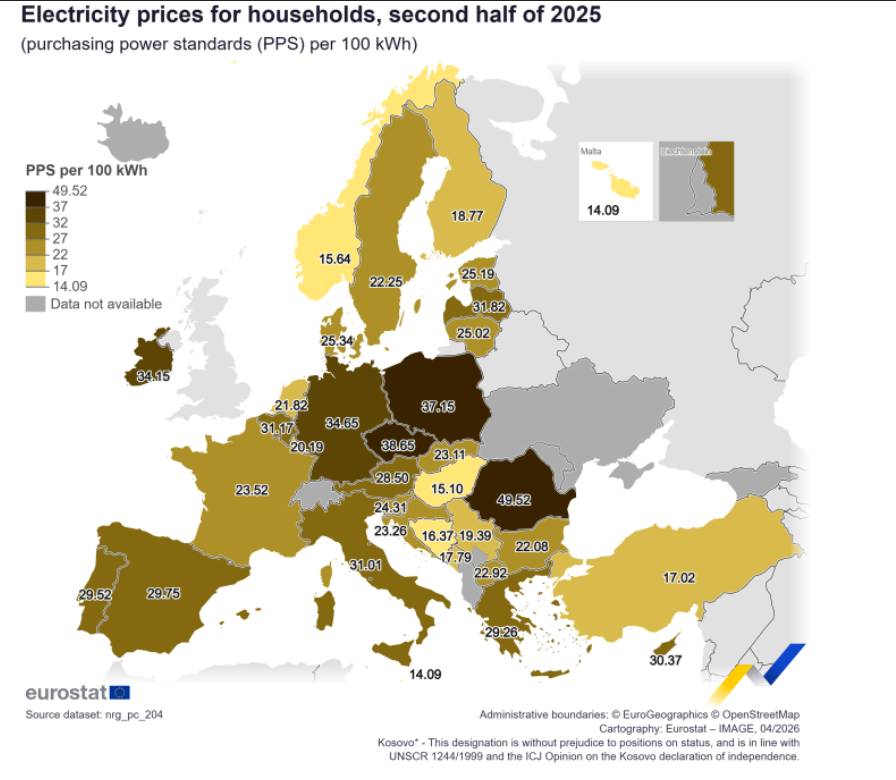
In European statistics on energy prices, Romania often appears as the "modest student" nominally (in €) below the EU average and below Western states. But when you put the same bill through the PPP (purchasing power) filter, Romania flips and becomes a country with maximum costs and prices. It's not statistical magic. It's the simplest diagnosis of recent years; it's not just how much you pay that matters, but how heavy that payment weighs on your economy.
Romania has a nominal final electricity price 21% below the EU average nominal price, but in reality, it is 15% above in PPP at final price. The difference does not come from a "hidden" tax, nor from a single tariff. It primarily comes from the low purchasing power of Romanians, which "weighs down" that same amount in euros.
Romania vs EU average. The components that make up the nominal electricity price show that Romania is "below EU level" in almost all components (distribution, margin, taxes), but when we analyze it in relation to purchasing power, it turns out that Romania jumps "over" the costs and final price of electricity. The "Commodity Price" component is slightly below the EU nominal price (-8%), but much above the EU average price reported to PPP (+32%). This indicates that energy is not necessarily more expensive in euros, but it is more expensive relative to what the Romanian economy can buy.
Romania vs Germany + Netherlands (dense networks, high load). Romania seems much below nominal costs and prices (network, margin, final), but in fact, when compared to purchasing power, Romania has commodity prices up to +84% higher than in DE+NL.
Romania vs Poland (structurally closer). Romania has approximately the same nominal price for the commodity price as Poland and has electricity distribution tariffs below those in Poland. At the level of the final electricity price reported to purchasing power, it is below the similar level of Poland.
The "Network Load Degree" (MWh/km/year) is essential in determining the size of transport and distribution tariffs. In the real world (without political involvement), the network load (how much energy passes per kilometer of the network) is critical:
• Dense networks and large quantities of energy transported bring a fixed cost spread over more MWh, resulting in lower kWh tariffs.
• Extended networks and small quantities of energy transported (dispersed and variable consumption) bring a fixed cost spread over fewer MWh, resulting in higher kWh tariffs.
Analyzing the components of the electricity price: A) Commodity Price (the component that flips the story in PPP)
 The commodity price of electricity without taxes and tariffs reported to purchasing power places Romania in 2nd place in the ranking of EU countries, surpassed only by Bulgaria. The market structure explains why the commodity is not cheap.
The difference comes from:
High exposure to market prices. The Romanian market has been strongly influenced by regional volatility, and protection mechanisms have been applied more to the final bill than to the formation of the wholesale price.
The production structure of Romania, hydro and nuclear, offers competitive costs, but in periods of low hydricity or nuclear maintenance, the marginal price is dictated by more expensive technologies (coal and gas), and regional interconnections quickly transmit external shocks.
The size of the market and liquidity. Western markets, such as Germany or the Netherlands, have much larger volume, superior liquidity, and sophisticated hedging mechanisms. Romania has a smaller and more volatile market, which can amplify marginal prices.
How the commodity price can be reduced:
1. More competitive supply, better hedging, more efficient contracts, reducing imbalance costs, efficient investments that lower the marginal price (especially during expensive hours).
2. Increasing purchasing power by raising wages, productivity, and taxes.
3. Lower volatility of market prices can be achieved by ensuring functional market mechanisms, along with infrastructure development (interconnections, flexibility, storage) that reduces episodes of high prices.
B) Distribution (Romania "cheap" nominally, almost aligned in PPP)
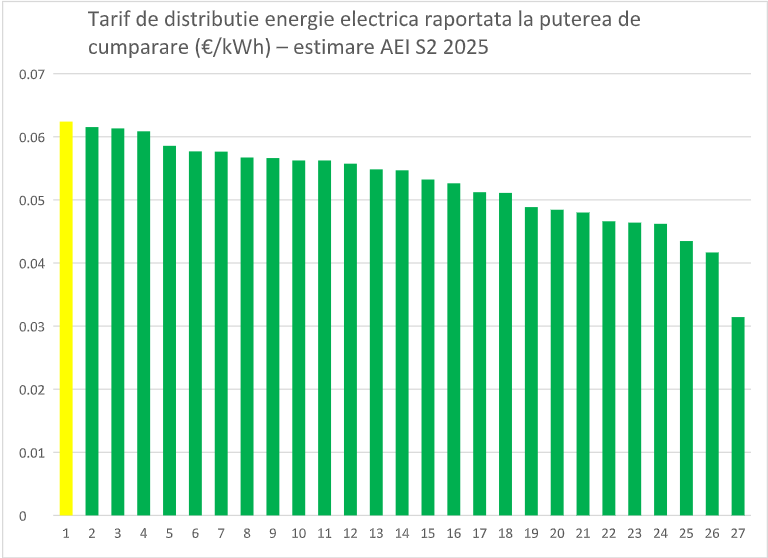 The average electricity distribution tariffs in Romania reported to purchasing power place Romania in 1st place in the ranking of EU countries.
The structural characteristics of the network amplify the problem
Relatively low consumption per customer. Distribution is an infrastructure with high fixed costs. In Romania, the volume distributed per customer is small, leading to a high unit cost per kWh, low network load, and reduced economic efficiency. Romania has a lower per capita consumption than Western economies, which means that the same fixed costs are spread over fewer MWh.
Mixed density and extended rural network. In Romania, there is a dense urban area, but also an extensive and dispersed rural network. Areas with low density require many kilometers of network, have few consumers, which raises the cost for distributed units.
How the electricity distribution tariff can be reduced:
1. Increasing the load degree of distribution networks, smart electrification (heat pumps, EV), new connections, reducing the degree of "under-utilization" of networks.
2. Lower losses on the network. Technical and non-technical losses translate into additional costs/kWh. Reducing them lowers the effective tariff.
3. More efficient CAPEX through targeted investments (not just network expansion), digitalization that reduces OPEX.
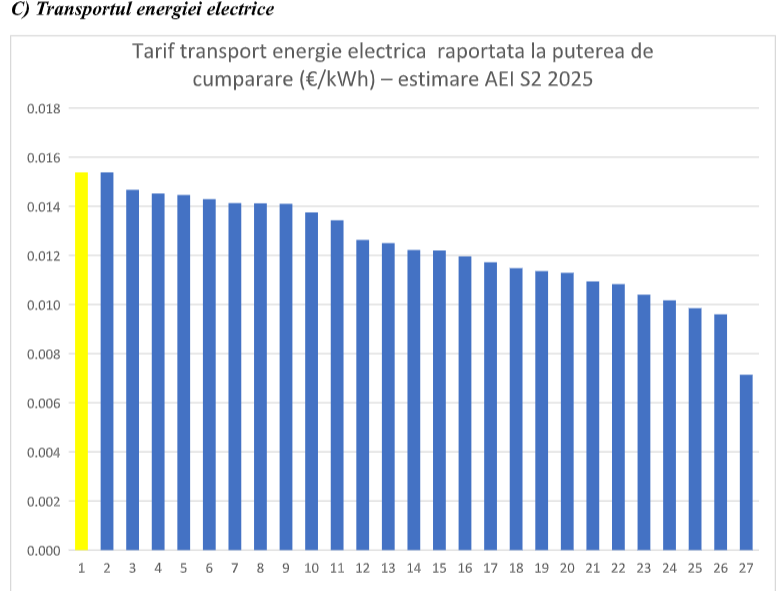 Electricity transport tariffs in Romania reported to purchasing power place Romania in 1st place in the ranking of EU countries.
Structural factors that push Romania to the top
Geographical size and system topology. In Romania, there is an extensive transport network over a large area, varied terrain, production areas far from consumption centers, necessitating regional interconnection. The transport network must cover long distances and ensure system stability in a complex territory. Fixed costs are high.
Relatively modest volume compared to infrastructure. Transport is dominated by fixed costs. If the transit volume is not very high, the unit cost per MWh increases, and economic efficiency decreases. Romania does not have the same industrial consumption volume as Western economies. Thus, the infrastructure is spread over fewer MWh.
Balancing and stability costs. The integration of renewables and regional volatility increases system service costs. In a smaller market, these costs can have a proportionally greater impact than in large and very liquid economies.
How the electricity transport tariff can be reduced:
1. Increasing electricity flows throughout the year through networks. More transit volumes (production, export/import, industrial consumption) can reduce the unit cost.
2. Reducing congestion lowers expensive system services and decreases transport tariffs.
3. Market rules that reduce balancing costs. Increasing flexibility, storage, and aggregation capacity leads to lower transport tariffs.
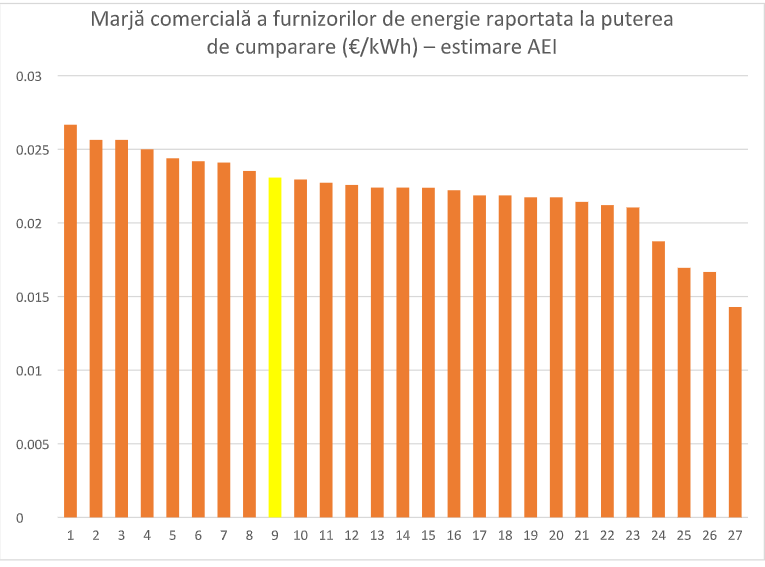
D) Commercial Margin (nominally small, PPP close to others)
The commercial margin of electricity supply in Romania reported to purchasing power places Romania in 9th place in the ranking of EU countries.
Specific factors of the Romanian market that have determined this position in the European ranking
Volatility in recent years. The energy crisis has increased the need for working capital, the risk of imbalance, and pressure on cash flow. Suppliers have operated in a high-risk environment, and the margin must cover this risk.
Ceiling and compensation schemes. State interventions have generated: settlement delays, financial blockage, additional administrative costs, legislative uncertainty. These elements increase the indirect costs of supply.
Fragmented market, but not fully mature. Although there is competition, the Romanian market: does not have the same liquidity and sophistication as Western markets, has relatively limited consumer mobility, involves significant operational costs relative to the volume managed.
Higher risk of non-payment. The income level and socio-economic structure imply a higher commercial risk compared to highly developed economies. This risk must be covered in the margin.
How to reduce the commercial margins of electricity:
1. Creating real competition that drives margins down to the minimum level necessary to ensure the company's operation.
2. Reducing supply costs (standardizing processes, digitalization, interactive communication with customers) leads to a smaller margin.
 E) Taxes/Excise/VAT
Taxes for electricity supplied in Romania reported to purchasing power place Romania in 11th place in the ranking of EU countries.
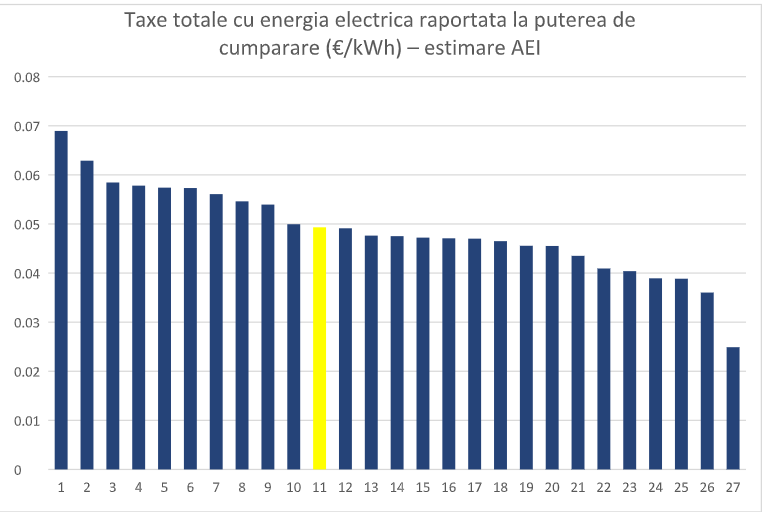 How to reduce electricity taxes - by implementing a tax policy aimed at achieving a rapid nominal decrease, this is the lever.
Lower prices "hold", require government action on all components that make up the electricity price (commodity price, taxes, network efficiency and losses, balancing costs). This lowers the bill in euros.
Eliminating the paradox of "cheap in euros, expensive in PPP" must prompt the government to act in the direction of stimulating productivity growth, investment, and labor, increasing income and wages. This does not instantly change the bill, but it changes the understanding of the weight of the bill.
Latest News
12:57
12:49
12:48
12:47
12:46
See more news
NEWS ON THE SAME TOPICS