Sever Voinescu, Dilemma: The Drones in the Mind and Home of the Romanian



Always see our news on Google
You know the popular saying, "God, give the Romanian the mind to think ahead!" Traditionally, this is how our governments operate, in full agreement with the spirit of the nation, after all. Although everything indicates not just the probability but the fatality of a negative event, no one does much to prevent it; the event occurs, and only after that do we take action, as we should have done preventively. In the end, we contemplate what we have suffered, what we did after we suffered, what we resolved by acting, and we tell ourselves, "God, give the Romanian the mind to think ahead!" But not because we feel sorry for not having acted in time, but to congratulate ourselves for having done what should have been done in the end. The issue of timely action is not even raised in our civilization. We are always in reaction and never in prevention. Only that this kind of reaction, always delayed, costs dearly. Too dearly. Absurdly dearly. Often, it costs the lives of Romanians.
I cannot forget the case of stray dogs. It has not been many years since the streets of our cities were no longer for people, but for packs of stray dogs. Walking through the cities of Romania, especially at night, became bloody adventures under the threat of the jaws of these frightened and hungry animals, out of control. A minority group of hysterical activists claimed that this was good, that dogs should roam the streets and people should step aside, while a majority of normal people resignedly accepted the thought that this must be normal: the city is no longer for people, but for aggressive stray dogs. Although, obviously, the natural administrative solution was to remove the unowned dogs from the streets of the cities, the naturalness had no power anymore. It was becoming increasingly evident that something serious would happen, as unpleasant interactions between people and dogs multiplied. Until the tragedy occurred, no one did anything. On a fateful day, an adorable child of a few years was mauled in a park (in a public park!) in broad daylight by stray dogs, dying in agony. Immediately, the world mobilized, legislation came, logistics were created, and the animals disappeared from the streets in a few weeks. Normality was imposed. But a child had to die! Could the tragedy have been avoided? Certainly. With minimal precaution and the power of common sense. But, too often, we have neither. I think from time to time of that child as a martyr of the public interest – today, of course, the incident is almost forgotten.
Things are not very different now, with Russian drones falling over us. At first, about two years ago if I remember correctly, the first drones fell in the field. It took us a few days to find them, and generally, people found them before the authorities. Of course, we made jokes. The unanimous conclusion of the specialists was that nothing serious was happening, it happens sometimes, and it is better to let the drones fall where they may. We were assured that our military forces were watching them from the plane, seeing and monitoring them. Then, the drones began to fall close to localities. Residents started to hear and see them falling. Nothing serious, it happens sometimes when you have a war at the border – the specialists said. Just people should be careful when they are notified on their phones that drones are coming, not to stand in their way, to step aside, to go somewhere, it was unclear where, but not to stay around. It is better to let them fall where they may, anyway our guys are keeping an eye on them from the plane. The popular jokes continue. It doesn't take long and a drone falls on a roof, in a yard. Even before the officials reacted, Romanians filled the networks with a frothy wave of jokes. The specialists, in unison, said this time that it was a bit serious, but nothing dramatic, it happens sometimes, good that no one is hurt.
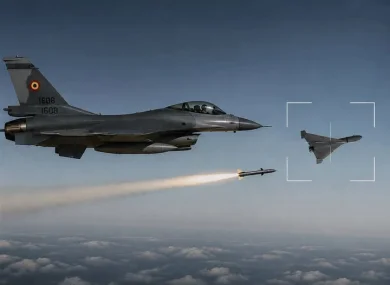
More non-specialists drew attention from the very first incidents that the first case in which a drone would hit a dwelling is imminent. It is logical to happen. It will happen. All the non-specialists said that raising planes is useless. Non-specialists, relying on some physics learned in the ninth grade, said that the difference in altitude and speed at which a multirole plane and a drone operate in descent makes the attempt to hit the drone with a missile not only unlikely but also dangerous. You must defend yourself against these kinds of drones differently. Only that the specialists, people with complex studies in the art of modern warfare, and especially the fans of the specialists asked the non-specialists to shut the hell up because they don't know what they're talking about.
Predictably, the moment came when a drone fell on an apartment building. Two civilians injured. How much of a specialist do you have to be not to understand from the very first incident, from the first drone that fell far away, in the field, that this moment would come? Almost two years have passed since the first incident and on this occasion we learn that Romania is "accelerating" the acquisition of equipment suitable for this kind of situation. Now we are accelerating. For two years we did not accelerate. Instead of immediately acquiring the appropriate defensive system after the first incident, we responded to the phenomenon of Russian drones entering our airspace with a strategy adopted by CSA, absurdly logical and shamefully political. The principle of that strategy was: we raise planes and watch the drones frolicking in our airspace: if they go far away, let them go healthily, if they come towards localities, let the pilot decide what to do. Well, if the drone comes towards Galați, what should the pilot decide? If he shoots and hits, drone fragments mixed with missile fragments fall over the city. If he shoots and misses, both the drone and the missile that missed the target fall in the city. If he does not shoot, the drone hits the locality. Take your pick, pilot, CSA is with you! Do you think this is a strategy to protect the residents along our eastern borders from the fall of stranded or intentionally sent drones from Russia? Of course, the strategy of "let the pilot decide" is not the solution, but the acquisition of equipment for these specific situations, its installation, and its use. We do what we need to do only after the first drone fell one night over a house where our compatriots were sleeping, an event we knew for two years would happen. Why, Lord, do we remain with the mind to think ahead? What is happening to our minds from before?
https://www.dilema.ro/tilc-show/dronele-din-mintea-si-casa-romanului
Latest News
19:52
19:51
19:09
19:04
18:51
See more news
NEWS ON THE SAME TOPICS








.webp)