Did our team win?


Always see our news on Google
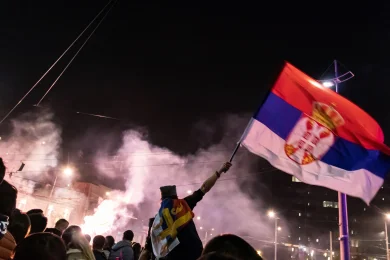
Sunday’s elections in Serbia were well received by pro-European circles on the old continent, although the implications of the collapse of the political system dominated by Aleksandar Vucic are far from clear. Some were quick to identify Serbia, as of last night, as a country that had left Euroscepticism behind, in a sea of European countries where commitment to the European project is creaking, whether ideologically or pragmatically.
Things are not quite like that, or, more safely, we do not know how they are. The new winning list in Serbia’s snap parliamentary elections is rather anti-establishment than pro-European. Some equated the fall of the Vucic regime with that of the Orban regime in Hungary, but even there the similarities have their limits, beyond the closeness between the two leaders of the respective “neighboring and friendly peoples,” as it was once said. First of all, the Orban regime and the Vucic regime resembled each other more through illiberalism and a certain drift toward authoritarianism than through Euroscepticism. Their relationship with the European Union is difficult to compare in any real sense. Hungary is a member state; Serbia is a perpetual candidate at the gates of the EU. Orban’s sovereigntism was not necessarily of the exit or anti-establishment variety—it was also absurd for a leader with such a long tenure and who had gone through so many ideological phases to be genuinely anti-establishment. His sovereigntism was rather one at odds with the self-definition and directions, at a certain point, of the European colossus. In Serbia, the situation is more complicated: if Vucic was seen by some as an Orban-style sovereigntist, the resemblance has clear limits, because the Serbian president could exercise this characteristic only in relation to negotiations over his country’s accession to the EU, or with regard to adjacent features of sovereigntism (discourse on migration, EU foreign policy, relations with the US, Russia, and China, Serbia’s complicated relationship with its neighbors, etc.). Whether we are talking about “classic” European sovereigntism (of the Orban variety), based on leaders with a long history, or about movements that have emerged (with more or less electoral success) over the past 10 years, with a strong anti-establishment dimension preceding an ideological one, in member countries, one of the lines of tension on which sovereigntism is built is national versus European, in the context of the ideological battle with the “bureaucrat in Brussels.” Some European leaders in this camp subsume this chapter under a type of anti-elitism/anti-politicianism that gives it the specific nuance political analysts call populism.
Serbia’s paradox is this: today we look at the Vucic system as one that had strayed from democracy and a European orientation. For the pro-European camp, the episode is a success in the sense of the fall of the Orban regime in Hungary. But in Serbia’s specific context, Vucic displayed certain bizarre, or rather opportunistic, accents. He began his political career on the far right, later moving more toward the center and intersecting with many possible ideologies. He was a key figure in negotiations over Serbia’s accession to the EU, but he negotiated so toughly that the process has still not been completed and has no prospect of doing so quickly. This is apropos of some of our analysts who complain that Romania did not negotiate toughly enough with the EU when it joined: they did not want us quite that badly, you know… Returning to Vucic, he was sometimes European, sometimes a sovereigntist—it is enough to look at his attitude during the refugee crisis, when he positioned himself alongside Mrs. Merkel, only for this reference point to subsequently disappear once Mrs. Merkel also vanished from high politics. Of course, politics is dictated by interests. Leaders of small countries are sensitive to nuances and must think more in terms of interests than in terms of grand and abstract principles. I simply observe that a European Serbia did not exist politically for very long before Vucic. This is understandable, given its recent history. The reality is that we do not know whether yesterday’s election episode will lead to something like the democratization of Serbia in the long term, or to a considerable increase there in the appetite for Europe. As the AI says: can I help you with anything else?
Latest News
13:56
13:35
13:14
13:02
12:42
See more news
NEWS ON THE SAME TOPICS