



Andrei Cornea: (Self)humiliation of Europe


Always see our news on Google
In anticipation of some probable new deadlines set for Donald Trump by the leaders of the largest European powers, in order to obtain for unfortunate Ukraine a peace project, through which Putin should not be outright rewarded for aggression, gaining through peace what he could not obtain through war, and for Europe not to find itself in the situation of being the next prey of the Russian tyrant, I rediscover an old text, from which I republic (with modifications) a fragment written "to the nerves". But those "nerves" from many years ago were a bit different from those that the current situation generates, when we see the humiliations to which the leaders of England, France, Germany, Italy, Norway, etc. allow themselves to be subjected not only as physical persons but also as representatives of their peoples, hesitating once again to stand firm not only against the dictator from the East but also against the deranged one from the West. The idea of the fragment is that the European (Western) has almost forgotten today his great history; moreover, he has come to be ashamed of it. Therefore, he is no longer capable of raising his head and trying to live (or die, if necessary) according to the model of the past. Let’s be clear: in today’s world of predators, the only way to earn respect is to show not so much that you are strong, but rather that you are ready to use the power you have and that others know you have.
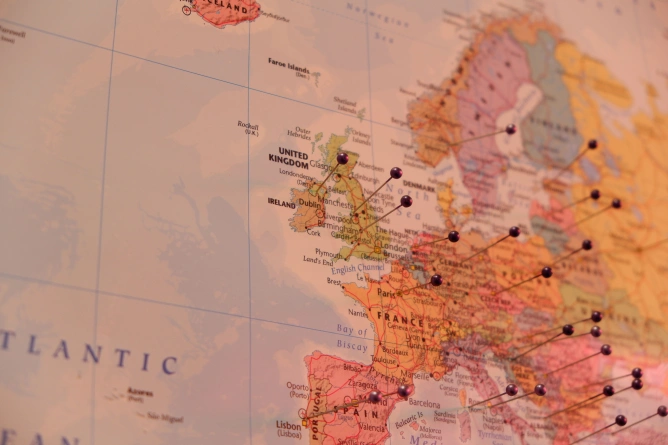
Today’s European gives the impression that he has a short memory, a myopic view, and that, in fact, he wishes to free himself from the burden of the past simply by forgetting it. He is a domestic, peaceful animal, who is only concerned with grazing on the small lush meadow at his feet. That the wolves outside look at him and the meadow with greed is therefore not surprising. His ancestor longed for the Indies, for the Americas, for the Southern Seas. He was brutal and colonizing with the glances of a predatory bird, aimed at the distance. The average Briton, Spaniard, or Frenchman had the global perspective of their respective empires. The maps of the world were studied also because they were a cartography of the seas traversed by the fleets of the homeland. History was written partisanship and sounded different on one side and the other of the Rhine. But at least it was studied intensely and passionately, and its models, good, bad, but always glorious, still mattered. And, to be honest, who else but the imperial and colonizing nations invented universal history and geography? Herodotus and Strabo belonged to a people whose primordial literary work, the Iliad, depicts the conquest, plunder, and destruction of a foreign city, located beyond the sea...
Today, Europe has become a province without a real capital. It sees only at the grass level. It thinks small and complacently. It speaks discreetly, politely, just in case it does not disturb others too much. Its only solid ties to the past are given by tourism and the assumption of historical guilt. Both have become industries, which – after a necessary and welcome stage – have gone off the rails, producing their respective products in suffocating quantities.
Indeed, Europe has specialized in apologizing: to Africans, for having brought them into slavery, to Native Americans, for having infected them with viruses and colonized them after discovering them, to Muslims, for not succumbing to the Crescent Moon, to Asians, for having stolen various inventions, after which it exploited and humiliated them. Endless apologies, welcome up to a certain point – who could deny it? – but then becoming a pathology. And on top of that, apologies not devoid of a certain crafty opportunism: some have oil, others are numerous, others are fanatical, others pose problems with immigration. Unilateral apologies, however: African kings sold their subjects as slaves. Muslims condemn the Crusades, but consider the conquest of Constantinople and Visigoth Spain in order. The Russians continue to glorify their empire and view the loss of parts of it in 1991 as a national catastrophe. (In the meantime, they have methodically started to rebuild it.) China conquers global markets, threatens America’s supremacy, and dominates the seas of the Far East. Of all civilizations, Europe is the exception that renounces its old glories, that is, its self. It is the only one that has regrets. And to paraphrase Cioran: what value does a Europe without the population of China have and which now flees from the "glory of France" and that of other powers?
We know well: Europe has fallen ill with cultural relativism, with the consequence of minimizing the value of its own achievements. And I do not refer to warships or cannons, although they might deserve to feel proud of the ingenuity of those who built them. But why would Europeans today hurry to love this extraordinary democratic institution that is the European Union, when some – like a great prelate of the Church of England – recited to them, some years ago, that Sharia is not inferior to European legislation which could, at certain points, draw inspiration from it? Why would those indoctrinated that all civilizations are equal, that the differences between them are nothing but "options" that cannot be hierarchized and that doing so proves racism, still be enthusiastic about saving Europe? Their grandparents knew that Europe is destined, not so much by arms, but especially by values and institutions, to dominate the world. (A similar conviction is still firmly held today, with serenity, by Muslims, Chinese, or Russians.) But we no longer have the courage to tell the non-European world that liberalism, federalism, parliamentary democracy, secularism, the equality of women with men, and religious tolerance are values clearly superior to Confucianism, Sharia, Slavophile orthodoxy, and African animisms. Why do we not dare to declare that, despite all the damage done, European colonialism has made the colonized countries progress, that many African countries had not reached political and cultural maturity at the time of independence proclamation, and that the misfortunes of the third world were encouraged by a hasty decolonization politically exploited by the communist bloc?
And we, the Easterners, we, the Romanians? We, who have known the poisons of communism, should not we keep alive at least the passion for freedom that Europe has given us? Should we not at least look up? Well, we are even more narrow-minded, more provincial. Our perspective, encouraged by rebellions, is no longer even the country, it is the county. Soon it will be the village online, "the bubble". Who cares today about us in Europe and its freedoms, except when it comes to traveling, going to work, and funds? The Westerners have at least forgotten the greatness of the past, but we do not even have anything to forget. Great frustrations, inversely proportional to the size of achievements – here we are, the portrait.
And yet, there is one thing we can be proud of: the old Romanian principle of expediency, of survival without glory, the famous "it goes like this", seems to have been exported with huge success throughout united Europe. For what do we see? The European institutions "go like this", that is, without interest from the apathetic citizens. The administration of things replaces the politics of people and look: "it goes like this"! And we do not see "great" politics. Neither dignity nor courage. We see hesitations, inconsistency, inability to make radical common decisions. Self-humiliation in the face of the great bandits of the world. We know what we should do, but it’s in vain. We lack a Charlemagne to reinvent us, or at least a Churchill or De Gaulle to inspire us with the strength of authentic resistance. We have other concerns: "saving the planet" from climate change, for example.
Latest News
10:49
10:26
10:14
10:13
10:05
See more news
NEWS ON THE SAME TOPICS






.webp)


.webp)


