What awaits us in a Europe where crime is being automated faster than the state



Always see our news on Google
Crime adapts faster than the state to a world where digital technology produces direct physical effects. In a Europe that is entering a "phygital" reality, the Europol report shows how drones, robots, and autonomous systems are changing the rules of the game, while institutions remain anchored in a two-dimensional model of public order.
Europol published a report at the end of last year that extensively discusses the effects of technology on crime and the ability of law enforcement to cope with the situation. According to the report, Europe has already entered a phase where technological transformation is no longer a subject of innovation or economic competitiveness, but has become a public order and internal security issue. The report does not treat robots and autonomous systems as a science fiction scenario. We are facing an integrated reality in crime, in critical infrastructure, and in the activities of law enforcement. The Europol document emphasizes that states, as they are organized today, are built for a two-dimensional, physical, locatable world, while crime is rapidly evolving into a decentralized, automated, and remote form. The discrepancy is not just technical. We are dealing with a deeply political situation, as it calls into question the ability of public authorities to protect citizens without simultaneously losing democratic legitimacy.
For the European Union, the stakes are double. On one hand, it is about the practical ability to prevent and combat crimes that no longer respect the classic borders of territory or jurisdiction. On the other hand, it is about maintaining public trust in a state that must modernize its tools without slipping into excessive surveillance or opaque automation of force. Europol's analysis shows that these two objectives are not automatically compatible and that the lack of a coherent strategy risks undermining both.
Crime enters the era of "remote crimes"
The first alarm signal raised by Europol is related to the physical distancing between the offender and the crime. The report shows that the use of drones and autonomous systems allows criminal activities to be carried out without a direct presence in the space where they take place. Surveillance of sensitive areas, transport of illegal goods, monitoring of law enforcement, or even attacks can be carried out from kilometers away, sometimes from outside national jurisdiction. This evolution fundamentally changes law enforcement. The police are organized around the idea of proximity through patrols, perimeters, and rapid intervention at the scene. In the logic of "remote crimes," these benchmarks fade. A crime can be committed in one hour, coordinated from another country, and executed by an autonomous system that cannot be "interrogated" or intimidated in the classical sense of law enforcement. The report emphasizes that this distancing reduces risks for offenders and increases the difficulty of attributing responsibility.
Europol highlights that this is not just about isolated cases or marginal experiments. Commercial drones are becoming increasingly cheaper, easier to modify, and more efficient, and the knowledge required to adapt them circulates rapidly online. In this context, organized crime no longer needs complex infrastructures to expand its area of action, but can outsource the risk to relatively simple yet effective autonomous systems. This transformation creates a strategic gap. The report suggests that the state risks remaining anchored in a reactive model, while criminals operate preventively and anticipatively, using technology to avoid direct contact with authorities. In the absence of detection, monitoring, and counteraction capabilities adapted to this reality, law enforcement risks becoming symbolic, focused on consequences rather than on the effective control of the phenomenon.
War accelerates crime, not just innovation
The Europol report introduces an element that radically changes how the relationship between external security and internal security should be read in the sense that war is no longer an isolated phenomenon from crime, but becomes a direct accelerator of it. Recent conflicts, especially Russia's aggression against Ukraine, have become testing laboratories for technologies that, once out of the military context, quickly transfer to the civil and criminal environment. This transition is not theoretical or slow, but documented, rapid, and hard to control. Europol emphasizes that the pace of innovation in conflict zones far exceeds traditional regulatory or public procurement cycles. Drones produced in large quantities, rapidly adapted, modified in garages or improvised workshops, and operated at minimal costs have become part of the military arsenal. The report warns that exactly these characteristics—low cost, modularity, ease of operation—make the technology extremely attractive for organized crime and terrorist networks, once the know-how spreads beyond the front line.
A key element is the normalization of the use of automated violence. Technologies that a few years ago seemed exceptional are today widely used in conflicts, which lowers the psychological and operational threshold for their use for other purposes. The report suggests that this process creates a contamination effect in which tactics, methods, and technical solutions developed for war are replicated, adapted, and simplified for criminal use, including in the European space. This dynamic puts law enforcement in a structurally disadvantaged position. The police operate under strict legal constraints, with limited mandates and the obligation to minimize risks to the civilian population. War-inspired crime, on the other hand, has no such constraints. The report indicates that tools developed for countering drones in a military context are not always transferable to the urban civil environment, where public safety and respect for fundamental rights drastically limit intervention options.
From territorial policing to "3D policing"
After describing the transformation of crime and its acceleration under the influence of armed conflicts, the Europol report shifts the focus to a deeper issue. The space in which state authority is exercised is no longer two-dimensional. Traditionally, the police have been organized to control surfaces, streets, buildings, neighborhoods. Crime mediated by autonomous systems, however, ignores this logic and operates simultaneously in the air, on land, on water, and underwater. Europol describes this shift as a change in the operational environment, not just in tools. This expansion of criminal space creates a structural gap. While criminal networks can use drones to cross borders, bypass controlled infrastructure, or avoid checkpoints, law enforcement remains limited by jurisdictions, fragmented competencies, and resources designed for land control. The report suggests that the problem is not a lack of will, but a lack of an operational model adapted to a three-dimensional space, where crimes no longer respect predictable routes.
Europol introduces the idea that this change affects not only the way of intervention but also the way of detection and prevention. In a three-dimensional environment, crime can become invisible until the moment of effect occurs. Drones can collect information without being observed, can deliver objects without human contact, and can quickly disappear from the intervention area. The report indicates that this significantly reduces the effectiveness of traditional methods of patrolling, surveillance, and deterrence, which rely on physical presence and visibility.
Another essential aspect highlighted by Europol is the fragmentation of competencies. Air, maritime, and underground spaces are regulated through different frameworks, often managed by distinct authorities. Crime that exploits these spaces moves, however, without taking into account these administrative separations. The report suggests that, in the absence of an integrated approach, the state risks reacting sporadically to incidents, without having a coherent picture of the phenomenon. In this context, "3D policing" is presented as a redefinition of the police mission. Europol indicates the need for an operational thinking that includes monitoring volumes, not just surfaces, and coordination between units that until now operated relatively independently. This transformation involves not only the acquisition of new technologies but also the revision of procedures, professional training, and how public authority defines its presence in an increasingly complex secured space.
The strategic vulnerability of the EU – dependence on non-European suppliers
After describing the transformation of crime and the difficulty of the state to adapt its operational space, the Europol report introduces a less visible but structural problem. Law enforcement forces in the European Union are technologically dependent on suppliers outside the EU. Explicitly, the document warns that a large part of the existing capabilities in the field of drones, robots, and autonomous systems relies on equipment and software developed and controlled by non-European actors. This situation creates a vulnerability that goes beyond the technical sphere and enters the realm of strategic security. Europol shows that this dependence manifests itself in several forms. On one hand, there is a phenomenon of "vendor lock-in," where law enforcement agencies end up building their procedures and capabilities around a very limited number of suppliers. On the other hand, the lack of European alternatives reduces the capacity of member states to respond quickly to emerging risks, whether related to cybersecurity, data protection, or continued access to critical maintenance and updates. The report suggests that this situation can also affect public trust, under conditions where public order infrastructure depends on technologies that are beyond European political control.
An essential element highlighted by Europol is the asymmetry between crime and the state in this domain. While criminal networks can rapidly adopt commercially available technologies on the global market, law enforcement is constrained by slow public procurement processes, rigid standards, and contractual dependencies. This difference in speed and flexibility amplifies the risk that authorities will remain permanently behind threats, not due to a lack of competence, but due to a lack of technological autonomy. The report emphasizes that the problem is not just one of hardware, but also of control over data and interoperability. Autonomous systems generate large volumes of sensitive information, and the lack of full control over how this data is processed, stored, or transmitted raises serious questions about digital sovereignty. Europol warns that, in the absence of solid European technological ecosystems, law enforcement risks operating in a framework that does not fully reflect the EU's values and standards regarding the protection of fundamental rights.
In this context, the report does not propose simplistic solutions but indicates strategic directions such as European industrial cooperation, the development of internal capabilities, and the creation of common mechanisms for testing, procurement, and standardization. In short, without technological autonomy, operational adaptation remains incomplete. For the European Union, the stakes are not just police efficiency, but the ability to exercise public authority in a coherent, secure, and legitimate manner in a world where technology becomes a factor of power.
The legitimacy crisis. Technology without public trust becomes a political risk
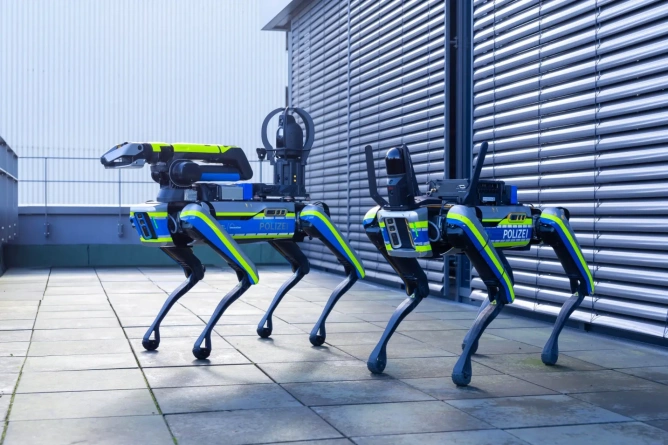
After identifying the operational limits and strategic vulnerabilities of law enforcement, the Europol report introduces public trust as an essential dimension, often treated marginally in security debates. The document emphasizes that the adoption of autonomous systems by the police is not just a matter of efficiency or technical capacity, but also one of democratic legitimacy. Without social acceptance, even the most advanced technologies can become factors of political and institutional contestation. The report shows that public reactions to the use of drones or robots by the police are often disproportionate compared to the actual capabilities of these systems. The mentioned examples indicate that public perception is influenced by fears related to surveillance, loss of privacy, and the "dehumanization" of law enforcement. In this context, technology is judged not only by what it does but by what it symbolizes, a possible opaque extension of state power into private space.
Europol observes that this legitimacy crisis is amplified by the gap between public expectations and technological reality. Citizens tend to attribute almost unlimited capabilities to robots and drones, while, in practice, these systems are often limited, dependent on human operators, and used in very specific scenarios. When concrete benefits are not visible or easily understood, fears become dominant, and any incident or controversial use gains major political resonance. The report suggests that this problem cannot be solved exclusively through regulation or post-factum communication. On the contrary, Europol insists on the need for public involvement before implementation, through transparency, consultations, and clear explanations regarding the purpose, limits, and guarantees associated with the use of technology. Without this effort, there is a risk that law enforcement will lose social support precisely at the moment when they need it most to cope with increasingly sophisticated forms of crime.
A police force perceived as distant, automated, and invasive risks being contested not only by offenders but also by citizens. For the European Union, this dimension is critical. Public order cannot be maintained solely through technical capacity, but depends on a social contract that must be renewed in an increasingly "robotized" society.
Regulation as a weak point of European security
The Europol report ultimately reaches a convergence point where regulation does not keep pace with technological reality. The document does not contest the existence of the European legal framework; on the contrary, it recognizes progress in areas such as drones, cybersecurity, or artificial intelligence. The identified problem is one of speed and coherence, not of political intention. Europol shows that most current rules were designed for remotely controlled systems, not for autonomous or semi-autonomous systems that can make decisions and act in the physical environment. In this context, gray areas arise related to responsibility, human control, operational use, and legal liability. The report indicates that as technological autonomy increases, existing legal frameworks become insufficient to cover real situations already encountered by law enforcement.
Another highlighted vulnerability is the fragmentation of regulation. Drones are regulated in a relatively advanced manner, but ground robots, underwater systems, or hybrid platforms remain governed by a mosaic of norms regarding product safety, data protection, labor, or public space. Europol suggests that this lack of harmonization creates operational uncertainty for the police and, paradoxically, advantages for criminal actors, who can exploit gaps between legal regimes.
The report also draws attention to the gap between general legislation and the specific needs of law enforcement. Acts such as the AI Act, Cybersecurity Act, or drone legislation are designed to cover a wide range of civil and industrial uses. Their application in the operational context of the police raises distinct issues related to urgency, proportionality, and the protection of fundamental rights in critical situations. Europol indicates that the lack of clear guidance for these scenarios risks blocking the legitimate use of technology or, conversely, generating abuses.
Finally, the report suggests that regulation should not only be reactive but anticipatory. It is not enough for the law to "catch up" with technology after it has already been widely adopted, either by industry or by crime. Europol advocates for frameworks that allow controlled testing, ethical assessment, and progressive adaptation of norms, so that law enforcement can remain relevant without exceeding the limits of democratic legitimacy.
Europol's analysis suggests that the stakes are not whether the police will use robots or drones, but how the state will manage to exercise its authority in a three-dimensional, automated, and deeply interconnected society. Without technological autonomy, without adapted regulation, and without public trust, the modernization of law enforcement risks remaining fragmented or contested. Essentially, the Europol report draws a clear line. The future of European security will not be decided by hardware or software, but by the Union's ability to anticipate, coordinate, and legitimize change. Public order in a Europe marked by "phygital" cannot be maintained solely through acquisitions or ad-hoc regulations, but requires a strategy that integrates technology, fundamental rights, and the social contract into a coherent framework. Without this convergence, the space between law, technology, and trust risks becoming precisely the ground on which the crime of the future will exploit.
Latest News
15:55
15:55
15:55
15:51
15:51
See more news
NEWS ON THE SAME TOPICS