search icon
search icon
Flag Arrow Down
Română
Română
Magyar
Magyar
English
English
Français
Français
Deutsch
Deutsch
Italiano
Italiano
Español
Español
Русский
Русский
日本語
日本語
中国人
中国人

Change Language

arrow down
  • Română
    Română
  • Magyar
    Magyar
  • English
    English
  • Français
    Français
  • Deutsch
    Deutsch
  • Italiano
    Italiano
  • Español
    Español
  • Русский
    Русский
  • 日本語
    日本語
  • 中国人
    中国人
Sections
  • News
  • Exclusive
  • INSCOP Surveys
  • Podcast
  • EU
  • Diaspora
  • Republic of Moldova
  • Politics
  • Economy
  • Current Affairs
  • International
  • Sport
  • Health
  • Education
  • IT&C knowledge
  • Arts & Lifestyle
  • Opinions
  • Elections 2025
  • Environment
About Us
Contact
Privacy policy
Terms and conditions
Quickly scroll through news digests and see how they are covered in different publications!
  • News
  • Exclusive
    • INSCOP Surveys
    • Podcast
    • EU
    • Diaspora
    • Republic of Moldova
    • Politics
    • Economy
    • Current Affairs
    • International
    • Sport
    • Health
    • Education
    • IT&C knowledge
    • Arts & Lifestyle
    • Opinions
    • Elections 2025
    • Environment
64 new news items in the last 24 hours
  1. Home
  2. International

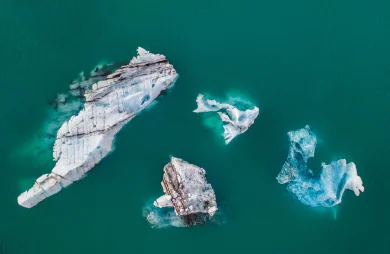
The A-23A iceberg, the largest in the world, is turning blue and rapidly disintegrating, warning scientists about its imminent fate.

Emese Grancsa
whatsapp
facebook
linkedin
x
copy-link copy-link
16 January 2026, 12:49
main event image
International
Credit: Alan J. Scullard / VWPics / Profimedia
google-preference

Always see our news on Google

Considered the largest in the world, iceberg A-23A has turned blue, and scientists warn that this phenomenon signals its imminent disintegration. The iceberg broke off from the Filchner ice shelf in Antarctica in 1986 and has drifted into the South Atlantic.

New NASA images show that it is now covered by meltwater, and experts estimate that A-23A could disintegrate in days or weeks. Although at its peak it had an area more than twice that of London, it has rapidly decreased to 1,182 km². Dr. Chris Shuman, a researcher, states that A-23A will not survive the southern summer, and the accumulation of water in the cracks of the ice accelerates its degradation. The iceberg, which has had a long and eventful journey, is now in waters 3°C warmer, being pushed towards even warmer areas, which will hasten its disappearance.

Sources

sursa imagine
Adevarul
Motivul pentru care cel mai mare aisberg din lume a devenit albastru. Ce se întâmplă cu "Regele mărilor"
sursa imagine
G4Media
Cel mai mare aisberg din lume a devenit albastru
sursa imagine
Mediafax
Cel mai mare iceberg din lume devine albastru – Oamenii de știință avertizează: „Dezintegrarea completă, peste câteva zile”
sursa imagine
Stiripesurse
Fenomen neobișnuit: Cel mai mare iceberg din lume se albăstrește. Cercetătorii sunt îngrijorați
sursa imagine
CBS News
Massive iconic iceberg turns blue and is "on the verge of complete disintegration," NASA says

Latest News

00:32

Aleksandar Vucic acknowledges the student opposition’s victory in Serbia’s snap election

22:56

Germany will participate with aircraft in the first military exercise of the Coalition of the Willing for Ukraine, which will also partly take place in Romania

22:37

Alexandru Nazare, on the audit requested by Sorin Grindeanu at all ministries: “There is absolutely no problem, it is actually a joy”

22:23

Traian Băsescu claims that Sorin Grindeanu will control the government through Marian Neacșu, while Prime Minister Luca Niculescu could become the target of criticism

22:09

Tens of thousands of Czechs protested in Prague against the reform of public media funding

See more news

NEWS ON THE SAME TOPICS

event image
Environment
A huge iceberg has capsized off the coast of Greenland, near the island of Ilulissat, generating massive waves.
event image
Environment
The National Research Authority announces a record of 21.1 degrees Celsius in oceans and significant ice loss in Greenland
event image
Environment
The world's oceans have just reached the highest temperature ever recorded.
event image
Environment
Another “catastrophic” year for Switzerland’s glaciers. Their volume has decreased by nearly 20% in five years
event image
Environment
The Concordia Station in Antarctica reported on July 18 the lowest temperature on Earth in 2012, reaching minus 84.1 degrees Celsius
event image
EU
September 2026 was the second warmest on record globally. Record-low flows also affected parts of the Danube.
app preview
Personalized news feed, AI-powered search, and notifications in a more interactive experience.
app preview app preview
aisberg NASA Nasa

Editor’s Recommendations

main event image
Opinions
24 October 2026, 20:53

Sever Voinescu: Playing at Sovereignty

app preview
Personalized news feed, AI-powered search, and notifications in a more interactive experience.
app preview
app store badge google play badge
  • News
  • Exclusive
  • INSCOP Surveys
  • Podcast
  • EU
  • Diaspora
  • Republic of Moldova
  • Politics
  • Economy
  • Current Affairs
  • International
  • Sport
  • Health
  • Education
  • IT&C knowledge
  • Arts & Lifestyle
  • Opinions
  • Elections 2025
  • Environment
  • About Us
  • Contact
Privacy policy
Cookies Policy
Terms and conditions
Open source licenses
All rights reserved Strategic Media Team SRL

Technology in partnership with

anpc-sal anpc-sol