SPECIAL Informat.ro | The Case of Nicolas Sarkozy: how a former leader from the Élysée Palace ended up at the center of a battle between politics and justice



Always see our news on Google
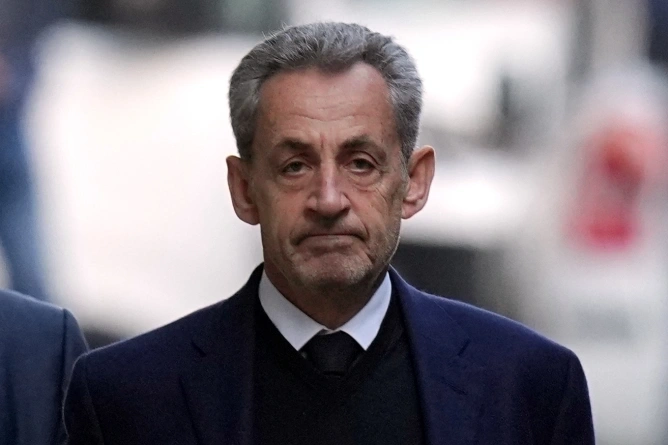
Nicolas Sarkozy, former president of France from 2007 to 2012 and one of the dominant figures of the French right in the last two decades, built a political career marked by controversial reforms, a hyperactive presidential style, and a close relationship with the business environment. His rise, from mayor of a Paris suburb to interior minister and then to Elysee, was however accompanied by a series of scandals and investigations that, after the end of his term, have come to redefine public perception of his political legacy. This combination of being a central leader of the right and accumulating criminal cases makes the current trial regarding the Libyan financing of the 2007 campaign perceived as a turning point, both for his political biography and for the image of French justice. Nicolas Sarkozy remains an emblematic case study for the way justice, politics, and public perception intersect when a former president is tried for corruption charges and external financing of the campaign, in a context where experts and international comparisons underline the almost unprecedented nature of his situation.
The Sarkozy Case – Between Appeal, Public Pressure, and Institutional Stakes
In the current judicial phase, Sarkozy contests a conviction for criminal conspiracy related to the alleged financing of the 2007 campaign with money from Muammar Gaddafi's regime, the accusations concerning a "corruption pact" through which close collaborators allegedly tried to obtain Libyan funds through opaque channels – bank transfers, cash payments, and offshore structures. Judges have retained the idea of a "Faustian corruption pact" at the highest level, in which electoral financing would have been, according to the logic of the accusation, compensated by political and economic advantages for Tripoli, from contracts to diplomatic assistance in sensitive cases. Legally, the gravity is double: it is not just a violation of campaign financing rules, but the suspicion that indeed France's foreign policy would have been partially conditioned by a hidden flow of money. A court in Paris sentenced him to five years in prison for conspiracy, considering sufficient the fact that he allowed his close associates to "obtain or attempt to obtain" Libyan financing, even if it could not be demonstrated that those funds actually entered the campaign accounts. This type of reasoning emphasizes intention and the architecture of the influence network rather than the complete traceability of the funds, which explains the strong reactions among experts in constitutional law and the rule of law. How Experts View the "Sarkozy Case": A Stress Test for the Rule of Law
Jurists and commentators specialized in constitutional law have highlighted the "remarkable" nature of the fact that a former president has been not only prosecuted but also convicted for conspiracy related to corruption at the highest level of power. Doctrinal analyses show that the court insisted on the idea that the attempt to prepare a framework for corruption at the top of the state, even without evidence of the final use of the money, is in itself "exceptionally serious" as it undermines citizens' trust in representatives and in republican institutions. On Verfassungsblog, experts in European law described the case as a situation where justice "confronts power", emphasizing that Sarkozy was prosecuted for corruption, illegal financing, and concealment of Libyan public funds, even if not all charges led to conviction. Other comments, including in reference press, speak of a moment of "assertion of the rule of law", where equality before the law is applied even to a former head of state, in a political system that has long been accustomed to protecting the top of the pyramid. At the same time, experts cited in the international press warn about gray areas: the lack of an exact sum, the networks of intermediaries, contradictions in testimonies, and the difficulty of proving a direct Sarkozy-Gaddafi agreement are used by his supporters to speak about "spectacular justice" and the possible political instrumentalization of investigations that have lasted nearly a decade.
Erosion of Political Capital: Between Symbolic Authority and Corroded Image
Politically, Sarkozy starts from a paradoxical position: he remains a reference figure for part of the right, but is increasingly perceived through the lens of criminal cases. He has already been convicted in other cases, including for corruption and influence peddling in the wiretapping case, where he received three years in prison, two of which were suspended, and for intentionally exceeding spending limits in the 2012 campaign. These successive convictions shape the image of a former president caught in a "judicial marathon", and the new appeal in the Libyan case comes against a backdrop of already established distrust. Analyses published in Le Monde or in academic journals emphasize that Sarkozy reaches his fifth major trial, under electronic surveillance after a previous conviction, which transforms him into a symbol of the "punitive turn" of French justice. The paradox observed by specialists: part of the right-wing electorate that supported the strengthening of criminal repression tools now denounces the severity with which its own camp is treated, and Sarkozy, in particular, which fuels discourses about "double standards" or "politicized justice". In terms of image, this paradox gradually erodes his status as a "moral authority" within traditional right, even if he remains a reference point for certain conservative currents. Libya, Gaddafi, and the Implications of External Financing for French Politics
The accusations regarding Libyan financing go beyond the simple violation of electoral law and directly touch the relationship between France's foreign policy and authoritarian regimes. Prosecutors have argued that the money intended for Sarkozy's campaign would have been inscribed in a "corruption pact" in which Tripoli sought economic advantages, diplomatic recognition, and support on sensitive issues, such as the arrest warrant against Abdallah Senoussi, responsible for a bombing with dozens of victims. For analysts, if this logic were definitively confirmed, it would mean that French foreign policy was, at least partially, "negotiated" based on a hidden exchange between financial resources and state decisions, raising major questions about decision-making sovereignty and the integrity of alliances. Moreover, some commentators have questioned what this would retrospectively mean for the Franco-British military intervention in 2011 against Gaddafi, if it were confirmed that the president who pushed for that operation had previously benefited from financing from the same dictatorship. Even if the courts have not established a direct link between the alleged financing and the decision to intervene, the mere suspicion fuels a broader discussion about conflicts of interest at the geopolitical level. In reputational terms, the fact that Sarkozy's name is recurrently associated with Gaddafi in a register of "Faustian corruption pact", as formulated in an indictment, places the case in the same category as major scandals of foreign influence on democratic processes, from Russian financial interference to opaque lobbying networks of other authoritarian regimes. Comparisons: Sarkozy and Another Former President Brought Before Justice
To assess the specificity of the Sarkozy case, experts frequently compare it with other presidential or high-ranking figures who have been convicted for corruption or abuse of public resources.
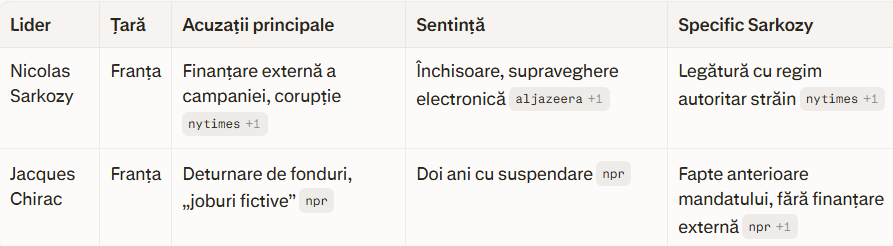
Jacques Chirac, for example, was convicted in 2011 for embezzlement and "fictitious jobs" related to his time as mayor of Paris, receiving two years in prison with a suspended sentence, but without accusations related to external electoral financing or pacts with authoritarian regimes. From this perspective, experts emphasize that, although France has known presidential-level convictions before, the Sarkozy case stands out due to its transnational dimension and direct implications for the credibility of foreign policy.
Globally, Sarkozy's situation is sometimes compared to cases of former presidents or prime ministers from other democracies who have been prosecuted for corruption or illegal financing, but its "unique" character lies in the combination of conspiracy charges with a foreign dictatorial regime and the succession of convictions on distinct cases.
Political and Legal Lessons: What the Sarkozy Case Says About Today's France
Jacques Chirac, for example, was convicted in 2011 for embezzlement and "fictitious jobs" related to his time as mayor of Paris, receiving two years in prison with a suspended sentence, but without accusations related to external electoral financing or pacts with authoritarian regimes. From this perspective, experts emphasize that, although France has known presidential-level convictions before, the Sarkozy case stands out due to its transnational dimension and direct implications for the credibility of foreign policy.
Globally, Sarkozy's situation is sometimes compared to cases of former presidents or prime ministers from other democracies who have been prosecuted for corruption or illegal financing, but its "unique" character lies in the combination of conspiracy charges with a foreign dictatorial regime and the succession of convictions on distinct cases.
Political and Legal Lessons: What the Sarkozy Case Says About Today's France
Experts in law and political science see in this series of trials an indicator of the institutional maturation of the Republic: a former president can be sentenced to prison for conspiracy and corruption without the system collapsing, and the principle of equality before the law gains concrete application. However, the same evolution fuels polarization: Sarkozy's supporters denounce a "justice of intent" and an "excessive judicialization of politics", while critics speak of a late repair in a system that has tolerated for too long the promiscuity between money, power, and influence. In terms of political culture, the case fuels discussions about the moralization of public life, transparency in campaign financing, and the limits of relationships with authoritarian regimes, especially when they can later be converted into leverage or strategic vulnerability. Compared to other cases, from Chirac to various scandals involving French ministers, Sarkozy's "Libyan case" pushes the debate into a new zone regarding the criminal responsibility of those who control foreign policy and national security. In the end, what makes Nicolas Sarkozy's situation so politically charged is precisely the overlap of these plans: a former president already doubly convicted for corruption and illegal financing, an accusation of conspiracy with a foreign dictatorial regime for supporting the campaign, a justice that asserts its independence, and a society divided between the need for example and the suspicion of instrumentalization. This combination transforms it into a difficult-to-ignore precedent, both for future French leaders and for how Western democracies manage the relationship between political power, money, and criminal responsibility.
*****Synthesis made with the help of a data monitoring flow provided by the media monitoring platform NewsVibe Romania. The analysis, data, and images presented have been enhanced with the help of Machine Learning and Artificial Intelligence tools.
Latest News
23:03
22:44
22:40
22:37
22:34
See more news
NEWS ON THE SAME TOPICS