Frontex: Irregular border crossings decreased by 26% in 2025



Always see our news on Google
Despite the lowest figures since 2021, the agency warns that migration pressure remains volatile and Europe must remain prepared for sudden changes.
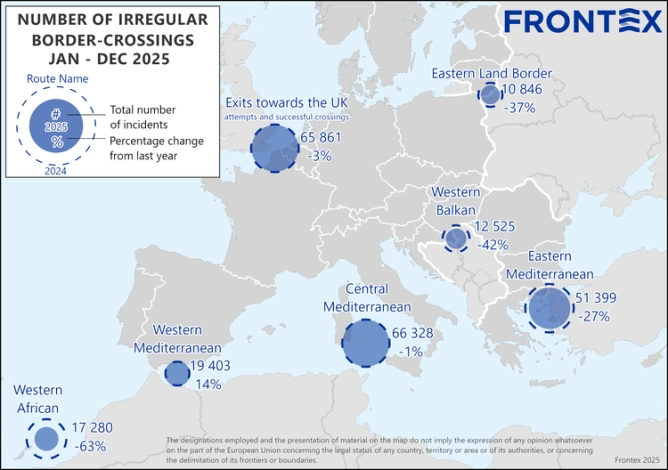
Brussels, January 15, 2026 – The number of irregular crossings of the EU's external border decreased by more than a quarter (26%) in 2025, reaching nearly 178,000 detections. According to preliminary consolidated figures published today by Frontex, the European Border and Coast Guard Agency, this total is less than half of that recorded in 2023 and marks the lowest level since 2021.
In short
Irregular border crossings in the EU decreased by 26% in 2025, to approximately 178,000, the lowest level in the last four years.
The Central Mediterranean remained the most active route, while routes from West Africa and the Western Balkans recorded significant decreases.
Frontex Executive Director Hans Leijtens warns against complacency, noting that 2026 will be a crucial year with the full implementation of the EU Pact on Migration and Asylum.
Although the downward trend is a significant development, Frontex officials urge caution, emphasizing that the situation at Europe's borders remains unpredictable. Migration pressure is dynamic, often changing rapidly between routes due to conflicts, instability, and the adaptability of smuggling networks. Additionally, the EU continues to face challenges from hostile actors attempting to exploit migration flows to exert political pressure on its external borders.
"The trend is moving in the right direction, but the risks do not disappear," said Frontex Executive Director Hans Leijtens. "This decrease shows that cooperation can yield results. It is not an invitation to relax." Leijtens emphasized that 2026 will be a "crucial year" for managing European borders, with the EU Pact on Migration and Asylum set to become fully applicable in June. This major reform will coincide with the launch of new technical systems, including the full implementation of the Entry/Exit System (EES) and the planned launch of the European Travel Information and Authorization System (ETIAS).
The Central Mediterranean remained the busiest migration route in 2025, with detection levels broadly similar to those of the previous year. Departures from Libya continued to be the main driver of movements towards Italy. In contrast, the Eastern Mediterranean route recorded an overall decrease, although a specific corridor from eastern Libya to the island of Crete saw traffic more than tripling, illustrating how quickly smuggling patterns can change.
The steepest declines were recorded on the West Africa route, where detections fell by about two-thirds due to a significantly lower number of departures from Mauritania, Morocco, and Senegal. Similarly, the Western Balkans route experienced a marked decrease in the number of cases, attributed to increased security measures and tighter operational cooperation, including a new joint Frontex operation launched in Bosnia and Herzegovina in November 2025. In contrast, the Western Mediterranean route recorded an increase, primarily driven by a higher number of departures from Algeria.
The three most frequently detected nationalities across all routes were citizens of Bangladesh, Egypt, and Afghanistan. Despite the overall lower figures, the human cost remains high; the International Organization for Migration estimates that at least 1,878 people lost their lives in the Mediterranean in 2025.
Latest News
18:25
18:17
18:07
18:03
17:58
See more news
NEWS ON THE SAME TOPICS