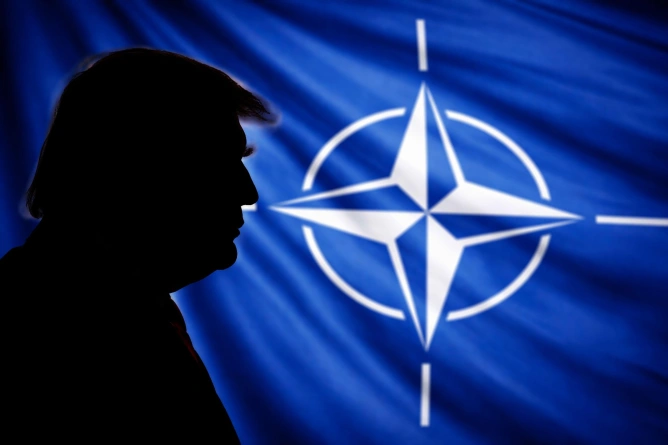
ANALYSIS Trump puts NATO in play again: How real is the scenario of the US exiting the Alliance



Always see our news on Google
The American President Donald Trump amplified on Wednesday his threat that he would pull the U.S. out of NATO, taking up a speech he used back in his first term at the White House. An analysis of a possible exit of the Americans from the North Atlantic Alliance and the procedural steps involves answers to the questions: how feasible and easy is such an EXIT from the perspective of international law, but also from the perspective of American domestic politics and strategic costs.
How can the U.S. exit NATO: what does the Alliance Treaty say
Article 13 of the North Atlantic Treaty explicitly regulates the withdrawal of a member state.
The text provides that, after 20 years from the entry into force of the treaty (that is, after 1969), any party may cease to be a party "one year after notification of the denunciation sent to the Government of the United States of America," the depositary of the treaty.
In procedural terms, the steps are minimal: The state that wants to withdraw sends a notification of denunciation to the U.S. Government, as the depositary; The U.S. Government informs the other allied governments about the submission of the notification; After a period of one year from the notification, that state ceases to be a NATO member, without needing the agreement of the other allies.
From the perspective of international law, the procedure is therefore very simple: a single formal act (the notification) triggers, with a one-year delay, automatic withdrawal.
The real complexity is not in the NATO Treaty, but in the internal constitutional law of the U.S. – that is, in the question of who actually has the power to denounce the treaty: the president alone or the president together with the Senate/Congress.
What does American legislation say about a possible exit from NATO
The U.S. Constitution does not explicitly regulate who can denounce treaties, although it provides that they are concluded by the president "with the advice and consent of the Senate" (two-thirds of senators at ratification).
In practice, American presidents have unilaterally denounced international treaties in the past, and the Supreme Court has avoided clearly ruling on whether Congressional approval is needed for withdrawal, treating the issue as a "political question".
In the case of NATO, the stakes are much higher since the Alliance is the pivot of the U.S. global alliance system and the basis of American presence in Europe. An exit would directly affect the security of allies, the credibility of American guarantees in Asia, and the global position of the U.S.
That is why Congress has repeatedly tried to limit the president's maneuvering room, and previous legislatures have introduced initiatives like the "NATO Support Act" or provisions in the annual defense law (NDAA) that condition any potential withdrawal on Congressional approval or explicitly prohibit funding for a unilateral exit.
Most constitutional law experts interviewed by the American press believe that:
The president could attempt a unilateral denunciation of the NATO Treaty, invoking the previous practice of the U.S. regarding treaties. However, such a gesture would almost certainly be challenged in court, arguing that the same legislative branch that ratified the treaty (the Senate) must have a say in the denunciation. The Supreme Court would be faced with a historic decision: either confirming a very broad power of the executive, or imposing a decisive role for Congress in withdrawals from fundamental alliances. Additionally, Congress can effectively block an exit through budgetary mechanisms (refusing to fund the dismantling of NATO structures on U.S. territory or the relocation of forces) or through laws that explicitly declare that U.S. policy is to remain in NATO.
Consequently, legally the international procedure is simple, but politically and constitutionally it would be a long, conflictual process, with a significant risk of blockage or compromise that could completely halt the withdrawal.
Is there any precedent? Has any country exited NATO?
No member state has used Article 13 to formally exit NATO since the alliance's creation in 1949.
However, there have been three situations that sometimes come up in discussions:
Algeria (which was part of France until 1962), Malta (a British colony until 1964), Cyprus (a British territory until 1960): these cases refer to changes in political status (independence or constitutional changes) and not to the voluntary exit of a sovereign member from NATO; they are listed in doctrine as technical withdrawals, not as a political precedent for "exit".
France: In 1966, France withdrew from NATO's integrated military structure but remained a member of the alliance and the Treaty; Paris returned to the integrated military command in 2009.
Greece: In 1974, after the Cyprus crisis, Greece withdrew from the integrated military structure in southern Europe but did not denounce the Treaty; it returned to NATO's military structures in 1980.
Historically speaking, therefore, there is no precedent for a mature democracy, a founding member, to formally denounce the North Atlantic Treaty.
Even states that have had serious conflicts with Washington or major strategic divergences have preferred to remain in the alliance and play within it, rather than leave it.
How many times has Donald Trump threatened to pull the U.S. out of NATO and in what contexts
Donald Trump has repeatedly used the threat of withdrawal from NATO as a pressure tool on European allies, especially regarding defense spending.
According to a New York Times investigation, in 2018 Trump "repeatedly raised the possibility of U.S. withdrawal from NATO" in private discussions with his national security team, stating that he sees the alliance as a burden and that he could "go it alone" if allies do not increase their military budgets.
At the NATO summit in 2018, he threatened European leaders that the U.S. would "go its own way" if states do not quickly reach 2% of GDP for defense, even exceeding the target and demanding 4% from some allies.
Later, at a rally in West Virginia, he publicly confirmed that he had threatened to withdraw from NATO, stating: "I told those people to pay up... otherwise we’re leaving" – a statement picked up and analyzed by the Atlantic Council.
In 2018, he recounted conversations with NATO officials, saying that when asked if he would leave the alliance if they do not "pay their bills," he replied: "Yes, I would consider it." In the following years, during the campaign and post-presidency, he periodically returned to the idea that NATO is "obsolete" or "unfair" to the U.S., suggesting that Washington should not defend countries that do not meet the 2% of GDP threshold for defense.
Trump radicalized his rhetoric upon returning to the White House, culminating in threats amid the Iran war
Once back in power, his distrust of NATO combined with the new crisis with Iran and tensions on the eastern flank.
American and European press reported that the Pentagon and NATO structures are already discussing scenarios for a possible withdrawal or massive reduction of U.S. involvement in the alliance, precisely because the threats are considered credible enough to justify contingency planning.
In an interview with The Telegraph published on April 1, 2026, Trump explicitly states that he is "seriously considering" pulling the U.S. out of NATO after allies did not follow his line in the war with Iran and describes the alliance as a "paper tiger," minimizing the military capabilities of British and European forces.
If we look strictly at moments when he directly threatened or clearly suggested American withdrawal, we can identify at least three major phases:
In 2018 when he made repeated threats in private, later confirmed in the press and partially publicly assumed.
Then in the period 2018-2020 he made public statements and at rallies that he could "leave" or let countries "go it alone" if they do not pay enough.
In the 2026 interview with The Telegraph, in which he says he is "seriously considering" a withdrawal, in the context of the war with Iran and acute tensions with European allies, is the most explicit and clear message, in the context of which there have been ongoing threats. The pattern is clear: Trump has used this option multiple times, both publicly and privately, as a negotiation tool, as well as an expression of structural distrust towards NATO.
The context of the interview with The Telegraph and the reaction of experts
The interview with The Telegraph comes against a backdrop of a cumulative crisis: the U.S.-Iran war, pressures on energy routes (the Strait of Hormuz), tensions with European allies perceived as reluctant to escalate, and increasingly intense discussions in Europe about "strategic autonomy" from Washington.
Trump uses the already known vocabulary: he describes NATO as a "paper tiger," questions the military value of key allies, and implicitly conditions American commitment on their willingness to follow Washington's line in the conflict with Iran.
Experts in Euro-Atlantic security, Washington think tanks, and NATO analysts interpret these messages in three main keys:
As a pressure tool on allies to increase military spending and align policies towards Iran and Russia.
As an expression of an older vision of Trump, who sees alliances in transactional terms ("pay or we won’t defend you"), not as a strategic public good of the U.S.
As a real risk factor for NATO stability, serious enough that European states and alliance military structures are considering scenarios for partial decoupling or even American withdrawal, even if the probability of a formal denunciation of the treaty is still considered low.
Published analyses in the Western press and academic environment emphasize that:
The withdrawal procedure (one year from notification) is too simple to be ignored: if a determined president were to send the letter of denunciation, NATO would automatically enter an existential crisis regime. However, internal institutional resistance in the U.S. – Congress, the judicial system, the national security establishment – would make such an endeavor difficult to carry out.
Messages like "I am seriously considering leaving NATO" are perceived by many experts more as political threats, meant to maximize Washington's negotiating power, rather than as an announcement of a decision already made.
At the same time, repeated threats have cumulative effects:
They increase pressure on European governments to meet and increase defense spending, and some states have significantly accelerated rearmament programs precisely out of fear of a possible withdrawal or relaxation of American commitment.
They fuel the discussion about building autonomous European capabilities – either within the EU or through regional frameworks – that can manage crisis scenarios in the event of a partial exit or a "reduced presence" of the U.S. in NATO.
Are Trump's threats just rhetoric?
If we relate to the question "how real is the possibility of the U.S. exiting NATO," the analysis combines law, domestic politics, and strategic interests:
Internationally legal: withdrawal is very easy, there are no blocking mechanisms from other allies, and Article 13 provides a clear framework, with a one-year term.
American constitutional: there is a normative void that the executive could exploit, but Congress and possibly the Supreme Court could restrict or even reverse such a decision; the internal political costs would be enormous.
Strategically: NATO remains the essential instrument through which the U.S. projects its power in Europe and deters Russia; abandoning the alliance would weaken Washington's global position and fuel the perception of American withdrawal, including in Asia and the Middle East.
Conclusions
Therefore, many analysts believe that Trump's threats are primarily a negotiation tool, with a high degree of theatricality, used to obtain concessions on defense spending, support for American operations (such as the conflict with Iran), and other sensitive issues.
However, the repetition of these threats, combined with a potential legal protection void (if Congress fails to clearly block a unilateral exit), transforms what was once "campaign rhetoric" into a structural risk for the alliance.
Thus, the threats are more than mere "scare tactics" for allies, but less than a clear, irreversible exit plan: they function as a pressure lever, with a real degree of risk, but also with multiple institutional brakes that make an effective exit unlikely in the short term.
Analysis conducted with the support of Perplexity
Latest News
23:00
22:55
22:47
22:39
22:33
See more news
NEWS ON THE SAME TOPICS