



SPECIAL Informat.ro / The top international political topics of the last week. Effects on Romania


Always see our news on Google
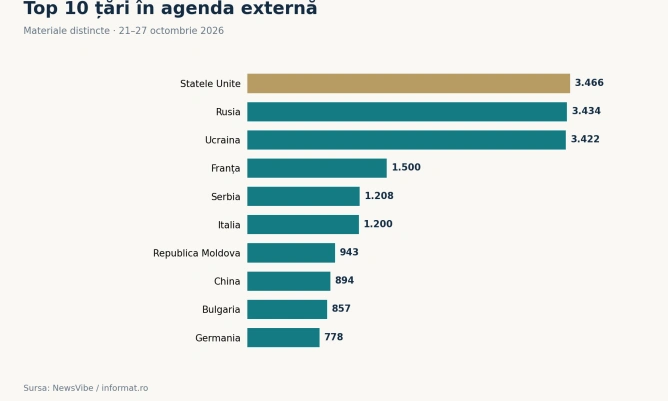
The last week in global politics is marked by the Ukraine war files and pressure on NATO, political interference in FIFA's decisions at the 2026 World Cup, the humanitarian crisis in Sudan fueled by drone attacks, China's strategic test in the Asia-Pacific, Slovakia's repositioning within the Alliance, and tensions between the USA and Italy. The data was collected by the media monitoring platform NewsVibe Romania, from June 30 to July 6, 2026, identifying over 10,000 articles published in the global press. The ranking of international security themes is based on the number of mentions and their visibility in press articles from the last seven days, taking into account the estimated impact of each material and the recurrence of the subject in distinct sources.
The Ukraine War and Pressure on NATO
The Ukraine war continues to represent one of the most intense security crises globally, both due to the scale of Russian attacks and the political pressure on NATO. A new massive attack on Kyiv, in which Russia launched hundreds of drones and dozens of missiles, including Iskander-M ballistic missiles and Zircon and Oniks anti-ship missiles, killed civilians and demonstrated the vulnerability of Ukrainian infrastructure against ballistic weapons. Ukrainian air forces acknowledged that none of the ballistic and anti-ship missiles were shot down, all reaching their targets, which amplified the pressure on Western allies.
In this context, President Volodymyr Zelensky sent a very firm message to NATO member states, emphasizing that it is "of critical importance" for the Ankara summit to conclude with concrete decisions regarding the strengthening of Ukraine's air defense. Zelensky insisted that the Patriot missiles still in the depots of US and European allies could change the course of the confrontation if delivered quickly to Kyiv. His message was explicit: both the United States and Europe have sufficient resources to stop the Russian "terror," but everything depends on the political will to use these capabilities. Through the intensity of the attack on Kyiv and the tone of the appeal to NATO, the issue of Ukraine is at the center of global debate, with the epicenter in Ukraine and Russia, but with strong reverberations in the Western capitals of NATO and EU member states.
Political Interference in FIFA and the 2026 World Cup
The FIFA World Cup 2026 has generated one of the most visible controversies at the intersection of sports and international politics, following the direct intervention of the US president in the fate of an American player. Forward Folarin Balogun had been sent off with a red card in the match against Bosnia and Herzegovina, which, according to the rules, automatically triggered a suspension of at least one match – a suspension that would have prevented him from playing in the round of 16 against Belgium.
Several reports stated that President Donald Trump personally called FIFA President Gianni Infantino to request a review of Balogun's suspension, and the world federation surprisingly decided to annul the sanction and convert the penalty into a one-year probation period. Following this decision, Balogun became eligible for the match against Belgium, and Trump publicly congratulated FIFA, claiming that it had "corrected a major injustice."
Reactions were virulent in Europe. The Belgian Football Federation, supported by politicians in Belgium, accused of "changing the rules to please Trump" and "trying to cheat to win," invoking the principles of fair play. UEFA, the European body, stated in a press release that the decision to automatically suspend a player after a red card is not discretionary and leaves no room for interpretation, and lifting this suspension "has crossed a red line." The German press went further, arguing that under Gianni Infantino's leadership, FIFA is constantly pushing the limits to please the powerful and that this episode strikes at the organization's last "thread of credibility."
The controversy has been intensely discussed in the USA, Belgium, Germany, Italy, and Slovakia and has quickly become a symbol of the perception that political influence can rewrite the rules of a global tournament, transforming the World Cup into a stage of power rather than a sports competition.
The Humanitarian Crisis and Drone Violence in Sudan
The war in Sudan, although less present in the forefront of European politics, generates one of the most concerning humanitarian crises of the moment. UNICEF announced that over 300 children have been killed in the last six months, mainly due to drone attacks, reflecting an intense and devastating use of remote combat technologies. The conflict is concentrated in the states of Kordofan, Darfur, and Blue Nile, and approximately 60% of human life losses are attributed to drone warfare.
The UN Human Rights Council, composed of 47 states, has adopted by consensus a call for an "urgent investigation" into violations of international law and possible international crimes committed in the city of al-Obeid. At the same time, the Council expressed its "deep concern" over the imminent risk of "widespread atrocities," calling for an independent research mission to document the situation. Following the violence, over 1.2 million people have been displaced just in al-Obeid, and the Sudanese army claims to have regained control over the main fighting axes in the city.
Asia-Pacific Security and China's Strategic Test
China has confirmed that it conducted a test of a strategic missile without a nuclear payload in the Pacific Ocean, launched from a nuclear-powered strategic submarine, in an exercise officially presented as routine. According to the Chinese Navy, the missile was equipped with a training warhead, fell accurately into a predefined maritime area, and regional states were notified in advance.
This exercise, however, raised concerns in several countries in the Asia-Pacific region, especially in Japan, New Zealand, and Australia, which warned of risks to regional stability and the strategic balance in the Pacific. The lack of details about the exact location of the launch and the affected maritime range fueled fears of a potential escalation of military competition in the area.
Slovakia's Position on Military Aid to Ukraine
Slovakia's position in relation to NATO and Ukraine reveals internal tensions within the allied camp. President Peter Pellegrini announced that Slovakia will support the conclusions of the NATO summit, after consultations with Prime Minister Robert Fico and Foreign Minister Juraj Blanár, all belonging to the Smer party. At the same time, Pellegrini specified that any financial commitments regarding military aid to Ukraine remain at the discretion of each state and reiterated that Slovakia will not engage in new contributions or loans intended for Kyiv. This position combines acceptance of NATO's common political line with an explicit reserve regarding the additional costs of military support, sending a signal of reluctance to allies.
Tensions in US-Italy Relations
Transatlantic relations have been shaken by a new image conflict between President Donald Trump and Italian Prime Minister Giorgia Meloni. The US president posted on social media a photo of Meloni, accompanied by the text "A restraining order is needed," in a formulation perceived as offensive and aggressive. The episode comes after Trump accused Meloni of having "begged" him to take a picture at the G7 summit, an accusation that the Italian prime minister dismissed as a "made-up story."
Implications for Romania in the Context of Global Politics
The Ukraine war and pressure on NATO have direct consequences for Romania, even if it is not explicitly mentioned in the analyzed articles. The intensification of attacks on Kyiv, using hundreds of drones and dozens of ballistic and anti-ship missiles, confirms that Eastern Europe remains the most exposed region to military risks and potential spillover effects of the conflict. For Romania, as a state on NATO's eastern flank, the demonstrated vulnerability of Ukrainian infrastructure against ballistic weapons and Volodymyr Zelensky's call for strengthening air defense transforms the NATO agenda into a matter of national security, not just solidarity with Kyiv.
Slovakia's position on military aid to Ukraine, by accepting the conclusions of the NATO summit but refusing to participate in new financial contributions or loans for Kyiv, may influence the decision-making balance within the Alliance. In a context where some states are limiting their involvement, the voice of Eastern countries interested in strengthening the eastern flank, including Romania, becomes essential for maintaining the credibility of NATO's deterrence at the Black Sea and in proximity to Ukraine.
Asia-Pacific security and China's strategic test, conducted with a strategic missile launched from a nuclear submarine, indicate that the Indo-Pacific is increasingly becoming part of the global security equation. Reactions from Japan, New Zealand, and Australia to this exercise suggest that NATO and its partners will pay increased attention to the region, which will require Romania to align its positions and foreign relations to a strategy that is no longer limited to the Eastern European neighborhood.
*****Synthesis made with the help of a data monitoring flow provided by the media monitoring platform NewsVibe Romania. The analysis, data, and images presented have been enhanced with the help of Machine Learning and Artificial Intelligence tools.
Latest News
15:47
15:47
15:44
15:39
15:27
See more news
NEWS ON THE SAME TOPICS





.webp)
.webp)


